A reader has pointed out to me that Robert Roberts' Ecclesial Guide uses the terms "withdraw/withdrawal/withdrawing" and "separate" approximately 50 times, but never uses the words "reconcile" or "reconciliation" even once!
This should immediately alert us to the fact that the author of The Ecclesial Guide was more interested in separating, dividing and "standing apart" than in what Paul calls "the ministry of reconciliation".
The Ecclesial Guide was first published in 1883. The following year saw the beginnings of what would become known as the "inspiration controversy" which led to a major division in the Christadelphian community in 1885. That would seem to be a good opportunity to see how the suggestions laid out in the Guide for resolving disputes were applied. To all those people who insist that ecclesias today should follow The Ecclesial Guide, I would suugest they take a look at how Robert Roberts and the Birmingham ecclesia applied the Guide in 1885.
In an earlier post about Robert Ashcroft I gave the details as to how Roberts went about "withdrawing" from Ashcroft. Here is some of that information again:
In January 1885, an ecclesial meeting of the Birmingham (Temperance Hall) ecclesia was held at which an article by Ashcroft in his Exegetist was discussed. A vote was taken, and the majority were against Roberts. The following month Roberts tried again, and at a meeting of the ecclesia a motion was adopted regarding their understanding of inspiration which said "[we] will take no action of withdrawal from any member of the ecclesia, until accusation is made against him in scriptural form, and he has been heard in his own defence".
Roberts then invited several brethren 'to tea' and for a quiet talk on Friday 22 May. After tea Roberts dropped a bombshell asking several brethren to resign from the ecclesia, and then proposed that if the brethren present denounced Robert Ashcroft and Joseph Chamberlin all could be forgiven and forgotten. They refused.
The next day Roberts posted 'postcards' asking the recipients to sign their acceptance of Roberts' view on inspiration, and their promise to withdraw fellowship from brethren Ashcroft and Chamberlin. Roberts made it clear that he held the lease to the ecclesial meeting place "and whoever remained with him would remain in the premises".
Roberts then sent ‘tickets' to his supporters in the ecclesia, which they were to produce in order to gain admittance to the meetings of the ecclesia. Fellowship was therefore denied to anyone not holding a ticket, and a physically strong brother was put in charge of the door to bar their entry. A meeting of Roberts' supporters, possessing tickets, dissolved the ecclesia and reconstituted themselves with a new basis of fellowship including Roberts' definition of inspiration.
Take another look at the suggestions set out in the Guide for resolving differences of opinion and you will see none of this heavy-handedness: nothing about issuing 'tickets' to your supporters, putting 'strong brethren' at the door to keep your opponents out, or going against the clear decision of the ecclesia to allow differences of opinions. Roberts taught one thing and then practiced another, because a foundation for "withdrawal" and "separation" rather than reconciliation had already been laid. Yet it was Roberts' example, rather than his lofty words, which was ultimately followed by the religious purists and so to this day there remains an atmosphere of fear, intimidation and isolation in the Christadelphian community.
Paul's advice would be to keep a watchful eye on those who cause troubles and make difficulties, in plain opposition to the teaching you have been given, those who take bits and pieces of the teaching that you learned and then use them to make trouble, and steer clear of them, giving them a wide berth. (Rom 16:17).
It's time that fair-minded Christadelphians spoke out against this heavy-handed bullying and intimidation, and steered well clear of those who teach about "standing apart".
Saturday, July 07, 2007
A note on dichostasia or "standing apart"
In the previous post I explained that the Greek word translated "divisions" in Romans 16:17 is dichostasia which literally means "standing apart". I noted that it is seen in a party-spirit where people who hold the same opinion cluster together and vote or act as a group.
The terrible irony is that the very people who insist on a uniform understanding of "fundamental doctrine" as the way of achieving unity in the Body of Christ are very often the same people who are creating division by "standing apart" from those who hold differing views.
I recently came across an incredibly brazen example of this. On May 10 this year a group of 38 delegates from 10 ecclesias in the Brisbane area met to discuss, among other things, how to handle ecclesias in their area who weren't conforming.
The official minutes of the meeting noted that one of these ecclesias under investigation was feeling "intimidated" and "isolated" as a result of previous discussions. It was suggested that this ecclesia (Kedron Brook) should be invited to join the "Combined Arranging Brothers Meeting". Incredibly, the minutes record that it was decided not to invite Kedron Brook (KB) to attend their meeting because "Bro XX raised the point that by KB attending this meeting would not allow discussion of them to take place"!
Here is a very clear example of dichostasia - the party-spirit where brethren who hold the same opinion cluster together and vote or act as a group, and exclude dissenters or non-conformists.
Not only is it unbrotherly and divisive for a group of ecclesias to decide that they want to "stand apart" and talk about another ecclesia without them being present, but it seems to me that it's just plain stupid to circulate this in their official minutes. But then, I will probably never understand the thinking of such brethren.
The terrible irony is that the very people who insist on a uniform understanding of "fundamental doctrine" as the way of achieving unity in the Body of Christ are very often the same people who are creating division by "standing apart" from those who hold differing views.
I recently came across an incredibly brazen example of this. On May 10 this year a group of 38 delegates from 10 ecclesias in the Brisbane area met to discuss, among other things, how to handle ecclesias in their area who weren't conforming.
The official minutes of the meeting noted that one of these ecclesias under investigation was feeling "intimidated" and "isolated" as a result of previous discussions. It was suggested that this ecclesia (Kedron Brook) should be invited to join the "Combined Arranging Brothers Meeting". Incredibly, the minutes record that it was decided not to invite Kedron Brook (KB) to attend their meeting because "Bro XX raised the point that by KB attending this meeting would not allow discussion of them to take place"!
Here is a very clear example of dichostasia - the party-spirit where brethren who hold the same opinion cluster together and vote or act as a group, and exclude dissenters or non-conformists.
Not only is it unbrotherly and divisive for a group of ecclesias to decide that they want to "stand apart" and talk about another ecclesia without them being present, but it seems to me that it's just plain stupid to circulate this in their official minutes. But then, I will probably never understand the thinking of such brethren.


Wrested Scriptures (2) - "offences contrary to the doctrine which you have learned"
In my last post I showed that one of the Scriptures which are frequently quoted in support of "withdrawing fellowship" when read in it's context actually means something quite different from the meaning attached to it by religious purists*. In this post I want to consider another passage whose meaning has been reversed by the purists.
Of all the scriptures which have wrested (twisted or distorted) by the purists, this one may have suffered more maltreatment than most others. Written for the very purpose of protecting and preserving the church from division, it has become one of the chief instruments of such division.
What did Paul mean when he wrote about "the doctrine you have learned"? We first need to look at the context to see what Paul had been teaching the Romans which would cause them to avoid those who were divisive. The context shows that Paul had been teaching them that division among brethren is a sin. The "doctrine" he is referring to is the teaching that no one should cause division ("doctrine" literally means "teaching"). In a nutshell, that teaching in Romans is summed up in 14:19 "Let us therefore make every effort to do what leads to peace and to mutual edification".
The verse we are looking at comes at the end of a body of teaching which commences in Romans 12:1. Paul devotes the next 4 chapters to Christian conduct, especially as related to unity in the community of God's people. His primary teaching is that God's people should not be divided and its members should not put obstacles in front of another believer.
Here are some key verses from that body of teaching:
So what should be done about a person who insists that his/her view is the right one and that everyone else should agree with it? How do we handle a person (or group of people) who is/are threatening to divide a church or group of believers by making a big issue out of a difference of opinion? Paul says "I urge you, brothers, to watch out for those who cause divisions and put obstacles in your way that are contrary to the teaching you have learned. Keep away from them" (Rom 16:17 NIV).
We should note several things about these words:
It is sadly ironic that the chief offenders against unity are the ones most likely to quote this verse to justify the divisions they are causing. Such is the nature of the religious purists that they wrest, or twist Scripture to make it say the opposite of what it was intended to mean.
* I will explain this term "religious purists" later when we get to a Scripture about it.
Now I beseech you, brethren, mark them which cause divisions and offences contrary to the doctrine which you have learned, and avoid them. (Romans 16:17 KJV)
Of all the scriptures which have wrested (twisted or distorted) by the purists, this one may have suffered more maltreatment than most others. Written for the very purpose of protecting and preserving the church from division, it has become one of the chief instruments of such division.
What did Paul mean when he wrote about "the doctrine you have learned"? We first need to look at the context to see what Paul had been teaching the Romans which would cause them to avoid those who were divisive. The context shows that Paul had been teaching them that division among brethren is a sin. The "doctrine" he is referring to is the teaching that no one should cause division ("doctrine" literally means "teaching"). In a nutshell, that teaching in Romans is summed up in 14:19 "Let us therefore make every effort to do what leads to peace and to mutual edification".
The verse we are looking at comes at the end of a body of teaching which commences in Romans 12:1. Paul devotes the next 4 chapters to Christian conduct, especially as related to unity in the community of God's people. His primary teaching is that God's people should not be divided and its members should not put obstacles in front of another believer.
Here are some key verses from that body of teaching:
- "In Christ we who are many form one body, and each member belongs to all the others" (12:5).
- "Love must be sincere." (12:9)
- "Be devoted to one another in brotherly love. Honor one another above yourselves." (12:10)
- "Live in harmony with one another. Do not be proud, but be willing to associate with people of low position. Do not be conceited." (12:16)
- "Let no debt remain outstanding, except the continuing debt to love one another". (13:8)
- Chapter 14 deals at length with the attitudes necessary to preserve unity in spite of differences. The foundation of Paul's teaching about this is laid in verse one: "Accept him whose faith is weak, without passing judgment on disputable matters."
So what should be done about a person who insists that his/her view is the right one and that everyone else should agree with it? How do we handle a person (or group of people) who is/are threatening to divide a church or group of believers by making a big issue out of a difference of opinion? Paul says "I urge you, brothers, to watch out for those who cause divisions and put obstacles in your way that are contrary to the teaching you have learned. Keep away from them" (Rom 16:17 NIV).
We should note several things about these words:
- Paul is not advocating any public or corporate action here. He is not telling a congregation that they should excommunicate or disfellowship any one.
- The "avoiding" recommended by Paul is an individual thing - they are simply told to steer clear of those who create division and stay out of their way.
- The KJV says "Mark them which cause division." The word "mark" is from the Greek skopeo and literally means "to observe, watch, to keep an eye on." The person is not "marked" in any way and nothing is actually done to them. They are simply put under surveillance, or carefully watched.
- The word "divisions" is from dichostasia which literally means "standing apart" and here it refers to "alienating one from another." It is seen in a party-spirit where people who hold the same opinion cluster together and vote or act as a group.
- The word "avoid" is from ekklino which means "to turn away from, to hold aloof from, to stay out of the way." There is nothing in the word which implies any formal or organised disciplinary action. W.E. Vine in his Expository Dictionary of NT Words says, "In exhorting them to turn away from false teachers, the Apostle is not speaking of excommunication, but of personal dissociation from the offenders." Commentator Albert Barnes puts it this way: "That is, avoid them as teachers; do not follow them. It does not mean that they were to be treated harshly; but that they were to be avoided in their instructions. They were to disregard all that they could say tending to produce alienation and strife; and resolve to cultivate the spirit of peace and union."
- "And now I implore you, my brothers, to keep a watchful eye on those who cause troubles and make difficulties among you, in plain opposition to the teaching you have been given, and steer clear of them." (J. B. Phillips)
- "One final word of counsel, friends. Keep a sharp eye out for those who take bits and pieces of the teaching that you learned and then use them to make trouble. Give these people a wide berth." (The Message)
It is sadly ironic that the chief offenders against unity are the ones most likely to quote this verse to justify the divisions they are causing. Such is the nature of the religious purists that they wrest, or twist Scripture to make it say the opposite of what it was intended to mean.
* I will explain this term "religious purists" later when we get to a Scripture about it.
Friday, July 06, 2007
Wrested Scriptures (1) - "withdraw fellowship"
In earlier posts I've written about Jesus' teachings on the injustice of exclusivism (especially as it was practiced by the religious leaders of His day) and the "good news" that God was welcoming into His Kingdom those who had been excluded, marginalised, disenfranchised and rejected by the religious purists.
In this short series I'd like to look at the Scriptures quoted by the religious purists of our own day to support their practice of "withdrawing fellowship" from people who disagree with them. We will see that these Scriptures have been "wrested" in order to make them mean something quite different from what they actually say.
The expression "withdraw fellowship" is often regarded by Christadelphians as preferable to "disfellowship" (although that is still a very common term) or "excommunicate", because it is claimed to be a Biblical expression. Christadelphians almost certainly adopted this practice from the Disciples/Churches of Christ (sometimes called "Campbellites" by Christadelphians, but more accurately described as the Stone-Campbell Movement) who also use the term "withdraw fellowship" in some circles. Robert Roberts' Guide to the Formation and Conduct of Christadelphian ecclesias (1883, aka "The Ecclesial Guide") in referring to an "offender" says it is an ecclesia's "duty to separate him from their fellowship by withdrawal".
The expression "withdraw fellowship" does not occur in the Bible. However, religious purists usually quote 2 Thessalonians 3:6 from the King James Version in support of their fellowship practices.
To understand this verse we first need to understand the context. Thessalonica was a free city (urbs libera) within the Roman Empire. One of the privileges of being a free city was that freedom from taxation (libertas cum immunitate) was granted, and direct descendants of original families, as well as retired soldiers, were supported by the dole if they registered and requested it.
This status as a free city provided a lot of opportunity for leisure. Being devoid of scholastic opportunities, the tendency was for many of the men to degenerate into lazy and irresponsible louts and loungers, ready for any excitement which might be aroused to offset the monotony (and Acts 17:5 provides a hint as to how easy it was to find people of that type in Thessalonica).
This explains why Paul emphasised to the Thessalonian believers the necessity of securing honest employment, holding it, and earning one's own livelihood. He mentioned this in his first letter:
We should especially note the immediate context. Paul's makes it clear in the words that follow that he is referring to the problem of laziness which was rife in the Thessalonian community.
The KJV expression "walketh disorderly" has been used by religious purists to expel anyone who doesn't measure up to their standards, doctrinal or behavioural. In the Thessalonian context we can see that the NIV's translation "every brother who is idle" is a reference to the problem of idleness in Thessalonica. Other translations render it similarly:
The word "withdraw" is from the Greek stello which means "to avoid, to hold aloof." There is not the slightest hint of congregational, ecclesial or corporate action. There is no public or formal discipline. Nothing is done to the idle person. He is simply left where he is while the brethren step back from him. To "withdraw yourselves" means to step back, to retreat, or to retire from the scene. It does not mean to expel or remove. The phrase "have no company with him" (v. 14) is intended to forbid the extending of hospitality. It would preclude invitations to social gatherings to which the idle might flock and at which they would eat at the expense of others.
We should also note that the one from whom the brethren are to step back or hold themselves aloof is referred to as a brother, although a lazy one who is living in idleness. Paul twice refers to the lazy individual as a brother. There is absolutely no justification for the practice amongst religious purists of refusing to call a disfellowshipped person a brother. This practice in the Christadelphian community began with John Thomas and Robert Roberts who, after they had fallen out with a brother, thereafter referred to him as "Mr". But there is no Scriptural justification for it - a brother does not cease to be a brother just because you disagree with him, or even if you "withdraw" from him.
It is almost impossible to imagine how the tangled maze of disciplinary action - accusation, boycott, disfellowship, and congregational exclusivism - has grown out of this passage. When authoritarians seek justification for their bullying attitudes they undoubtedly find that the words "withdraw yourselves" provide a handy tool to satisfy their divisiveness and they appropriate them as a weapon in the arsenal of factionalism.
In this short series I'd like to look at the Scriptures quoted by the religious purists of our own day to support their practice of "withdrawing fellowship" from people who disagree with them. We will see that these Scriptures have been "wrested" in order to make them mean something quite different from what they actually say.
The expression "withdraw fellowship" is often regarded by Christadelphians as preferable to "disfellowship" (although that is still a very common term) or "excommunicate", because it is claimed to be a Biblical expression. Christadelphians almost certainly adopted this practice from the Disciples/Churches of Christ (sometimes called "Campbellites" by Christadelphians, but more accurately described as the Stone-Campbell Movement) who also use the term "withdraw fellowship" in some circles. Robert Roberts' Guide to the Formation and Conduct of Christadelphian ecclesias (1883, aka "The Ecclesial Guide") in referring to an "offender" says it is an ecclesia's "duty to separate him from their fellowship by withdrawal".
The expression "withdraw fellowship" does not occur in the Bible. However, religious purists usually quote 2 Thessalonians 3:6 from the King James Version in support of their fellowship practices.
"Now we command you, brethren, in the name of our Lord Jesus Christ, that ye withdraw yourselves from every brother that walketh disorderly, and not after the tradition which he received of us."
To understand this verse we first need to understand the context. Thessalonica was a free city (urbs libera) within the Roman Empire. One of the privileges of being a free city was that freedom from taxation (libertas cum immunitate) was granted, and direct descendants of original families, as well as retired soldiers, were supported by the dole if they registered and requested it.
This status as a free city provided a lot of opportunity for leisure. Being devoid of scholastic opportunities, the tendency was for many of the men to degenerate into lazy and irresponsible louts and loungers, ready for any excitement which might be aroused to offset the monotony (and Acts 17:5 provides a hint as to how easy it was to find people of that type in Thessalonica).
This explains why Paul emphasised to the Thessalonian believers the necessity of securing honest employment, holding it, and earning one's own livelihood. He mentioned this in his first letter:
- Make it your ambition to lead a quiet life, to mind your own business and to work with your hands, just as we told you, so that your daily life may win the respect of outsiders and so that you will not be dependent on anybody. (1 Th 4:11-12).
- Surely you remember, brothers, our toil and hardship; we worked night and day in order not to be a burden to anyone while we preached the gospel of God to you. (1 Th 2:9)
We should especially note the immediate context. Paul's makes it clear in the words that follow that he is referring to the problem of laziness which was rife in the Thessalonian community.
- For you yourselves know how you ought to follow our example. We were not idle when we were with you, nor did we eat anyone's food without paying for it. On the contrary, we worked night and day, laboring and toiling so that we would not be a burden to any of you. We did this, not because we do not have the right to such help, but in order to make ourselves a model for you to follow. For even when we were with you, we gave you this rule: "If a man will not work, he shall not eat." (2 Th 3:7-10).
The KJV expression "walketh disorderly" has been used by religious purists to expel anyone who doesn't measure up to their standards, doctrinal or behavioural. In the Thessalonian context we can see that the NIV's translation "every brother who is idle" is a reference to the problem of idleness in Thessalonica. Other translations render it similarly:
- "Keep away from any brother who is walking in idleness" (RSV)
- "Refuse to have anything to do with those among you who are lazy and refuse to work the way we taught you. Don't permit them to freeload on the rest." (The Message)
- "Withdraw and keep away from every brother (fellow believer) who is slack in the performance of duty and is disorderly, living as a shirker" (Amplified Bible)
- "Keep away from all brothers who are living a lazy life." (TEV)
- "Hold aloof from every Christian brother who falls into idle habits." (NEB)
The word "withdraw" is from the Greek stello which means "to avoid, to hold aloof." There is not the slightest hint of congregational, ecclesial or corporate action. There is no public or formal discipline. Nothing is done to the idle person. He is simply left where he is while the brethren step back from him. To "withdraw yourselves" means to step back, to retreat, or to retire from the scene. It does not mean to expel or remove. The phrase "have no company with him" (v. 14) is intended to forbid the extending of hospitality. It would preclude invitations to social gatherings to which the idle might flock and at which they would eat at the expense of others.
We should also note that the one from whom the brethren are to step back or hold themselves aloof is referred to as a brother, although a lazy one who is living in idleness. Paul twice refers to the lazy individual as a brother. There is absolutely no justification for the practice amongst religious purists of refusing to call a disfellowshipped person a brother. This practice in the Christadelphian community began with John Thomas and Robert Roberts who, after they had fallen out with a brother, thereafter referred to him as "Mr". But there is no Scriptural justification for it - a brother does not cease to be a brother just because you disagree with him, or even if you "withdraw" from him.
It is almost impossible to imagine how the tangled maze of disciplinary action - accusation, boycott, disfellowship, and congregational exclusivism - has grown out of this passage. When authoritarians seek justification for their bullying attitudes they undoubtedly find that the words "withdraw yourselves" provide a handy tool to satisfy their divisiveness and they appropriate them as a weapon in the arsenal of factionalism.
Saturday, June 16, 2007
Being happy
The Tibetan Dalai Lama is in Australia. From the newspaper reports it appears that the main thrust of his message is that the point of life is to be happy.
Perhaps most people would be surprised to learn that Jesus taught the same thing!
Unfortunately, the teachings of Jesus have been so shrouded in religious jargon that few people would associate Jesus' teachings with "being happy". Yet His most famous sermon - the sermon on the mount - begins with the word "Happy". The sermon on the mount was placed in Matthew's account of the life of Jesus in a way which indicated that this sermon was an encapsulation of Jesus' main message - the "good news of the kingdom" (see this post for the evidence of that). And He began this sermon with a series of statements about happiness.
But most people will miss this point - especially if they are reading from the most popular English translations which have the word "blessed" instead of the word "happy". The word "blessed" in Greek is makarios and the word "beatitude" often used in Christian literature and in some Bibles comes from a later Latin translation. The Amplified Bible (AB) translates the opening words of the sermon this way:
"Blessed (happy, to be envied, and spiritually prosperous - with life-joy and satisfaction in God's favor and salvation, regardless of their outward conditions) are the poor in spirit" (Matt 5:3)".
In subsequent verses the AB tried to capture the richness of meaning in this word by translating it these ways:
It's a pity that Christianity often fails to appeal to 'ordinary' people simply because it's presented with it's own jargon which makes little sense to people without a church background. I was recently give a rather nice little summary of the Christadelphian faith being used by an ecclesia which is making a real effort to present the Gospel more simply. Given its brevity I was therefore surprised to see it included the words "righteous", "grace" and "spirit" without explanation. These are all familiar terms to church-going people or Bible-readers, but not to the average person in the street.
Let's make a real effort to de-mystify the teachings of Jesus by avoiding terms which are confusing, ambiguous or devoid of the power that was originally intended. If we did that, then rather flocking to hear the Dalai Lama speak about "being happy" people might respond by saying "there's nothing new in that - after all, Jesus taught the same thing".
Perhaps most people would be surprised to learn that Jesus taught the same thing!
Unfortunately, the teachings of Jesus have been so shrouded in religious jargon that few people would associate Jesus' teachings with "being happy". Yet His most famous sermon - the sermon on the mount - begins with the word "Happy". The sermon on the mount was placed in Matthew's account of the life of Jesus in a way which indicated that this sermon was an encapsulation of Jesus' main message - the "good news of the kingdom" (see this post for the evidence of that). And He began this sermon with a series of statements about happiness.
But most people will miss this point - especially if they are reading from the most popular English translations which have the word "blessed" instead of the word "happy". The word "blessed" in Greek is makarios and the word "beatitude" often used in Christian literature and in some Bibles comes from a later Latin translation. The Amplified Bible (AB) translates the opening words of the sermon this way:
"Blessed (happy, to be envied, and spiritually prosperous - with life-joy and satisfaction in God's favor and salvation, regardless of their outward conditions) are the poor in spirit" (Matt 5:3)".
In subsequent verses the AB tried to capture the richness of meaning in this word by translating it these ways:
- enviably happy [with a happiness produced by the experience of God's favor and especially conditioned by the revelation of His matchless grace]
- happy, blithesome, joyous, spiritually prosperous - with life-joy and satisfaction in God's favor and salvation, regardless of their outward conditions
- Blessed and fortunate and happy
Makarios describes that joy which has its secret within itself, that joy which is serene and untouchable, and self contained, that joy which is completely independent of all the chances and the chances of life. ... "No one," said Jesus, "will take your joy from you" (John 16: 22). The beatitudes speak of that joy which seeks us through our pain, that joy which sorrow and loss, and pain and grief, are powerless to touch, that joy which shines through tears, and which nothing in life or death can take away.
. . . The world can win its joys, and the world can equally well lose its joys. A change in fortune, a collapse in health, the failure of a plan, the disappointment of an ambition, even a change in the weather, can take away the fickle joy the world can give. But the Christian has the serene and untouchable joy which comes from walking for ever in the company and in the presence of Jesus Christ.
The greatness of the beatitudes is that they are not wistful glimpses of some future beauty; they are not even golden promises of some distant glory; they are triumphant shouts of bliss for a permanent joy that nothing in the world can ever take away.("The Gospel of Matthew" Volume 1)
It's a pity that Christianity often fails to appeal to 'ordinary' people simply because it's presented with it's own jargon which makes little sense to people without a church background. I was recently give a rather nice little summary of the Christadelphian faith being used by an ecclesia which is making a real effort to present the Gospel more simply. Given its brevity I was therefore surprised to see it included the words "righteous", "grace" and "spirit" without explanation. These are all familiar terms to church-going people or Bible-readers, but not to the average person in the street.
Let's make a real effort to de-mystify the teachings of Jesus by avoiding terms which are confusing, ambiguous or devoid of the power that was originally intended. If we did that, then rather flocking to hear the Dalai Lama speak about "being happy" people might respond by saying "there's nothing new in that - after all, Jesus taught the same thing".
Dan Brown was right
Ever since Dan Brown wrote his popular novel The Da Vinci Code in 2003 there has been a great deal of criticism and controversy in a proliferation of books refutting, rebutting and reviewing his claims. Evangelical Christians and Catholics have both been vocal in pointing out the inaccuracies and historical errors in the book, although possibly for different reasons.
These subsequent books have debunked many of the myths in The Da Vinci Code. For example, a substantial part of the plot of Brown's book is based on the claim that "The Priory of Sion" was founded in 1099. In fact, the 'Priory' didn't exist before 1956.
While there is a brass line running north-south through the Church of Saint-Sulpice in Paris, it is not a part of the Paris Meridian, as claimed in the book. The Paris Meridian actually passes about 100 metres east of it. The line is instead more of a gnomon or sundial/calendar, meant to mark the solstice and equinoxes. The book also claims that at the explicit demand of French President François Mitterrand, the Louvre Pyramid in Paris was constructed with 666 panes of glass. The pyramid actually contains 603 diamond-shaped and 70 triangular panes of glass, totalling 673. And Mary Magdalene isn't buried beneath the pyramid.
The claim that Rosslyn Chapel was built by the Knights Templar is also false. It was actually founded by Sir William St Clair, third Earl of Orkney and Lord of Rosslyn, and its construction began in 1470, long after the Knights were suppressed.
In fact, there are so many historical and geographical errors in this book it is good to be reminded that it is, after all, a work of fiction (and not a particularly good one either, in my opinion). No one should take its claims seriously.
However, there are a few things which Dan Brown got right (but not many).
First, he tapped into a widespread interest in the community in matters of faith and religion. A lot of people are interested in the historical Jesus and in His teachings. This interest is also reflected in the substantial number of books about Jesus and early Christianity which have gone on to become best-sellers since the publication of The Da Vinci Code.
Second, and perhaps even more noteworthy, Dan Brown realised that while there is an interest in Jesus and matters of faith generally, an enormous number of people do not trust the church to interpret such things for them. It seems, in fact, that they trust a fiction-writer more than they do the institutionalised church. Of course, Brown profited substantially by writing a book which tapped into the community interest in Jesus while at the same time further eroding the credibility of the church. This was actually a great deal more clever than anything in the book.
Third, Brown realised that there was a watershed in the development of Christianity in the fourth century, and that Christianity took a significant change of direction. Two significant landmarks in this development followed the conversion of the Roman Emperor Constantine (272-337 AD) to Christianity. By the Edict of Milan in 313 AD he legalised Christianity and made it the preferred religion of the Roman empire. Then, in 325 AD the Emperor himself presided over a council of Christian Bishops called the First Council of Nicaea which was held in Bithynia in modern-day Turkey. This Council set the church on a new course which was to irreversibly change the way Christians thought of their founder, and the way the teachings of Jesus Christ would be interpreted and applied.
Although Brown made some historical errors about Constantine and fourth-century Christianity, he at least realised that there was a change of direction after Nicaea. But he missed the main issue completely. The key to understanding what went wrong at Nicaea lies in understanding why the debate about the divinity/humanity of Jesus was important to the Emperor of Rome, why it was a political issue (more than a theological one), and why the victors at that particular Council sought to destroy their opponents and eradicate their writings and teachings. It had everything to do with power and politics and had nothing to do with Mary Magdalene.
To put it simply (something Brown didn't do) Christianity has been distorted by its neglect of the actual figure and teachings of Christ. It seems that a lot of people intuitively know this, and therefore do not trust the church to tell the truth about Jesus or faithfully interpret His teachings.
Brown's alternative, however, is sheer nonsense.
I believe that the success of books like The Da Vinci Code have created an opportunity for us to teach the same message which Jesus taught. Jesus didn't come to build a church. He didn't come to do three days work. He came to prepare people for His Kingdom. His message is surprisingly simple, and if we remove the clutter which the church added to His message, and take away the church's authoritarian structures and trappings of power, the teachings of Jesus are also amazingly attractive.
Jesus was undoubtedly an interesting speaker. Large crowds followed him, sometimes travelling long distances and going without food so they would not miss a word. His audience were impressed by the way in which He taught, as well as by His message and His unique personality. The reason He drew large crowds was a combination of what He taught, who He was, and how He taught. If only we could re-focus on His message and methods, and disconnect it from 'doing church', I believe that more people would be interested in looking at the actual teachings of Jesus.
These subsequent books have debunked many of the myths in The Da Vinci Code. For example, a substantial part of the plot of Brown's book is based on the claim that "The Priory of Sion" was founded in 1099. In fact, the 'Priory' didn't exist before 1956.
While there is a brass line running north-south through the Church of Saint-Sulpice in Paris, it is not a part of the Paris Meridian, as claimed in the book. The Paris Meridian actually passes about 100 metres east of it. The line is instead more of a gnomon or sundial/calendar, meant to mark the solstice and equinoxes. The book also claims that at the explicit demand of French President François Mitterrand, the Louvre Pyramid in Paris was constructed with 666 panes of glass. The pyramid actually contains 603 diamond-shaped and 70 triangular panes of glass, totalling 673. And Mary Magdalene isn't buried beneath the pyramid.
The claim that Rosslyn Chapel was built by the Knights Templar is also false. It was actually founded by Sir William St Clair, third Earl of Orkney and Lord of Rosslyn, and its construction began in 1470, long after the Knights were suppressed.
In fact, there are so many historical and geographical errors in this book it is good to be reminded that it is, after all, a work of fiction (and not a particularly good one either, in my opinion). No one should take its claims seriously.
However, there are a few things which Dan Brown got right (but not many).
First, he tapped into a widespread interest in the community in matters of faith and religion. A lot of people are interested in the historical Jesus and in His teachings. This interest is also reflected in the substantial number of books about Jesus and early Christianity which have gone on to become best-sellers since the publication of The Da Vinci Code.
Second, and perhaps even more noteworthy, Dan Brown realised that while there is an interest in Jesus and matters of faith generally, an enormous number of people do not trust the church to interpret such things for them. It seems, in fact, that they trust a fiction-writer more than they do the institutionalised church. Of course, Brown profited substantially by writing a book which tapped into the community interest in Jesus while at the same time further eroding the credibility of the church. This was actually a great deal more clever than anything in the book.
Third, Brown realised that there was a watershed in the development of Christianity in the fourth century, and that Christianity took a significant change of direction. Two significant landmarks in this development followed the conversion of the Roman Emperor Constantine (272-337 AD) to Christianity. By the Edict of Milan in 313 AD he legalised Christianity and made it the preferred religion of the Roman empire. Then, in 325 AD the Emperor himself presided over a council of Christian Bishops called the First Council of Nicaea which was held in Bithynia in modern-day Turkey. This Council set the church on a new course which was to irreversibly change the way Christians thought of their founder, and the way the teachings of Jesus Christ would be interpreted and applied.
Although Brown made some historical errors about Constantine and fourth-century Christianity, he at least realised that there was a change of direction after Nicaea. But he missed the main issue completely. The key to understanding what went wrong at Nicaea lies in understanding why the debate about the divinity/humanity of Jesus was important to the Emperor of Rome, why it was a political issue (more than a theological one), and why the victors at that particular Council sought to destroy their opponents and eradicate their writings and teachings. It had everything to do with power and politics and had nothing to do with Mary Magdalene.
To put it simply (something Brown didn't do) Christianity has been distorted by its neglect of the actual figure and teachings of Christ. It seems that a lot of people intuitively know this, and therefore do not trust the church to tell the truth about Jesus or faithfully interpret His teachings.
Brown's alternative, however, is sheer nonsense.
I believe that the success of books like The Da Vinci Code have created an opportunity for us to teach the same message which Jesus taught. Jesus didn't come to build a church. He didn't come to do three days work. He came to prepare people for His Kingdom. His message is surprisingly simple, and if we remove the clutter which the church added to His message, and take away the church's authoritarian structures and trappings of power, the teachings of Jesus are also amazingly attractive.
Jesus was undoubtedly an interesting speaker. Large crowds followed him, sometimes travelling long distances and going without food so they would not miss a word. His audience were impressed by the way in which He taught, as well as by His message and His unique personality. The reason He drew large crowds was a combination of what He taught, who He was, and how He taught. If only we could re-focus on His message and methods, and disconnect it from 'doing church', I believe that more people would be interested in looking at the actual teachings of Jesus.
Monday, June 04, 2007
More on 'Chinese whispers'
Rumours are rarely true.
I mentioned in my previous post that over recent weeks I have heard some rumours which are so bizarre it surprises me that intelligent people could be instrumental in passing them on.
For example, I heard one rumour which said that on a missionary trip to China I spoke in Chinese by the power of the Holy Spirit!! As the rumour goes, as a result of this incident the brother who was with me refused to do any more missionary work with me. Well, not only is the story so utterly untrue, it is actually beyond belief. IF I could speak Chinese without learning it (and I certainly can't and don't speak Chinese, either with or without the Holy Spirit), then any 'miraculous' ability to speak it would surely be a sign that God was doing something wonderful, and it would be sheer madness for anyone to refuse to work with someone who was demonstrably working under the power of God. In fact, I'd think it would be a definite advantage in a mission field to have someone who could speak the local language, especially if he could do it without learning it! But it never happened, and nothing even remotely like it ever happened. I have no idea how absurd rumours like this start, but it seems quite malicious to me.
I generally try to ignore rumours, and the more absurd they become the more justified I feel in taking this approach. However, the recent scurrilous attacks by North Oaks (Qld) ecclesia on the Pine Rivers ecclesia, are not simply unsubstantiated rumours - they include complete fabrications of a malicious nature and it's about time people stood up to the intimidation and bullying from ecclesias like North Oaks. The Lord hates a sower of discord among brethren (Proverbs 6:16, 19), and the Arranging Brethren of the North Oaks ecclesia will one day have to give an account for their actions.
One has to wonder about the reasons North Oaks ecclesia has mounted their assault on the Pine Rivers ecclesia. We recently visited Pine Rivers and noted that the ecclesia seemed to be a particularly happy place. Their meeting room was packed to capacity, the youth group is growing, the worship was joyful and vibrant, and everyone we spoke with was positive and grateful for a place like this where they could worship, study the Word of God, fellowship and grow in grace. I understand that people who have not been to Christadelphian meetings for years are now finding a spiritual home at Pine Rivers. Others who have been bullied in the hardline ecclesias, or who find their stifling legalism just too much to bear, are also discovering that Pine Rivers is a place where they can learn about the way of grace, and where they find grace and acceptance. Now pressure is being put on some of these folks to return to the graceless ecclesias from which they'd escaped, and some are reporting intimidation and threats of exclusion from families if they don't.
Perhaps the hardline Brisbane ecclesias, like North Oaks, are themselves feeling threatened by the steady drift of their members towards a grace-based way of faith and away from their legalism. Perhaps their ecclesial rulers feel threatened that they will lose their power base if this drift turns into an exodus.
For years the hardline neo-conservative Brisbane ecclesias relentlessly attacked the Brisbane (Petrie Terrace) ecclesia, and refused to fellowship with them. Their campaign targeted one brother in particular, and they managed to divide the ecclesias across an entire continent as a result. When they finally resumed fellowship with Petrie Terrace ecclesia I predicted it wouldn't be long and they'd find a new target to bully (a leopard doesn't change its spots). It seems I was right and they've now identified their next victim.
I mentioned in my previous post that over recent weeks I have heard some rumours which are so bizarre it surprises me that intelligent people could be instrumental in passing them on.
For example, I heard one rumour which said that on a missionary trip to China I spoke in Chinese by the power of the Holy Spirit!! As the rumour goes, as a result of this incident the brother who was with me refused to do any more missionary work with me. Well, not only is the story so utterly untrue, it is actually beyond belief. IF I could speak Chinese without learning it (and I certainly can't and don't speak Chinese, either with or without the Holy Spirit), then any 'miraculous' ability to speak it would surely be a sign that God was doing something wonderful, and it would be sheer madness for anyone to refuse to work with someone who was demonstrably working under the power of God. In fact, I'd think it would be a definite advantage in a mission field to have someone who could speak the local language, especially if he could do it without learning it! But it never happened, and nothing even remotely like it ever happened. I have no idea how absurd rumours like this start, but it seems quite malicious to me.
I generally try to ignore rumours, and the more absurd they become the more justified I feel in taking this approach. However, the recent scurrilous attacks by North Oaks (Qld) ecclesia on the Pine Rivers ecclesia, are not simply unsubstantiated rumours - they include complete fabrications of a malicious nature and it's about time people stood up to the intimidation and bullying from ecclesias like North Oaks. The Lord hates a sower of discord among brethren (Proverbs 6:16, 19), and the Arranging Brethren of the North Oaks ecclesia will one day have to give an account for their actions.
One has to wonder about the reasons North Oaks ecclesia has mounted their assault on the Pine Rivers ecclesia. We recently visited Pine Rivers and noted that the ecclesia seemed to be a particularly happy place. Their meeting room was packed to capacity, the youth group is growing, the worship was joyful and vibrant, and everyone we spoke with was positive and grateful for a place like this where they could worship, study the Word of God, fellowship and grow in grace. I understand that people who have not been to Christadelphian meetings for years are now finding a spiritual home at Pine Rivers. Others who have been bullied in the hardline ecclesias, or who find their stifling legalism just too much to bear, are also discovering that Pine Rivers is a place where they can learn about the way of grace, and where they find grace and acceptance. Now pressure is being put on some of these folks to return to the graceless ecclesias from which they'd escaped, and some are reporting intimidation and threats of exclusion from families if they don't.
Perhaps the hardline Brisbane ecclesias, like North Oaks, are themselves feeling threatened by the steady drift of their members towards a grace-based way of faith and away from their legalism. Perhaps their ecclesial rulers feel threatened that they will lose their power base if this drift turns into an exodus.
For years the hardline neo-conservative Brisbane ecclesias relentlessly attacked the Brisbane (Petrie Terrace) ecclesia, and refused to fellowship with them. Their campaign targeted one brother in particular, and they managed to divide the ecclesias across an entire continent as a result. When they finally resumed fellowship with Petrie Terrace ecclesia I predicted it wouldn't be long and they'd find a new target to bully (a leopard doesn't change its spots). It seems I was right and they've now identified their next victim.
Sunday, June 03, 2007
Truth in reporting
I haven't been blogging for a while as I've been busy with several commitments. I have a few posts partially written, and I hope to finish them soon and get back to some regular blogging.
However, some very recent happenings among the Christadelphian ecclesias in the Brisbane area (Australia) have prompted me to post something about truth in reporting. We often hear things through the "grapevine" and wonder whether they are actually true or have simply been churned out by the rumour mill.
I guess we're all familiar with the game of 'Chinese whispers' where something whispered to one person in the room then makes it's way around a group of people, each time being slightly distorted until the end result is something which is so distorted from the original message that it bears no resemblance to it.
Sometimes we just dismiss misreporting as a kind of innocent game of Chinese whispers. But what if an untruth was started deliberately and maliciously?
Over recent months I've heard rumours about myself which are contradictory and so far from the truth that I cannot imagine how they could possibly have started. The recent rumours have included things which are so bizarre that I cannot understand how any intelligent person could seriously pass them on, yet they do! (I may give an example of this in my next post.)
I want to give just one example here of what I believe is simply troublemaking of the worse kind.
On 25 April this year I received an email from someone I don't know, but who I later discovered is an Arranging Brother of the North Oaks ecclesia in Queensland. He said he'd heard a rumour that I believed in the trinity. I replied immediately and told him quite clearly that the rumour is untrue, and added "In fact, I was instrumental in having a lengthy work disproving the trinity translated into Urdu for use in preaching by the Christadelphians in Pakistan. That's hardly something I would do if I believed in the trinity!"
Not satisfied with this answer he emailed again and asked "As for beleiving in the trinity and being a trinitarian probably these could be different its like saying I believe the same as a roman catholic but im not a roman catholic which is it. (sic)"
It seemed to me that this fellow was determined to believe the rumour rather than anything I could say to the contrary, so I sent this reply: "I fail to see how believing in the trinity and being a trinitarian could be different, unless you've come up with a new kind of hair-splitting that's beyond my comprehension. I definitely don't believe in the trinity and I'm not a trinitarian. I don't think I can make that any plainer and it's 'saying it as it is'."
That seemed to satisfy him. He replied the same day and said "thank you for clearing up the trinity problem". He then added: "I can now say without a doubt you do not believe in the doctrine of the trinity. This is what happens unless we get actual words then people don't believe us I will not make my own judgment its what you have said "I definitely don't believe in the trinity and I'm not a Trinitarian" if people ask me I can now say exactually (sic) what it is".
Having given me the impression that he was now going to report accurately what I'd said, you can imagine how surprised I was to learn that the next day he wrote to another Queensland ecclesia (Pine Rivers) "On behalf of the arranging Brethren of NorthOaks Ecclesia" with this comment: "We believe that he [Stephen Cook] probably will fellowship those who believe in the Trinity". Although he'd sent me four emails over the previous two days he never once asked whether I would or would not "fellowship with those who believe in the Trinity", and didn't ask me even a single question about who I would or would not fellowship. What he thinks I'd "probably" do is pure speculation. And even though he thanked me "for clearing up the Trinity problem" it's clear that he still had a problem - but the problem now was that I hadn't given him the answer he was looking for!
The simple fact that he speculates about what I'd "probably" do (even though he didn't ask me when he had the opportunity) rather than reporting what I'd said (even though he said he would report "exactly" what I'd said), indicates to me that he wasn't really interested in the truth, just in getting some 'evidence' he could use against me.
The reason why North Oaks wrote to Pine Rivers ecclesia, apparently, was to object to some of their members facilitating an event where I was to be one of the speakers. Incidentally, this event was a meeting of non-trinitarians where I spoke against the trinity! And now they are actively lobbying the other Queensland ecclesias to have Pine Rivers ecclesia ostracised because some of their members invited me to speak at the gathering. I don't know if they've stopped telling the lie about me being a trinitarian, but today I learned that they've invented (or are actively passing on) at least two more lies about me!
These truly are worrying times for Australian Christadelphians. My advice to anyone who may have been approached or lobbied by North Oaks ecclesia in an effort to ostracise Pine Rivers ecclesia is to think carefully and prayerfully about what you are being asked to do, and to ask yourself if you can trust any information coming from an ecclesia with a divisive and disruptive agenda.
However, some very recent happenings among the Christadelphian ecclesias in the Brisbane area (Australia) have prompted me to post something about truth in reporting. We often hear things through the "grapevine" and wonder whether they are actually true or have simply been churned out by the rumour mill.
I guess we're all familiar with the game of 'Chinese whispers' where something whispered to one person in the room then makes it's way around a group of people, each time being slightly distorted until the end result is something which is so distorted from the original message that it bears no resemblance to it.
Sometimes we just dismiss misreporting as a kind of innocent game of Chinese whispers. But what if an untruth was started deliberately and maliciously?
Over recent months I've heard rumours about myself which are contradictory and so far from the truth that I cannot imagine how they could possibly have started. The recent rumours have included things which are so bizarre that I cannot understand how any intelligent person could seriously pass them on, yet they do! (I may give an example of this in my next post.)
I want to give just one example here of what I believe is simply troublemaking of the worse kind.
On 25 April this year I received an email from someone I don't know, but who I later discovered is an Arranging Brother of the North Oaks ecclesia in Queensland. He said he'd heard a rumour that I believed in the trinity. I replied immediately and told him quite clearly that the rumour is untrue, and added "In fact, I was instrumental in having a lengthy work disproving the trinity translated into Urdu for use in preaching by the Christadelphians in Pakistan. That's hardly something I would do if I believed in the trinity!"
Not satisfied with this answer he emailed again and asked "As for beleiving in the trinity and being a trinitarian probably these could be different its like saying I believe the same as a roman catholic but im not a roman catholic which is it. (sic)"
It seemed to me that this fellow was determined to believe the rumour rather than anything I could say to the contrary, so I sent this reply: "I fail to see how believing in the trinity and being a trinitarian could be different, unless you've come up with a new kind of hair-splitting that's beyond my comprehension. I definitely don't believe in the trinity and I'm not a trinitarian. I don't think I can make that any plainer and it's 'saying it as it is'."
That seemed to satisfy him. He replied the same day and said "thank you for clearing up the trinity problem". He then added: "I can now say without a doubt you do not believe in the doctrine of the trinity. This is what happens unless we get actual words then people don't believe us I will not make my own judgment its what you have said "I definitely don't believe in the trinity and I'm not a Trinitarian" if people ask me I can now say exactually (sic) what it is".
Having given me the impression that he was now going to report accurately what I'd said, you can imagine how surprised I was to learn that the next day he wrote to another Queensland ecclesia (Pine Rivers) "On behalf of the arranging Brethren of NorthOaks Ecclesia" with this comment: "We believe that he [Stephen Cook] probably will fellowship those who believe in the Trinity". Although he'd sent me four emails over the previous two days he never once asked whether I would or would not "fellowship with those who believe in the Trinity", and didn't ask me even a single question about who I would or would not fellowship. What he thinks I'd "probably" do is pure speculation. And even though he thanked me "for clearing up the Trinity problem" it's clear that he still had a problem - but the problem now was that I hadn't given him the answer he was looking for!
The simple fact that he speculates about what I'd "probably" do (even though he didn't ask me when he had the opportunity) rather than reporting what I'd said (even though he said he would report "exactly" what I'd said), indicates to me that he wasn't really interested in the truth, just in getting some 'evidence' he could use against me.
The reason why North Oaks wrote to Pine Rivers ecclesia, apparently, was to object to some of their members facilitating an event where I was to be one of the speakers. Incidentally, this event was a meeting of non-trinitarians where I spoke against the trinity! And now they are actively lobbying the other Queensland ecclesias to have Pine Rivers ecclesia ostracised because some of their members invited me to speak at the gathering. I don't know if they've stopped telling the lie about me being a trinitarian, but today I learned that they've invented (or are actively passing on) at least two more lies about me!
These truly are worrying times for Australian Christadelphians. My advice to anyone who may have been approached or lobbied by North Oaks ecclesia in an effort to ostracise Pine Rivers ecclesia is to think carefully and prayerfully about what you are being asked to do, and to ask yourself if you can trust any information coming from an ecclesia with a divisive and disruptive agenda.
Monday, April 30, 2007
UNITY IN FAITH
The expression in this title comes from Ephesians 4:12-13. Paul lists some of the offices in the early church and then provides the reason why Christ made these appointments: “God’s consecrated people should be fully equipped, that the work of service might go on, and that the body of Christ should be built up. And this is to go on until we all arrive at complete unity in faith in and knowledge of God, until we reach perfect manhood, until we reach a stature which can be measured by the fullness of Christ” (Barclay’s translation).[1]
The expression “fully equipped” (Greek katartizein) is one which was used in politics for bringing together opposing factions so that government could go on. It was used in surgery for setting a broken limb or putting a joint back into its place, and in the NT for mending nets (Mark 1:19). In other words, the term is one which is used for “putting a thing into the condition in which it ought to be”.[2]
Paul then uses an expression, accurately translated by Barclay as ‘arrive at’, which means to arrive at a destination. He is making it clear that this is a primary goal or ‘mission’ of the church. It is a threefold destination:
1. Unity in faith;
2. Perfect manhood;
3. A stature which can be measured by the fullness of Christ.
We will look at some of these terms in more detail.
UNITY IN FAITH
To some people this expression describes an agreement with tenets of religion, a common creed or Statement of Faith. However, the object of a creed or statement of faith is usually to define who IS in the group as well as who IS NOT. For example, the Birmingham amended Statement of Faith defines ‘the faith’ both “positively and negatively” with 31 clauses stating what the ecclesia does believe, and 35 “doctrines to be rejected”, or what it does not believe. The fact that the BASF has been amended betrays the historical reality that the original definition of ‘the faith’ had to be changed in order to exclude from fellowship those who differed with its authors on matters not already covered. Hence it is exclusive rather than unifying.
I believe Barclay has structured his translation of this verse correctly when he speaks of “unity in faith in and knowledge of God”. It is our faith, or trust in God and our personal knowledge of Him which unites us, not our acceptance of a summary of doctrines. Francis Foulkes got it right when he wrote: “Faith is not just the acceptance of a collection of dogmas, in the embracing of which unity will be found. It is something deeper and more personal. It is unity in the knowledge of the Son of God. We can never know any person simply with our mind; and knowledge of such a Person as is envisaged here must involve the deepest possible fellowship.” [3]
It seems that the early Christadelphians weren’t as exclusive in their fellowship as later generations. John Thomas, for example, continued to meet and fellowship with congregations belonging to the Disciples of Christ or Churches of Christ, even after renouncing his earlier beliefs and the teachings of the leaders of that denomination and being re-baptised. The first Constitution of what could be called a Christadelphian ecclesia was of the Royal Association of Believers in New York, of which brother Thomas was a member, in 1854 (the name ‘Christadelphian’ not being coined until 1864). The clause on ‘fellowship’ stated:
“Being the Lord’s table, and not the table of the Association, all of good report within the city or without it, who believing the gospel of the kingdom, have been immersed, are cordially invited to worship with us; the only privileges withheld being a participation in the direction of our affairs, and speech without previous invitation.” [4]
In this early Constitution fellowship, or “the privilege of Christian worship”, was distinguished from “membership” of the Association. Fellowship was open to “all of good report” who believed the gospel and had been immersed. No attempt was made to restrict fellowship to members only, on the grounds that it was “the Lord’s table, and not the table of the Association”. Membership was disallowed “to any immersed believers who cannot prove that they walk as becomes the kingdom of God and of Christ.”
In the case of both fellowship and membership the emphasis was on the need to have a good reputation and to live a lifestyle consistent with the Gospel. How times have changed when the emphasis of interviews for baptism or membership of an ecclesia is on what a person believes rather than on how they live! And what of those ecclesias who welcome visitors at the door with a card stating their doctrinal or fellowship position and asking for an endorsement before the visitor can proceed further! Have they forgotten that it is the Lord’s table and not their own?
The Association is defined as "an aggregation of persons who believe 'the things' covenanted to Abraham and to David, 'concerning the kingdom of God and the Name of Jesus Christ', and have therefore been 'immersed into the name of the Father, and of the Son, and of the Holy Spirit'." No further definition of the Gospel is included or appended. What constituted the Gospel was apparently understood by the members without having to be enshrined in a creed or Statement of Faith.
PERFECT MANHOOD
The expression “unto a perfect man” describes a mature adult. The Greek word translated perfect (teleios) means to be mature. The word ‘man’ describes an adult as distinct from a child (rather than a man as distinct from a woman) and is used to express this distinction in 1 Corinthians 13:11. It is necessary for the church to go through a process of growth and maturing. Divisions, quarrels and disunity are evidence of spiritual immaturity and childishness.
Growth, of necessity, means change. As we mature we inevitably change and adapt our thinking and attitudes. Some brethren, however, see their refusal to change one iota from the ideas and expressions of a previous generation as a strength. They see it as a sign of consistency. Having said “I still teach what I have taught for years” John Thomas, however, readily admitted that as he “learned from the word” he had changed his thinking on many matters. “Must a man never progress? If he discovers an error in his premises, must he for ever hold to it for the sake of consistency? May such a calamity never befall me! Rather let me change every day, till I get right at last.” [6]
THE MEASURE OF THE STATURE OF THE FULNESS OF CHRIST
The word translated ‘stature’ means age or physical stature and is used here figuratively of maturity. Our spiritual maturity can be measured by “the fulness of Christ”. Paul uses this same expression in 1:23 and Colossians 1:10 to explain that the church should be the full expression of Jesus Christ by being filled by him.
The context of this passage shows that the church is filled by Christ by making full use of the gifts and grace that he seeks to impart. Paul’s language here, including his repeated allusions to the human body, is similar to that in 1 Corinthians 12 where he describes one body with many parts. There he argues that “God has arranged the parts in the body, every one of them, just as he wanted them to be” (v 18), and goes on to say that “there should be no division in the body, but that its parts should have equal concern for each other” (v 25). He concludes with a list of ‘office-bearers’ (v 28ff), similar to that in Ephesians, to emphasise that we all have different abilities and different jobs to do but that the same God is working in each one for the common good (see v 6f).
Now both these Scriptures are emphasising to us that we must value the contribution each brother and sister can make. Regardless of how different our abilities, or level of personal maturity or knowledge, we must recognise that God is working with and in each individual for the common good. Hence no part of the body can afford to be without another , or to cut itself off from the rest of the body (’The eye cannot say to the hand, “I don’t need you!”’ v21). Yet isn’t that precisely what we attempt to do every time we ‘disfellowship’ an individual or an ecclesia, or group ourselves into ‘fellowships’?
Paul concludes his appeal to the Ephesians for “unity of the Spirit through the bond of peace” (4:3) with another allusion to the human body. “Speaking the truth in love, we will in all things grow up into him who is the Head, that is, Christ. From him the whole body, joined and held together by every supporting ligament, grows and builds itself up in love, as each part does its work” (v 15f). His expression “held together” translates the Greek word sunbibazomenon, which is used of bringing things or people together, and of reconciling those who have quarrelled[7] . Like the supporting ligaments which hold a joint together and enable it to function correctly, so love enables those who have quarrelled to be reconciled. Has this been the missing ingredient in previous fellowship discussions?
Note that Paul stresses both here and earlier that the body depends for its growth on the Lord’s direction and arrangements. We can grow and prosper only to the extent that we follow his leadership and are in tune with him.
[1] William Barclay, The Letters to the Galatians and Ephesians, The Saint Andrew Press, Edinburgh, 1976, p.145.
[2] Ibid, p.149.
[3] Francis Foulkes, The Epistle of Paul to the Ephesians, Wm.B.Eerdmans, Grand Rapids, Michigan, 1956, p121.
[4] John Thomas “Constitution of the Royal Association of Believers in New York” Herald of the Kingdom and Age to Come, January, 1854.
[6] From a letter written by John Thomas in 1848, quoted by Robert Roberts, Dr. Thomas: His Life and Work, The Christadelphian, Birmingham, 1954, p.153 (his emphasis).
[7] Foulkes, op cit, p.124.
The expression “fully equipped” (Greek katartizein) is one which was used in politics for bringing together opposing factions so that government could go on. It was used in surgery for setting a broken limb or putting a joint back into its place, and in the NT for mending nets (Mark 1:19). In other words, the term is one which is used for “putting a thing into the condition in which it ought to be”.[2]
Paul then uses an expression, accurately translated by Barclay as ‘arrive at’, which means to arrive at a destination. He is making it clear that this is a primary goal or ‘mission’ of the church. It is a threefold destination:
1. Unity in faith;
2. Perfect manhood;
3. A stature which can be measured by the fullness of Christ.
We will look at some of these terms in more detail.
UNITY IN FAITH
To some people this expression describes an agreement with tenets of religion, a common creed or Statement of Faith. However, the object of a creed or statement of faith is usually to define who IS in the group as well as who IS NOT. For example, the Birmingham amended Statement of Faith defines ‘the faith’ both “positively and negatively” with 31 clauses stating what the ecclesia does believe, and 35 “doctrines to be rejected”, or what it does not believe. The fact that the BASF has been amended betrays the historical reality that the original definition of ‘the faith’ had to be changed in order to exclude from fellowship those who differed with its authors on matters not already covered. Hence it is exclusive rather than unifying.
I believe Barclay has structured his translation of this verse correctly when he speaks of “unity in faith in and knowledge of God”. It is our faith, or trust in God and our personal knowledge of Him which unites us, not our acceptance of a summary of doctrines. Francis Foulkes got it right when he wrote: “Faith is not just the acceptance of a collection of dogmas, in the embracing of which unity will be found. It is something deeper and more personal. It is unity in the knowledge of the Son of God. We can never know any person simply with our mind; and knowledge of such a Person as is envisaged here must involve the deepest possible fellowship.” [3]
It seems that the early Christadelphians weren’t as exclusive in their fellowship as later generations. John Thomas, for example, continued to meet and fellowship with congregations belonging to the Disciples of Christ or Churches of Christ, even after renouncing his earlier beliefs and the teachings of the leaders of that denomination and being re-baptised. The first Constitution of what could be called a Christadelphian ecclesia was of the Royal Association of Believers in New York, of which brother Thomas was a member, in 1854 (the name ‘Christadelphian’ not being coined until 1864). The clause on ‘fellowship’ stated:
“Being the Lord’s table, and not the table of the Association, all of good report within the city or without it, who believing the gospel of the kingdom, have been immersed, are cordially invited to worship with us; the only privileges withheld being a participation in the direction of our affairs, and speech without previous invitation.” [4]
In this early Constitution fellowship, or “the privilege of Christian worship”, was distinguished from “membership” of the Association. Fellowship was open to “all of good report” who believed the gospel and had been immersed. No attempt was made to restrict fellowship to members only, on the grounds that it was “the Lord’s table, and not the table of the Association”. Membership was disallowed “to any immersed believers who cannot prove that they walk as becomes the kingdom of God and of Christ.”
In the case of both fellowship and membership the emphasis was on the need to have a good reputation and to live a lifestyle consistent with the Gospel. How times have changed when the emphasis of interviews for baptism or membership of an ecclesia is on what a person believes rather than on how they live! And what of those ecclesias who welcome visitors at the door with a card stating their doctrinal or fellowship position and asking for an endorsement before the visitor can proceed further! Have they forgotten that it is the Lord’s table and not their own?
The Association is defined as "an aggregation of persons who believe 'the things' covenanted to Abraham and to David, 'concerning the kingdom of God and the Name of Jesus Christ', and have therefore been 'immersed into the name of the Father, and of the Son, and of the Holy Spirit'." No further definition of the Gospel is included or appended. What constituted the Gospel was apparently understood by the members without having to be enshrined in a creed or Statement of Faith.
PERFECT MANHOOD
The expression “unto a perfect man” describes a mature adult. The Greek word translated perfect (teleios) means to be mature. The word ‘man’ describes an adult as distinct from a child (rather than a man as distinct from a woman) and is used to express this distinction in 1 Corinthians 13:11. It is necessary for the church to go through a process of growth and maturing. Divisions, quarrels and disunity are evidence of spiritual immaturity and childishness.
Growth, of necessity, means change. As we mature we inevitably change and adapt our thinking and attitudes. Some brethren, however, see their refusal to change one iota from the ideas and expressions of a previous generation as a strength. They see it as a sign of consistency. Having said “I still teach what I have taught for years” John Thomas, however, readily admitted that as he “learned from the word” he had changed his thinking on many matters. “Must a man never progress? If he discovers an error in his premises, must he for ever hold to it for the sake of consistency? May such a calamity never befall me! Rather let me change every day, till I get right at last.” [6]
THE MEASURE OF THE STATURE OF THE FULNESS OF CHRIST
The word translated ‘stature’ means age or physical stature and is used here figuratively of maturity. Our spiritual maturity can be measured by “the fulness of Christ”. Paul uses this same expression in 1:23 and Colossians 1:10 to explain that the church should be the full expression of Jesus Christ by being filled by him.
The context of this passage shows that the church is filled by Christ by making full use of the gifts and grace that he seeks to impart. Paul’s language here, including his repeated allusions to the human body, is similar to that in 1 Corinthians 12 where he describes one body with many parts. There he argues that “God has arranged the parts in the body, every one of them, just as he wanted them to be” (v 18), and goes on to say that “there should be no division in the body, but that its parts should have equal concern for each other” (v 25). He concludes with a list of ‘office-bearers’ (v 28ff), similar to that in Ephesians, to emphasise that we all have different abilities and different jobs to do but that the same God is working in each one for the common good (see v 6f).
Now both these Scriptures are emphasising to us that we must value the contribution each brother and sister can make. Regardless of how different our abilities, or level of personal maturity or knowledge, we must recognise that God is working with and in each individual for the common good. Hence no part of the body can afford to be without another , or to cut itself off from the rest of the body (’The eye cannot say to the hand, “I don’t need you!”’ v21). Yet isn’t that precisely what we attempt to do every time we ‘disfellowship’ an individual or an ecclesia, or group ourselves into ‘fellowships’?
Paul concludes his appeal to the Ephesians for “unity of the Spirit through the bond of peace” (4:3) with another allusion to the human body. “Speaking the truth in love, we will in all things grow up into him who is the Head, that is, Christ. From him the whole body, joined and held together by every supporting ligament, grows and builds itself up in love, as each part does its work” (v 15f). His expression “held together” translates the Greek word sunbibazomenon, which is used of bringing things or people together, and of reconciling those who have quarrelled[7] . Like the supporting ligaments which hold a joint together and enable it to function correctly, so love enables those who have quarrelled to be reconciled. Has this been the missing ingredient in previous fellowship discussions?
Note that Paul stresses both here and earlier that the body depends for its growth on the Lord’s direction and arrangements. We can grow and prosper only to the extent that we follow his leadership and are in tune with him.
[1] William Barclay, The Letters to the Galatians and Ephesians, The Saint Andrew Press, Edinburgh, 1976, p.145.
[2] Ibid, p.149.
[3] Francis Foulkes, The Epistle of Paul to the Ephesians, Wm.B.Eerdmans, Grand Rapids, Michigan, 1956, p121.
[4] John Thomas “Constitution of the Royal Association of Believers in New York” Herald of the Kingdom and Age to Come, January, 1854.
[6] From a letter written by John Thomas in 1848, quoted by Robert Roberts, Dr. Thomas: His Life and Work, The Christadelphian, Birmingham, 1954, p.153 (his emphasis).
[7] Foulkes, op cit, p.124.
Saturday, April 07, 2007
Jesus walks into a bar ...
There is an interesting article in today's Sydney Morning Herald by journalist Barney Zwartz.
Titled "Jesus walks into a bar ..." the article refers to "an extraordinarily diverse and fast-growing Christian movement catering to the multitudes who reject the institutional church but want to follow its founder, Jesus Christ."
It goes on to say
Titled "Jesus walks into a bar ..." the article refers to "an extraordinarily diverse and fast-growing Christian movement catering to the multitudes who reject the institutional church but want to follow its founder, Jesus Christ."
It goes on to say
They meet in cafes, clubs, homes, halls, parks or galleries. Rather than "church", they may meet as families, students, businesspeople or surfies. They may be affiliated to mainstream churches or they may be entirely independent. Most are committed and young.The article quotes Dr Ruth Powell of the National Church Life Survey who says:
Many disenfranchised people under 50, the generation that left the churches, say they still want to follow Jesus, and know they still need others to help them, but have to find a new way, new structures. So all sorts of variants are happening under the radar. They are difficult to spot.
We then read about groups meeting for discussion or Bible study in cafes, clubs, pubs and other venues. Some of these people are new to Christianity while others are disenchanted with church although they still believe the teachings of Jesus are true.
Towards the end of the article we are reminded about Jesus' advice not to put new wine into old wineskins, or the wineskins burst, costing both wine and skins. Rather, put new wine into new wineskins.
I personally found this article to be very interesting and challenging. In fact, just before I read today's newspaper I sent an email to a friend saying:
As I see it one of the main reasons the Gospel as Christadelphians understand it isn’t more widespread is that it has been presented rather negatively. What I mean is, instead of saying “no one burns in hell” Christadelphians tend to preach “your loved ones aren’t in heaven” - mmm ... that would turn anyone off right away. And instead of preaching “Jesus was one of us” Christadelphians tend to go about by knocking those stupid churches that teach a lot of rubbish about 3 gods. That would hardly endear them to anyone. See my point?" I made the comment that "I reckon we need to find a way of saying what we believe in a way that’s not only positive, it’salso relevant. Then we need to find the right vehicle to communicate that message.
Well, as an out-of-church Christian myself I'd be interested in hearing your comments about meetings in cafes and pubs, and what is the best way of reaching people with a Gospel that's relevant to their lives. If you'd like to make a comment about that you can post a message on the Truth Alive message board, or send me an email.
Saturday, March 03, 2007
Just what we don't need
A new energy drink has just been launched in the US aimed at Christians.
Launched by a Texan 'faith-inspired' company, 1in3Trinity is marketed as the liquid companion to an active Christian lifestyle. 1in3Trinity claims its energy drink contains a special blend of grapes and plants that once originated from the Holy Land.
"Energize your mind and your body with the new Iin3Trinity energy drink," advertises the company.
According to Nutraingredients, an industry information service, "drinking an energy drink may not be what Jesus had in mind when he told his disciples, 'do this in memory of me'. But with 83 percent of Americans identifying themselves as Christians, this value-added approach could leave other companies wishing they had done it unto themselves earlier."
"We've got a cross on the can so it's based on Christianity," 1in3Trinity president Paula Masters told NutraIngredients-USA.
Nutraingredients commented that "The jury is out on whether a faith-based beverage called 1in3Trinity could prove a blessing or a curse for the functional products industry."
Whether this type of approach will be good for the functional foods industry is one thing, but whether it will be good for the image and credibility of Christianity is quite another. Quite frankly, with the challenges facing Christianity today this is the kind of 'help' the church doesn't need.
Launched by a Texan 'faith-inspired' company, 1in3Trinity is marketed as the liquid companion to an active Christian lifestyle. 1in3Trinity claims its energy drink contains a special blend of grapes and plants that once originated from the Holy Land.
"Energize your mind and your body with the new Iin3Trinity energy drink," advertises the company.
According to Nutraingredients, an industry information service, "drinking an energy drink may not be what Jesus had in mind when he told his disciples, 'do this in memory of me'. But with 83 percent of Americans identifying themselves as Christians, this value-added approach could leave other companies wishing they had done it unto themselves earlier."
"We've got a cross on the can so it's based on Christianity," 1in3Trinity president Paula Masters told NutraIngredients-USA.
Nutraingredients commented that "The jury is out on whether a faith-based beverage called 1in3Trinity could prove a blessing or a curse for the functional products industry."
Whether this type of approach will be good for the functional foods industry is one thing, but whether it will be good for the image and credibility of Christianity is quite another. Quite frankly, with the challenges facing Christianity today this is the kind of 'help' the church doesn't need.
Sunday, January 28, 2007
The Holy Spirit in Christadelphian theology
During some recent correspondence I was reminded yet again that the Christadelphian understanding of the Holy Spirit is 'unclear' to say the least and the subject is often deliberately avoided.
As far as Christadelphian anti-trinitarianism goes, there is no doubt about the Christadelphian position. The Holy Spirit is the power of God, not the third person of the Trinity. If asked to explain the Christadelphian theology of the Holy Spirit most Christadelphians would have no difficulty in explaining what the Holy Spirit is not - and would be acquainted well enough with sufficient texts to demonstrate that it is the power of God.
The difficulty for many Christadelphians is that their theology (or more precisely their pneumatology) has never been sufficiently developed to explain how this 'power of God' works today in the lives of individual believers, and some Christadelphians have complained over the years that their community does not provide good resources for understanding the subject.
In fact, controversies about the subject (especially in the 1960s and 1970s) led to division (especially in Australia where ecclesias were divided into two groups which were 'out of fellowship' with each other for many years while both groups claimed to be in the 'Central fellowship'). For fear of the consequences many people simply didn't discuss their views on the subject and almost an entire generation grew up with a poor understanding of the role of the Holy Spirit today.
It is sometimes claimed that Christadelphians believe the Holy Spirit is not active today in the life of the believer, that the gifts have ceased, and that there is no such thing as the 'indwelling' of the Holy Spirit beyond having an intellectual understanding of the Bible (and some Christadelphian groups have equated the Spirit of God with the Word of God - by which they mean the Bible - to such an extent that they refer to the Spirit-Word and read almost every reference to the Spirit to mean the Bible).
However, none of these propositions are stated in the Birmingham Statements of Faith (either amended or unamended). To the contrary, the Birmingham Statements of Faith positively affirm that an indwelling of the Holy Spirit is required in order for God to be manifest in believers.
What the BSF actually says about the subject is this:
What these statements clearly say is that God was manifested in the flesh by Jesus :
1. being begotten of God
2. being inhabited and used by God through the indwelling of the Holy Spirit
If Jesus is our example/model, the "firstborn among many brethren", then it follows that there is only one way we can manifest the Father, viz. by being:
1. born again, born of water and Spirit, so that we become childen of God
2. inhabited and used by God through the indwelling of the Holy Spirit.
It amazes me that so many Christadelphians seem to have missed what is so clearly spelled out in their own statements of faith.
A proper study of the Holy Spirit and its role in the lives of believers is well overdue. Some progress was made in this direction with the short work published by "The Christadelphian Office" (The Christadelphian Magazine and Publishing Association) entitled "The Holy Spirit and the Believer Today" (A.D. Norris, 1975) This work has apparently been out of print for some time and may even be an embarrassment to the current editor who seems to have a different view on the subject and may be reluctant to admit that Christadelphian doctrine (at least the way it's explained by the CMPA) appears to have changed on this point. Edgar Wille's excellent studies "The Holy Spirit - an exploratory survey of Scripture teaching" (first published 1975, reprinted 2000) is undoubtedly the best work on this subject to be published in the Christadelphian community and deserves to be given careful consideration.
As far as Christadelphian anti-trinitarianism goes, there is no doubt about the Christadelphian position. The Holy Spirit is the power of God, not the third person of the Trinity. If asked to explain the Christadelphian theology of the Holy Spirit most Christadelphians would have no difficulty in explaining what the Holy Spirit is not - and would be acquainted well enough with sufficient texts to demonstrate that it is the power of God.
The difficulty for many Christadelphians is that their theology (or more precisely their pneumatology) has never been sufficiently developed to explain how this 'power of God' works today in the lives of individual believers, and some Christadelphians have complained over the years that their community does not provide good resources for understanding the subject.
In fact, controversies about the subject (especially in the 1960s and 1970s) led to division (especially in Australia where ecclesias were divided into two groups which were 'out of fellowship' with each other for many years while both groups claimed to be in the 'Central fellowship'). For fear of the consequences many people simply didn't discuss their views on the subject and almost an entire generation grew up with a poor understanding of the role of the Holy Spirit today.
It is sometimes claimed that Christadelphians believe the Holy Spirit is not active today in the life of the believer, that the gifts have ceased, and that there is no such thing as the 'indwelling' of the Holy Spirit beyond having an intellectual understanding of the Bible (and some Christadelphian groups have equated the Spirit of God with the Word of God - by which they mean the Bible - to such an extent that they refer to the Spirit-Word and read almost every reference to the Spirit to mean the Bible).
However, none of these propositions are stated in the Birmingham Statements of Faith (either amended or unamended). To the contrary, the Birmingham Statements of Faith positively affirm that an indwelling of the Holy Spirit is required in order for God to be manifest in believers.
What the BSF actually says about the subject is this:
1. That the only true God is He Who was revealed to Abraham, Isaac and Jacob, by angelic visitation and vision, and to Moses at the flaming bush (unconsumed) and at Sinai, and Who manifested Himself in the Lord Jesus Christ, as the supreme self-existent Deity ...
2. That Jesus of Nazareth was the Son of God, begotten of the Virgin Mary by the Holy Spirit, without the intervention of man, and afterwards anointed with the same Spirit, without measure, at his baptism.
10. That being so begotten of God, and inhabited and used by God through the indwelling of the Holy Spirit, Jesus was Emmanuel, God with us, God manifested in the flesh - yet was, during his natural life, of like nature with mortal man, being made of a woman of the house and lineage of David, and therefore a sufferer, in the days of his flesh, from all the effects that came by Adam's transgression including the death that passed upon all man, which he shared by partaking of their physical nature.
What these statements clearly say is that God was manifested in the flesh by Jesus :
1. being begotten of God
2. being inhabited and used by God through the indwelling of the Holy Spirit
If Jesus is our example/model, the "firstborn among many brethren", then it follows that there is only one way we can manifest the Father, viz. by being:
1. born again, born of water and Spirit, so that we become childen of God
2. inhabited and used by God through the indwelling of the Holy Spirit.
It amazes me that so many Christadelphians seem to have missed what is so clearly spelled out in their own statements of faith.
A proper study of the Holy Spirit and its role in the lives of believers is well overdue. Some progress was made in this direction with the short work published by "The Christadelphian Office" (The Christadelphian Magazine and Publishing Association) entitled "The Holy Spirit and the Believer Today" (A.D. Norris, 1975) This work has apparently been out of print for some time and may even be an embarrassment to the current editor who seems to have a different view on the subject and may be reluctant to admit that Christadelphian doctrine (at least the way it's explained by the CMPA) appears to have changed on this point. Edgar Wille's excellent studies "The Holy Spirit - an exploratory survey of Scripture teaching" (first published 1975, reprinted 2000) is undoubtedly the best work on this subject to be published in the Christadelphian community and deserves to be given careful consideration.
Friday, January 19, 2007
Buried treasure
There are a few sayings, parables and stories by Jesus about buried or hidden treasure. One of them is about how someone finds something of great value and sells all that he has in order to acquire the land with the hidden treasure. It's a message about giving up everything in order to take hold of the treasure of the Gospel.
But there are two intriguing stories about a man who is given something of value and then buries it.
The two stories are similar and some scholars have argued that they are simply two different accounts of the same story, remembered differently by the Gospel-writers. In my opinion they are two similar yet different stories, spoken around the same time but with slightly different details and possibly a slightly different message.
Matthew tells the story of the 'parable of the talents' (25:14-30) as a parable about the kingdom of heaven; and Luke has a similar 'parable of the pounds [or, minas]' (19:11-27) "because they thought the kingdom of God would appear immediately" (v. 11).
In both stories a man travels into a far country, and before going he divides some money amongst his servants (in Luke's story they each receive one mina, and in Matthew's they receive a varying number of 'talents'). When he returns he calls them all to account to see how they have done. He commends the servants who have traded or invested well, and condemns one servant who did nothing with the mina or talent he was given. In Luke's story the last servant to give account says he hid the money wrapped in a handkerchief, while in Matthew's story the last servant reports how he buried it in the ground.
Both stories end with the owner of the money reprimanding the 'lazy' servant and telling him he ought to have at least put the money in the bank so he could have gained some interest.
The point of both stories is fairly obvious - we ought to put the talents, resources and opportunities we have been given to good use so that they produce something worthwhile for our Master. In both stories the master shows that he is delighted by a ten-fold increase, or even a doubling of what he has given on trust, but that he is extremely annoyed to simply receive back what he has entrusted. In Matthew's story the 'lazy' servant argues that he has kept 'safe' what he has been given. Both stories have this servant saying "I knew you to be a hard man, reaping where you have not sown, and gathering where you have not scattered seed [Matt and Lk], and collecting what you did not deposit [Lk]".
There are two important things to note here.
1. First we should note the attitude of the various servants to their master;
2. Then we should note the attitude of the 'lazy' [Matt] or 'wicked' [Lk] servant to what was entrusted to him.
The lazy servant says "I knew you to be a hard man ..." John Wesley, in his Notes on the New Testament, observes that "he never knew Christ who thinks him to be a hard master". This is a valuable observation. The servant who said "I knew you ..." was the servant who didn't know his master at all. On the other hand, the other servants put to good use what had been entrusted to them and produced outstanding results. In one story they double their money, while in the other they increase it 5 or 10 times! These servants didn't produce such a good return on their investment by good luck. They too had observed their master over the years, noted how he'd produced amazing results (apparently "reaping where he had not sowed"), and no doubt they had used some of the same manners and methods they'd observed in their successful and prosperous master. They were ultimately successful because they had imitated their master.
The lazy servant didn't know his master, nor did he know what was in his hand. Rather than see its potential to achieve some wonderful results he saw it as an onerous responsibility, a burden to be carried. Rather than see it as life-giving (when the master said he wanted to see his money back "with interest" the Greek literally means "with children") he saw it as something to be "wrapped up" and "buried". He mummified it!
What are we doing with whatever it is God has entrusted to us? Do we see them as talents, resources and opportunities which can produce amazing and outstanding results if only we imitate our Master's manners and methods? Or do we see it as something to be "preserved" and then handed back "intact" when we are called to account.
I often hear brethren speak of "preserving the Truth" as though all we have to do is to make sure nothing ever changes. These brethren often fight hard to make sure that creeds, dogmas, statements of faith, and other expressions of "the faith" are preserved "intact" and that any challenge to them is resisted and put down. I hear people, especially in the minority 'splinter' groups, boast that they are the closest things to "original Christadelphians" and that nothing with them has changed in 140 years. If this is what God wants then He doesn't really need anyone to help - He can bury it in the sands (like the Dead Sea scrolls) and preserve it for as long as He wants.
But God hasn't called us to "preserve" the truth - He has called us to put it out there so that it can produce children! He has called us to exercise faith, to take risks, to look for challenges and opportunities. If the master in these stories wanted to take the "safe" way, then he would have put his money in the bank. But instead, he put it in the hands of men who really knew him and would follow his example. In my experience it is often the people who think they know the most about Christ are the ones who know Him the least. Like the lazy/wicked servant they think they know Him, but their failure to follow His example, to use His methods and to have a heart for the things and for the people for which he has a heart, they demonstrate that they never knew Him at all.
But there are two intriguing stories about a man who is given something of value and then buries it.
The two stories are similar and some scholars have argued that they are simply two different accounts of the same story, remembered differently by the Gospel-writers. In my opinion they are two similar yet different stories, spoken around the same time but with slightly different details and possibly a slightly different message.
Matthew tells the story of the 'parable of the talents' (25:14-30) as a parable about the kingdom of heaven; and Luke has a similar 'parable of the pounds [or, minas]' (19:11-27) "because they thought the kingdom of God would appear immediately" (v. 11).
In both stories a man travels into a far country, and before going he divides some money amongst his servants (in Luke's story they each receive one mina, and in Matthew's they receive a varying number of 'talents'). When he returns he calls them all to account to see how they have done. He commends the servants who have traded or invested well, and condemns one servant who did nothing with the mina or talent he was given. In Luke's story the last servant to give account says he hid the money wrapped in a handkerchief, while in Matthew's story the last servant reports how he buried it in the ground.
Both stories end with the owner of the money reprimanding the 'lazy' servant and telling him he ought to have at least put the money in the bank so he could have gained some interest.
The point of both stories is fairly obvious - we ought to put the talents, resources and opportunities we have been given to good use so that they produce something worthwhile for our Master. In both stories the master shows that he is delighted by a ten-fold increase, or even a doubling of what he has given on trust, but that he is extremely annoyed to simply receive back what he has entrusted. In Matthew's story the 'lazy' servant argues that he has kept 'safe' what he has been given. Both stories have this servant saying "I knew you to be a hard man, reaping where you have not sown, and gathering where you have not scattered seed [Matt and Lk], and collecting what you did not deposit [Lk]".
There are two important things to note here.
1. First we should note the attitude of the various servants to their master;
2. Then we should note the attitude of the 'lazy' [Matt] or 'wicked' [Lk] servant to what was entrusted to him.
The lazy servant says "I knew you to be a hard man ..." John Wesley, in his Notes on the New Testament, observes that "he never knew Christ who thinks him to be a hard master". This is a valuable observation. The servant who said "I knew you ..." was the servant who didn't know his master at all. On the other hand, the other servants put to good use what had been entrusted to them and produced outstanding results. In one story they double their money, while in the other they increase it 5 or 10 times! These servants didn't produce such a good return on their investment by good luck. They too had observed their master over the years, noted how he'd produced amazing results (apparently "reaping where he had not sowed"), and no doubt they had used some of the same manners and methods they'd observed in their successful and prosperous master. They were ultimately successful because they had imitated their master.
The lazy servant didn't know his master, nor did he know what was in his hand. Rather than see its potential to achieve some wonderful results he saw it as an onerous responsibility, a burden to be carried. Rather than see it as life-giving (when the master said he wanted to see his money back "with interest" the Greek literally means "with children") he saw it as something to be "wrapped up" and "buried". He mummified it!
What are we doing with whatever it is God has entrusted to us? Do we see them as talents, resources and opportunities which can produce amazing and outstanding results if only we imitate our Master's manners and methods? Or do we see it as something to be "preserved" and then handed back "intact" when we are called to account.
I often hear brethren speak of "preserving the Truth" as though all we have to do is to make sure nothing ever changes. These brethren often fight hard to make sure that creeds, dogmas, statements of faith, and other expressions of "the faith" are preserved "intact" and that any challenge to them is resisted and put down. I hear people, especially in the minority 'splinter' groups, boast that they are the closest things to "original Christadelphians" and that nothing with them has changed in 140 years. If this is what God wants then He doesn't really need anyone to help - He can bury it in the sands (like the Dead Sea scrolls) and preserve it for as long as He wants.
But God hasn't called us to "preserve" the truth - He has called us to put it out there so that it can produce children! He has called us to exercise faith, to take risks, to look for challenges and opportunities. If the master in these stories wanted to take the "safe" way, then he would have put his money in the bank. But instead, he put it in the hands of men who really knew him and would follow his example. In my experience it is often the people who think they know the most about Christ are the ones who know Him the least. Like the lazy/wicked servant they think they know Him, but their failure to follow His example, to use His methods and to have a heart for the things and for the people for which he has a heart, they demonstrate that they never knew Him at all.
Thursday, January 18, 2007
Recent News
I've just added a new feature to the sidepanel of this blog. Current and recent Christian News will now be updated regularly and by clicking on any of the links you will be taken to the full news story. This feature is provided by the Ekklesia news service.
I've also paused for a short time with my series on the sermon on the mount. First there were the holidays and we took a couple weeks off for a much-needed break, and since I've been back I've been writing some articles about the devil and Satan. Some of this is appearing on Truth Alive under the Satan discussion thread. A complete set of notes will be available later for anyone who is interested.
What I'm attempting to do with this series of articles is to look at every reference in the Bible to the terms "devil", "Satan", "evil one", "tempter" etc. and analyse whether they tell us anything about the identity of the devil or Satan, whether it/he is internal or external, and whether the reference substantiates (or not) the Christadelphian view that the terms devil and Satan refer to sinful human nature.
Hopefully I'll be able to complete that series of articles soon and get back into my series here on Doctrine and Conduct.
Don't forget, you can always email me directly using the email address in my profile if you want to make a comment, ask a question, or discuss anything with me.
I've also paused for a short time with my series on the sermon on the mount. First there were the holidays and we took a couple weeks off for a much-needed break, and since I've been back I've been writing some articles about the devil and Satan. Some of this is appearing on Truth Alive under the Satan discussion thread. A complete set of notes will be available later for anyone who is interested.
What I'm attempting to do with this series of articles is to look at every reference in the Bible to the terms "devil", "Satan", "evil one", "tempter" etc. and analyse whether they tell us anything about the identity of the devil or Satan, whether it/he is internal or external, and whether the reference substantiates (or not) the Christadelphian view that the terms devil and Satan refer to sinful human nature.
Hopefully I'll be able to complete that series of articles soon and get back into my series here on Doctrine and Conduct.
Don't forget, you can always email me directly using the email address in my profile if you want to make a comment, ask a question, or discuss anything with me.
Monday, December 25, 2006
Doctrine and Conduct (20)
The way of grace.
We have looked at six triadic sayings in the sermon on the mount, following the pattern "you have heard that it was said ... but I say unto you ... so therefore ...". These sayings point to the traditional approach to righteousness, the causes of failure, and the way of grace.
This pattern reveals that Jesus was not instituting a new law or a string of new commandments which are idealistic and almost impossible to obey, but rather He is building on the theme of God's deliverance which He announced in the Beatitudes. The way of the Kingdom is the way of grace, and Jesus is calling everyone to participate in God's graciousness. The sermon has real, grace-based, practical guidance for living the Christian life. The way of grace empowers and enables people - it transforms lives and relationships, freeing us from the vicious cycles which lead to failure.
We have looked at six triadic sayings in the sermon on the mount, following the pattern "you have heard that it was said ... but I say unto you ... so therefore ...". These sayings point to the traditional approach to righteousness, the causes of failure, and the way of grace.
This pattern reveals that Jesus was not instituting a new law or a string of new commandments which are idealistic and almost impossible to obey, but rather He is building on the theme of God's deliverance which He announced in the Beatitudes. The way of the Kingdom is the way of grace, and Jesus is calling everyone to participate in God's graciousness. The sermon has real, grace-based, practical guidance for living the Christian life. The way of grace empowers and enables people - it transforms lives and relationships, freeing us from the vicious cycles which lead to failure.
Sunday, December 24, 2006
Doctrine and Conduct (19)
Having looked the Beatitudes as the introduction to the Sermon on the Mount I'd like to look at some of the key teachings of the remainder of the sermon.
First we should note the structure of many of the sayings in this sermon. Understanding the structure is important because we can otherwise easily misinterpret them.
Six of the sayings begin with the words "You have heard that it was said ..." and go on to say "but I tell you ..."
This immediately poses a problem for us, because some of them are direct quotations from the Law of Moses, or an allusion to a Mosaic law. The Law of Moses was the Law of God, so Jesus was in effect saying "you have heard it was said [by God] ... but I say ..." - He appears to be presuming to change, correct or add to the Law of God! If so, it's amazing that no one in the crowd seems to have been shocked or asked on what authority He was altering the Law of God.
The second problem is that if the Law of Moses wasn't onerous enough, Jesus now appears to be making it even more difficult to please God. The Law had said "don't murder", and that commandment would have been easy enough for a lot of people to keep, but if "don't be angry" becomes a commandment with equal force, then many more people become law-breakers. Indeed, a law that may have seemed difficult to keep would now become almost impossible. Even Jesus got angry (Mark 3:5) and called people fools (Matt 23:17) which would contradict His own commandment and make Him a sinner!
Is that what Jesus intended? Did He intend to replace the Law of Moses with an even more difficult law? Is he saying that if anyone missed the point that they couldn't be saved by law-keeping that He would now give them a law which would completely dash their hopes of being obedient or pleasing God? If so, then these six sayings would run counter to so much of His teaching about the graciousness of God and His generosity in "giving" the Kingdom to people who who previously been excluded from the community of God's people.
So what did He intend?
These problems are created because interpreters often make the mistake of seeing them as sayings in two parts (i.e. a dyadic pattern):
1. You have heard ...
2. But I tell you
The sayings then become hard sayings containing high ideals and making impossible demands.
In fact, five of these six these sayings are in three parts (triadic) and are followed by a statement beginning with "so ..." or "therefore". These statements are often seen as illustrations tacked on to the 'new' commandment. However, in the Greek the second parts all use participles describing an ongoing action and the third part ("so/therefore") are all imperatives.
The third part of these sayings are not merely illustrations - they are in fact the climax of the teaching. In Biblical teaching the third element of a teaching is where the climax regularly comes and Matthew's Gospel has about 27 teachings with a threefold or triadic pattern, with 14 of them in the Sermon on the Mount (see Stassen and Gushee, Kingdom Ethics).
The threefold pattern in these five sayings then becomes a statement of a commandment given through Moses or a traditional approach to righteousness, followed by a comment by Jesus about the root causes of failure - the vicious cycles that lead to these commandments being broken - and in the climax we have "the way of grace" or "the way of the Kingdom".
These five sayings should be read as threefold teachings, as follows:
1st saying:
(1) The commandment: You have heard that it was said to the people long ago, 'Do not murder, and anyone who murders will be subject to judgment.'
(2) The cause of failure: But I tell you that anyone who is angry with his brother will be subject to judgment. Again, anyone who says to his brother, 'Raca,' is answerable to the Sanhedrin. But anyone who says, 'You fool!' will be in danger of the fire of hell.
(3) The way of grace: So, if you are offering your gift at the altar and there remember that your brother has something against you, leave your gift there in front of the altar. First go and be reconciled to your brother; then come and offer your gift. "Settle matters quickly with your adversary who is taking you to court. Do it while you are still with him on the way, or he may hand you over to the judge, and the judge may hand you over to the officer, and you may be thrown into prison. I tell you the truth, you will not get out until you have paid the last penny.
2nd saying:
(1) The commandment: You have heard that it was said, 'Do not commit adultery.'
(2) The cause of failure: But I tell you that anyone who looks at a woman lustfully has already committed adultery with her in his heart.
(3) The way of grace: So, if your right eye causes you to sin, gouge it out and throw it away. It is better for you to lose one part of your body than for your whole body to be thrown into hell. And if your right hand causes you to sin, cut it off and throw it away. It is better for you to lose one part of your body than for your whole body to go into hell.
(The saying about divorce is in the dyadic form, and is connected to the saying about adultery. They share the same "way of grace" imperative).
3rd saying:
(1) The commandment: You have heard that it was said the people long ago, 'Do not break your oath, but keep the oaths you have made to the Lord.'
(2) The cause of failure: But I tell you, Do not swear at all: either by heaven, for it is God's throne; or by the earth, for it is his footstool; or by Jerusalem, for it is the city of the Great King. And do not swear by your head, for you cannot make even one hair white or black.
(3) The way of grace: So, simply let your 'Yes' be 'Yes,' and your 'No,' 'No'; anything beyond this comes from the evil one.
4th saying:
(1) The commandment: You have heard that it was said, 'Eye for eye, and tooth for tooth.'
(2) The cause of failure: But I tell you, do not retaliate revengefully by evil means.
(3) The way of grace: So, if someone strikes you on the right cheek, turn to him the other also. And if someone wants to sue you and take your tunic, let him have your cloak as well. If someone forces you to go one mile, go with him two miles. Give to the one who asks you, and do not turn away from the one who wants to borrow from you.
5th saying:
(1) The commandment: You have heard that it was said, 'Love your neighbor and hate your enemy.'
(2) The cause of failure: If you love those who love you, what reward will you get? Are not even the tax collectors doing that? And if you greet only your brothers, what are you doing more than others? Do not even pagans do that? Be perfect, therefore, as your heavenly Father is perfect.
(3) The way of grace: But I tell you: Love your enemies and pray for those who persecute you, that you may be sons of your Father in heaven. He causes his sun to rise on the evil and the good, and sends rain on the righteous and the unrighteous.
To be continued.
First we should note the structure of many of the sayings in this sermon. Understanding the structure is important because we can otherwise easily misinterpret them.
Six of the sayings begin with the words "You have heard that it was said ..." and go on to say "but I tell you ..."
This immediately poses a problem for us, because some of them are direct quotations from the Law of Moses, or an allusion to a Mosaic law. The Law of Moses was the Law of God, so Jesus was in effect saying "you have heard it was said [by God] ... but I say ..." - He appears to be presuming to change, correct or add to the Law of God! If so, it's amazing that no one in the crowd seems to have been shocked or asked on what authority He was altering the Law of God.
The second problem is that if the Law of Moses wasn't onerous enough, Jesus now appears to be making it even more difficult to please God. The Law had said "don't murder", and that commandment would have been easy enough for a lot of people to keep, but if "don't be angry" becomes a commandment with equal force, then many more people become law-breakers. Indeed, a law that may have seemed difficult to keep would now become almost impossible. Even Jesus got angry (Mark 3:5) and called people fools (Matt 23:17) which would contradict His own commandment and make Him a sinner!
Is that what Jesus intended? Did He intend to replace the Law of Moses with an even more difficult law? Is he saying that if anyone missed the point that they couldn't be saved by law-keeping that He would now give them a law which would completely dash their hopes of being obedient or pleasing God? If so, then these six sayings would run counter to so much of His teaching about the graciousness of God and His generosity in "giving" the Kingdom to people who who previously been excluded from the community of God's people.
So what did He intend?
These problems are created because interpreters often make the mistake of seeing them as sayings in two parts (i.e. a dyadic pattern):
1. You have heard ...
2. But I tell you
The sayings then become hard sayings containing high ideals and making impossible demands.
In fact, five of these six these sayings are in three parts (triadic) and are followed by a statement beginning with "so ..." or "therefore". These statements are often seen as illustrations tacked on to the 'new' commandment. However, in the Greek the second parts all use participles describing an ongoing action and the third part ("so/therefore") are all imperatives.
The third part of these sayings are not merely illustrations - they are in fact the climax of the teaching. In Biblical teaching the third element of a teaching is where the climax regularly comes and Matthew's Gospel has about 27 teachings with a threefold or triadic pattern, with 14 of them in the Sermon on the Mount (see Stassen and Gushee, Kingdom Ethics).
The threefold pattern in these five sayings then becomes a statement of a commandment given through Moses or a traditional approach to righteousness, followed by a comment by Jesus about the root causes of failure - the vicious cycles that lead to these commandments being broken - and in the climax we have "the way of grace" or "the way of the Kingdom".
These five sayings should be read as threefold teachings, as follows:
1st saying:
(1) The commandment: You have heard that it was said to the people long ago, 'Do not murder, and anyone who murders will be subject to judgment.'
(2) The cause of failure: But I tell you that anyone who is angry with his brother will be subject to judgment. Again, anyone who says to his brother, 'Raca,' is answerable to the Sanhedrin. But anyone who says, 'You fool!' will be in danger of the fire of hell.
(3) The way of grace: So, if you are offering your gift at the altar and there remember that your brother has something against you, leave your gift there in front of the altar. First go and be reconciled to your brother; then come and offer your gift. "Settle matters quickly with your adversary who is taking you to court. Do it while you are still with him on the way, or he may hand you over to the judge, and the judge may hand you over to the officer, and you may be thrown into prison. I tell you the truth, you will not get out until you have paid the last penny.
2nd saying:
(1) The commandment: You have heard that it was said, 'Do not commit adultery.'
(2) The cause of failure: But I tell you that anyone who looks at a woman lustfully has already committed adultery with her in his heart.
(3) The way of grace: So, if your right eye causes you to sin, gouge it out and throw it away. It is better for you to lose one part of your body than for your whole body to be thrown into hell. And if your right hand causes you to sin, cut it off and throw it away. It is better for you to lose one part of your body than for your whole body to go into hell.
(The saying about divorce is in the dyadic form, and is connected to the saying about adultery. They share the same "way of grace" imperative).
3rd saying:
(1) The commandment: You have heard that it was said the people long ago, 'Do not break your oath, but keep the oaths you have made to the Lord.'
(2) The cause of failure: But I tell you, Do not swear at all: either by heaven, for it is God's throne; or by the earth, for it is his footstool; or by Jerusalem, for it is the city of the Great King. And do not swear by your head, for you cannot make even one hair white or black.
(3) The way of grace: So, simply let your 'Yes' be 'Yes,' and your 'No,' 'No'; anything beyond this comes from the evil one.
4th saying:
(1) The commandment: You have heard that it was said, 'Eye for eye, and tooth for tooth.'
(2) The cause of failure: But I tell you, do not retaliate revengefully by evil means.
(3) The way of grace: So, if someone strikes you on the right cheek, turn to him the other also. And if someone wants to sue you and take your tunic, let him have your cloak as well. If someone forces you to go one mile, go with him two miles. Give to the one who asks you, and do not turn away from the one who wants to borrow from you.
5th saying:
(1) The commandment: You have heard that it was said, 'Love your neighbor and hate your enemy.'
(2) The cause of failure: If you love those who love you, what reward will you get? Are not even the tax collectors doing that? And if you greet only your brothers, what are you doing more than others? Do not even pagans do that? Be perfect, therefore, as your heavenly Father is perfect.
(3) The way of grace: But I tell you: Love your enemies and pray for those who persecute you, that you may be sons of your Father in heaven. He causes his sun to rise on the evil and the good, and sends rain on the righteous and the unrighteous.
To be continued.
Wednesday, December 13, 2006
Baptised "by whomsoever"
There are two strange yet important words in the consitutions of many Christadelphian ecclesias. Robert Roberts Guide to the Conduct and Formation of Christadelphian Ecclesias ("The Ecclesial Guide") on which many ecclesial constitutions are based, says:
Why were those words in parenthesis put there?
First, they recognise what is sometimes called "the priesthood of all believers". In other words, baptisms don't have to performed by ordained clergy in order to be valid. Anyone can perform a baptism.
Second, they put the emphasis on the person being baptised, not on the baptiser. In fact, the person performing the baptism doesn't necessarily have to have the same faith or beliefs as the person being baptised. For quite some time the identity of the person who re-baptised John Thomas was unknown (although some recent research has brought to light some convincing evidence that it was John Tomline Walsh, who never became a Christadelphian*).
Third, these parenthetical words allow for the possibility that some people may have been baptised while members of other denominations while believing "the same doctrines and precepts" as Christadelphians.
From my own family history there is an interesting account of three people who were accepted as Christadelphians although they were baptised in another church.
The Christadelphian Shield for June 5, 1941 has this intelligence from Granville (NSW) ecclesia about the baptism of my late father:
"That we recognize as brethren, and welcome to our fellowship, all who have been immersed (by whomsoever) after their acceptance of the same doctrines and precepts."
Why were those words in parenthesis put there?
First, they recognise what is sometimes called "the priesthood of all believers". In other words, baptisms don't have to performed by ordained clergy in order to be valid. Anyone can perform a baptism.
Second, they put the emphasis on the person being baptised, not on the baptiser. In fact, the person performing the baptism doesn't necessarily have to have the same faith or beliefs as the person being baptised. For quite some time the identity of the person who re-baptised John Thomas was unknown (although some recent research has brought to light some convincing evidence that it was John Tomline Walsh, who never became a Christadelphian*).
Third, these parenthetical words allow for the possibility that some people may have been baptised while members of other denominations while believing "the same doctrines and precepts" as Christadelphians.
From my own family history there is an interesting account of three people who were accepted as Christadelphians although they were baptised in another church.
The Christadelphian Shield for June 5, 1941 has this intelligence from Granville (NSW) ecclesia about the baptism of my late father:
 This was followed by a record that Granville ecclesia had received into fellowship three other people (including my late grandmother and late uncle) who had "previously been baptised into Christ believing these principles and doctrines". My grandmother had, in fact, been baptised in the Church of Christ and my uncle in an independant Christian Assembly, but after joining the Christadelphians they were members of Granville and then Yagoona ecclesias until they died, without ever being re-baptised by Christadelphians. The report says these three "had not met in fellowship with any ecclesia" although they had, in fact, been meeting and were "in fellowship" first with the Church of Christ and then with an independant Christian Assembly for some time before joining the Christadelphians.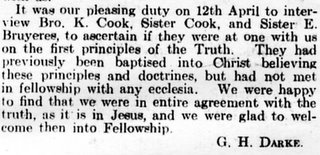
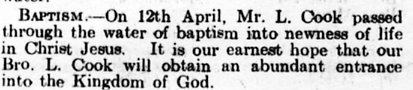
* Peter Hemingray John Thomas - His Friends and His Faith 2003 p.145
Doctrine & Conduct (18) - The Beatitudes - 6
So far in my series on the sermon on the mount and the beatitudes, I've looked at how Jesus' statements beginning with "happy are ..." are an announcement of God's deliverance for the oppressed. Together with Luke 4:18-19 (quoting Isaiah 61), these two statements are a declaration that God's promised deliverance has commenced in the ministry of Jesus and that the Messianic Age has begun.
In this message I'd like to look at how each of the beatitudes end.
The first and last beatitudes conclude with the words "... for theirs is the Kingdom of heaven" (in the present tense) while the others conclude with statements in the future tense.
While the full benefits of the Kingdom were to be experienced at some time future to when this sermon was given, the reality was that the Kingdom had already begun and that the poor in spirit, those who hungered for righteousness, the peacemakers, etc, were entering the kingdom there and then.
Jesus is saying that the Kingdom of God would come in stages. Like the prophets of Israel He taught about the Age to Come, and taught His disciples to pray "Your Kingdom come" (Matt 6:10). But He also taught that the power of this coming Kingdom was breaking in to the present age - "the kingdom of God has come upon you" (Matt 12:28).
The "now" kingdom reality is a "taste" of the "not yet" final consummation in the age to come. The citizens of the Age to Come are living now as the community of God. Jesus was calling His audience to be Kingdom-people, and to live Kingdom-dynamics. The writer to the Hebrews picks up the point and speaks of believers as "those who have once been enlightened, who have tasted the heavenly gift, who have shared in the Holy Spirit, who have tasted the goodness of the word of God and the powers of the coming age" (Hebrews 6:4-6). We are to live not only in expectancy of the Age to Come, but can be empowered, enabled and energised by the powers of the coming age to live a Kingdom-life today.
When we look carefully at the future-tense endings of the beatitudes we see that we do not need to wait for the Age to Come to enjoy these blessings to varying degrees. For example, Jesus says the peacemakers "will be called the sons of God". Paul wrote "those who are led by the Spirit of God are sons of God" (Romans 8:14) and "you are all sons of God through faith in Christ Jesus" (Galatians 3:26). John said: "to all who received him, to those who believed in his name, he gave the right to become children of God" (John 1:12). Being the children of God is a relationship we can enjoy now by receiving Christ, trusting in God and being led by His Spirit. So too we can be comforted, be filled, and receive mercy in our present Christian lives. Inheriting the earth and seeing God are the two which we might expect have only a future application. I want to discuss "seeing God" in this post, and will look at inheriting the earth later.
Quite a few of Jesus' sayings and miracles were about "seeing". He talked about the blind leading the blind, about people who had eyes but couldn't see, and about the eye being the light of the body. In one notable miracle he healed a blind man in two stages so that he first could see hazily, then clearly. Some of these teachings are telling us that we see what we want to see. The religious leaders came face to face with the Son of God, the Messiah of Israel, yet they couldn't see Him for who He was. On the other hand people who were mad and demon-possessed recognised immediately who He was.
Jesus spoke in a similar way about listening. He said, for example, " My sheep listen to my voice; I know them, and they follow me" (John 10:3-4, 27). Elihu in the book of Job answers Zophar's complaint (Job 11:5) "how I wish that God would speak" by saying "God does speak - now one way, now another - though man may not perceive it" (Job 33:14). He goes on to give several illustrations of how God speaks to us.
We can hear the voice of God, and we can see God. But sometimes God is speaking to us or appearing before our faces and we do not recognise Him. Paul wrote: For God, who said, "Let light shine out of darkness," made his light shine in our hearts to give us the light of the knowledge of the glory of God in the face of Christ. (2 Cor 4:6). Having said that God revealed Himself through Jesus, He goes on to say that Jesus is "revealed in our mortal body" (vv. 10-11). Sometimes God reveals Himself to us through mortal people, but we don't recognise Him because all we see is the "mortal body".
If we want to see God then we have to be "pure in heart" and look for God revealing Himself in other people. If we do not see God it may be because when we see other people we only see 'defiled', weak, human, sinful, mortal creatures and not the Creator in whose image and likeness they are made. But the pure in heart will see God - not only in the Age to Come, but in the here and now as He reveals Himself through His people.
I am reminded of Elisha's prayer: "O LORD, open his eyes so he may see." (2 Kings 6:17 see also v. 20).
In this message I'd like to look at how each of the beatitudes end.
The first and last beatitudes conclude with the words "... for theirs is the Kingdom of heaven" (in the present tense) while the others conclude with statements in the future tense.
... they will be comfortedI pointed out at the beginning of this series that the sermon on the mount follows immediately from Matthew's statement that "Jesus went throughout Galilee, teaching in their synagogues, preaching the good news of the kingdom" (Matt 4:23) and is in fact a summary of what Jesus taught about the kingdom. This is confirmed by the structure of the beatitudes, beginning and ending as they do with the words "for theirs is the kingdom of heaven".
... they will inherit the earth
... they will be filled
... they will be shown mercy
... they will see God
... they will be called sons of God
While the full benefits of the Kingdom were to be experienced at some time future to when this sermon was given, the reality was that the Kingdom had already begun and that the poor in spirit, those who hungered for righteousness, the peacemakers, etc, were entering the kingdom there and then.
Jesus is saying that the Kingdom of God would come in stages. Like the prophets of Israel He taught about the Age to Come, and taught His disciples to pray "Your Kingdom come" (Matt 6:10). But He also taught that the power of this coming Kingdom was breaking in to the present age - "the kingdom of God has come upon you" (Matt 12:28).
The "now" kingdom reality is a "taste" of the "not yet" final consummation in the age to come. The citizens of the Age to Come are living now as the community of God. Jesus was calling His audience to be Kingdom-people, and to live Kingdom-dynamics. The writer to the Hebrews picks up the point and speaks of believers as "those who have once been enlightened, who have tasted the heavenly gift, who have shared in the Holy Spirit, who have tasted the goodness of the word of God and the powers of the coming age" (Hebrews 6:4-6). We are to live not only in expectancy of the Age to Come, but can be empowered, enabled and energised by the powers of the coming age to live a Kingdom-life today.
When we look carefully at the future-tense endings of the beatitudes we see that we do not need to wait for the Age to Come to enjoy these blessings to varying degrees. For example, Jesus says the peacemakers "will be called the sons of God". Paul wrote "those who are led by the Spirit of God are sons of God" (Romans 8:14) and "you are all sons of God through faith in Christ Jesus" (Galatians 3:26). John said: "to all who received him, to those who believed in his name, he gave the right to become children of God" (John 1:12). Being the children of God is a relationship we can enjoy now by receiving Christ, trusting in God and being led by His Spirit. So too we can be comforted, be filled, and receive mercy in our present Christian lives. Inheriting the earth and seeing God are the two which we might expect have only a future application. I want to discuss "seeing God" in this post, and will look at inheriting the earth later.
Quite a few of Jesus' sayings and miracles were about "seeing". He talked about the blind leading the blind, about people who had eyes but couldn't see, and about the eye being the light of the body. In one notable miracle he healed a blind man in two stages so that he first could see hazily, then clearly. Some of these teachings are telling us that we see what we want to see. The religious leaders came face to face with the Son of God, the Messiah of Israel, yet they couldn't see Him for who He was. On the other hand people who were mad and demon-possessed recognised immediately who He was.
Jesus spoke in a similar way about listening. He said, for example, " My sheep listen to my voice; I know them, and they follow me" (John 10:3-4, 27). Elihu in the book of Job answers Zophar's complaint (Job 11:5) "how I wish that God would speak" by saying "God does speak - now one way, now another - though man may not perceive it" (Job 33:14). He goes on to give several illustrations of how God speaks to us.
We can hear the voice of God, and we can see God. But sometimes God is speaking to us or appearing before our faces and we do not recognise Him. Paul wrote: For God, who said, "Let light shine out of darkness," made his light shine in our hearts to give us the light of the knowledge of the glory of God in the face of Christ. (2 Cor 4:6). Having said that God revealed Himself through Jesus, He goes on to say that Jesus is "revealed in our mortal body" (vv. 10-11). Sometimes God reveals Himself to us through mortal people, but we don't recognise Him because all we see is the "mortal body".
If we want to see God then we have to be "pure in heart" and look for God revealing Himself in other people. If we do not see God it may be because when we see other people we only see 'defiled', weak, human, sinful, mortal creatures and not the Creator in whose image and likeness they are made. But the pure in heart will see God - not only in the Age to Come, but in the here and now as He reveals Himself through His people.
I am reminded of Elisha's prayer: "O LORD, open his eyes so he may see." (2 Kings 6:17 see also v. 20).
Tuesday, December 12, 2006
"Sincerity without truth cannot save"
In an earlier post I mentioned a sign that I've sometimes passed on a local Christadelphian hall which says: "Sincerity without truth cannot save". I said that I've been tempted to pin a note to their door saying "Truth without sincerity cannot save either. In fact, neither truth nor sincerity saves - we are saved by grace".
I received an email from a friend asking for some explanation of salvation by grace. He asked: "Is God's Grace unconditional, or it is conditional with ACCEPTING the Crucifixion of Christ (John 1:17b)? What should one DO to be saved by Grace?"
It's a good question. I thought my answer to that question is also relevant in the context of looking at the ethical teachings of Jesus, so I've reproduced it below.
I received an email from a friend asking for some explanation of salvation by grace. He asked: "Is God's Grace unconditional, or it is conditional with ACCEPTING the Crucifixion of Christ (John 1:17b)? What should one DO to be saved by Grace?"
It's a good question. I thought my answer to that question is also relevant in the context of looking at the ethical teachings of Jesus, so I've reproduced it below.
I think one of the problems with the issue of grace and works is that many scholars (beginning with Martin Luther) have made it an either/or situation. Are we saved by grace OR by works? When we answer, according to the Scriptures, that salvation is by grace, then some people will argue that works have no value then. However, Paul does not set grace against works – rather, he sets grace (or faith) against “the works of the law”, which were those particular aspects of the Law which distinguished Jews from Gentiles and led to Israel’s nationalism and exclusiveness. In Romans, for example, Paul is not arguing against works, or the Law, but is arguing the case for the inclusion of the Gentiles. He argues that we are saved by faith, and that those features of the Jewish Law which made them a distinctive group have no relevance to Gentiles.
I say that as a way of background to answering your question, because some people have wrongly argued that “good works” have no value, on the basis of their misunderstanding of Paul’s argument against “the works of the Law”. In fact, Paul elsewhere commends good works (quite frequently in fact) and James says that faith is demonstrated through works. In Paul’s terminology there is a big difference between “works of the law” and “good works”, and good works are the sign and seal of our faith.
“Grace” literally means “a gift”. There is nothing we can do to deserve or earn it – otherwise it would be a payment for services performed, not a gift. So in this sense grace is unconditional. Your reference to John 1:17 is interesting. Just a few verses earlier (v. 12-13) John said this: “Yet to all who received him, to those who believed in his name, he gave the right to become children of God— children born not of natural descent, nor of human decision or a husband's will, but born of God”.
John says some important things here.
(1) First he said we are to “receive Him”. Salvation is God’s gift (grace) but we have to receive it. If we do not receive it then we will never benefit from it. In this sense, we could say that grace is “conditional” on us receiving it. In other words, unless we do something to receive it (or accept it, to use your word) then it will have no effect on us.
(2) Secondly John says that if we receive Him He will give us the “right” (Gk. exousia = literally, the power of choice) to become the Sons of God. So it is dependant on us to make the choice to become a Son of God.
(3) But then John emphasises that our new birth is entirely the work of God - “born of God”.
In other words, what we do is to make the choice to accept everything God has on offer to enable us to live the new life - which is another way of saying we are to have “faith” or “trust” in God (faith and trust mean the same thing) to provide us with everything we need to live this new life. The new life, being born again, is the work of God. We cannot change ourselves through our own efforts.
But God, on the other hand, will not change us without our co-operation. This is why “grace” and “Spirit” are almost interchangeable in the New Testament, especially in Paul’s writings, because God’s grace is exercised through His Spirit. It is the Spirit which works in us and enables and empowers us to do God’s will and to live the Christian life. Then the Spirit working in us will produce “fruit” - which is the evidence that God is at work. Much of what we "do" (what both Paul and James would call “good works”) are not the results of our own efforts, but are the signs that God is at work in us, and God works in us because we “trust” Him to do it (“faith”). So we could say that for His grace to have an effect in our lives it is dependant on us having the faith/trust in Him to do it.
I hope this helps. I think the most important things for us to do are to:
(a) receive whatever God offers;
(b) choose to co-operate with Him; and
(c) submit to His authority (the “Lordship” of Jesus).
Then the works (or “fruit”) that are produced in our lives are really the works of God and God gets the glory.
One example of this in practice is baptism. Some people say that “baptism is essential to salvation”. In other words, being baptised is something we must do in order to be saved. I would put it differently: I would say that salvation is God’s free gift, and that a person who has received or accepted that salvation will then be baptised as the sign and seal of their new birth. Do you see the difference?
Monday, December 11, 2006
Doctrine & Conduct (17) - Separatists
The letters of John provide us with an example from the New Testament of how a doctrinal issue affected conduct, and how the early church dealt with this.
The dating of John's letters and the fourth Gospel are the subjects of speculation. We cannot know exactly when they were written, or in what order. It is generally agreed by most scholars that the Gospel of John, or at least an early version of it, was written first but that as a result of confusion or misinterpretation arising from this Gospel John later wrote an explanation or commentary that we now know as the First Epistle of John (although it doesn't have any of the usual characteristics of a 'letter' or 'epistle' and it would be more accurate to regard it as an explanatory treatise on the Gospel). It's possible that 2 John and 3 John were written as covering letters to individuals or churches and sent along with the treatise we call 1 John. It's also possible that around the same time a new beginning and conclusion were added to the fourth Gospel (which would explain why the opening and concluding verses of the Gospel and 1 John are so similar).
Precisely what the issues were that John was addressing in 1 John is also open to speculation. Based on evidence from Iranaeus (c. AD 180), the Nag Hammadi texts, and elsewhere, we can be fairly certain that John was dealing with an early form of the philosophical movement we now call Gnosticism (from the Greek gnosis = knowledge) because knowledge played a major and central role in their understanding of salvation.
What we do know from 1 John is that there was a connection between the doctrines taught by certain people in the churches with which John was involved, and their behaviour. It appears that the immediate reason for writing this treatise is that these people had recently broken away from the other Christians in the area: "They went out from us, but they did not really belong to us. For if they had belonged to us, they would have remained with us; but their going showed that none of them belonged to us" (1 John 2:19). From this verse this group of people are commmonly referred to as the "separatists" or "secessionists" for convenience.
From 1 John we can determine that the doctrine which led to this division involved the nature of Christ and whether or not He "has come in the flesh" (4:2). Most scholars have concluded that the separatists embraced a Christology which elevated Christ's divinity at the expense of His humanity (e.g. see G.M. Burge The Epistles of John). However, John pays at least as much attention to the ethical behaviour that resulted from this teaching as he does to the theological issues. For John it was not simply a matter of whether their theology was right or wrong, but about the implications it had for Christian living. The separatists boasted that they "know God", but they hated their fellow Christians who did not have the same "knowledge" (2:9; 4:20). A large part of 1 John deals with the importance of love as the defining characteristic of a Christian (e.g. 3:11-18; 4:8-10).
Eventually this intolerance led to the group with superior knowledge separating themselves from the rest of the Christian community, and John says that their secession was evidence that they never truly belonged.
I believe there is a warning here for modern believers who make their knowledge of certain doctrines a reason for separating from other Christians, or feeling superior to them. Divisions within the Christadelphian community have largely been over fine details of doctrine. Sociologist Bryan Wilson observed that these differences are often of such a detailed nature that an outsider wouldn't be able to see any difference at all. However, the heatedness of the conflict, the harsh words exchanged and the abiding nature of the divisions are often out of all proportion to the importance of the doctrinal details themselves. I believe this is precisely the kind of thing John is talking about: a doctrinal difference which leads to 'hatred' of fellow-Christians.
Going beyond the divisions within the Christadelphian community, I personally believe that Christadelphian separation from the wider Christian community should also be judged as the kind of 'separatism' that John condemned. Differences of understanding should be discussed and healthy dialogue encouraged. Common ground should be established and bridges built. I am not suggesting that doctrinal distinctives should be ignored or forgotten. However, fellow Christians should always be treated with respect and in love, and acknowledged as brethren.
It seems to me that when Paul dealt with the problem of Judaisers and legalists, and when John dealt with the issue of the separatists that they were dealing with the same kind of things that our Lord taught against when He encouraged inclusion, not exclusion, and when He demonstrated that holiness, not defilement, was contagious. There is no need to separate from people with differing views - we won't be 'defiled' or contaminated by our contact with them. To the contrary, when light comes into contact with darkness it will always overcome the darkness. Holiness is transferred, not defilement. 'Knowledge' does not transform people - love does.
The dating of John's letters and the fourth Gospel are the subjects of speculation. We cannot know exactly when they were written, or in what order. It is generally agreed by most scholars that the Gospel of John, or at least an early version of it, was written first but that as a result of confusion or misinterpretation arising from this Gospel John later wrote an explanation or commentary that we now know as the First Epistle of John (although it doesn't have any of the usual characteristics of a 'letter' or 'epistle' and it would be more accurate to regard it as an explanatory treatise on the Gospel). It's possible that 2 John and 3 John were written as covering letters to individuals or churches and sent along with the treatise we call 1 John. It's also possible that around the same time a new beginning and conclusion were added to the fourth Gospel (which would explain why the opening and concluding verses of the Gospel and 1 John are so similar).
Precisely what the issues were that John was addressing in 1 John is also open to speculation. Based on evidence from Iranaeus (c. AD 180), the Nag Hammadi texts, and elsewhere, we can be fairly certain that John was dealing with an early form of the philosophical movement we now call Gnosticism (from the Greek gnosis = knowledge) because knowledge played a major and central role in their understanding of salvation.
What we do know from 1 John is that there was a connection between the doctrines taught by certain people in the churches with which John was involved, and their behaviour. It appears that the immediate reason for writing this treatise is that these people had recently broken away from the other Christians in the area: "They went out from us, but they did not really belong to us. For if they had belonged to us, they would have remained with us; but their going showed that none of them belonged to us" (1 John 2:19). From this verse this group of people are commmonly referred to as the "separatists" or "secessionists" for convenience.
From 1 John we can determine that the doctrine which led to this division involved the nature of Christ and whether or not He "has come in the flesh" (4:2). Most scholars have concluded that the separatists embraced a Christology which elevated Christ's divinity at the expense of His humanity (e.g. see G.M. Burge The Epistles of John). However, John pays at least as much attention to the ethical behaviour that resulted from this teaching as he does to the theological issues. For John it was not simply a matter of whether their theology was right or wrong, but about the implications it had for Christian living. The separatists boasted that they "know God", but they hated their fellow Christians who did not have the same "knowledge" (2:9; 4:20). A large part of 1 John deals with the importance of love as the defining characteristic of a Christian (e.g. 3:11-18; 4:8-10).
"While christology was the main battleground in the community, the tangible expression of these disagreements came in the form of open conflict and hostility. Faulty christology spilled into unethical conduct" (G.M. Burge).John says that the separatists are "not obedient" and they are not "walking in the light". There is no evidence that they were living immoral lives. What made them "disobedient" was that they were intolerant of those who disagreed with them, and conflict resulted from their superior 'knowledge'. John refers to this intolerance as "hating" their fellow Christians.
Eventually this intolerance led to the group with superior knowledge separating themselves from the rest of the Christian community, and John says that their secession was evidence that they never truly belonged.
I believe there is a warning here for modern believers who make their knowledge of certain doctrines a reason for separating from other Christians, or feeling superior to them. Divisions within the Christadelphian community have largely been over fine details of doctrine. Sociologist Bryan Wilson observed that these differences are often of such a detailed nature that an outsider wouldn't be able to see any difference at all. However, the heatedness of the conflict, the harsh words exchanged and the abiding nature of the divisions are often out of all proportion to the importance of the doctrinal details themselves. I believe this is precisely the kind of thing John is talking about: a doctrinal difference which leads to 'hatred' of fellow-Christians.
Going beyond the divisions within the Christadelphian community, I personally believe that Christadelphian separation from the wider Christian community should also be judged as the kind of 'separatism' that John condemned. Differences of understanding should be discussed and healthy dialogue encouraged. Common ground should be established and bridges built. I am not suggesting that doctrinal distinctives should be ignored or forgotten. However, fellow Christians should always be treated with respect and in love, and acknowledged as brethren.
It seems to me that when Paul dealt with the problem of Judaisers and legalists, and when John dealt with the issue of the separatists that they were dealing with the same kind of things that our Lord taught against when He encouraged inclusion, not exclusion, and when He demonstrated that holiness, not defilement, was contagious. There is no need to separate from people with differing views - we won't be 'defiled' or contaminated by our contact with them. To the contrary, when light comes into contact with darkness it will always overcome the darkness. Holiness is transferred, not defilement. 'Knowledge' does not transform people - love does.
Subscribe to:
Posts (Atom)