Showing posts with label Christadelphian history. Show all posts

Wednesday, December 13, 2006

Baptised "by whomsoever"

There are two strange yet important words in the consitutions of many Christadelphian ecclesias. Robert Roberts Guide to the Conduct and Formation of Christadelphian Ecclesias ("The Ecclesial Guide") on which many ecclesial constitutions are based, says:


"That we recognize as brethren, and welcome to our fellowship, all who have been immersed (by whomsoever) after their acceptance of the same doctrines and precepts."

Why were those words in parenthesis put there?

First, they recognise what is sometimes called "the priesthood of all believers". In other words, baptisms don't have to performed by ordained clergy in order to be valid. Anyone can perform a baptism.

Second, they put the emphasis on the person being baptised, not on the baptiser. In fact, the person performing the baptism doesn't necessarily have to have the same faith or beliefs as the person being baptised. For quite some time the identity of the person who re-baptised John Thomas was unknown (although some recent research has brought to light some convincing evidence that it was John Tomline Walsh, who never became a Christadelphian*).

Third, these parenthetical words allow for the possibility that some people may have been baptised while members of other denominations while believing "the same doctrines and precepts" as Christadelphians.

From my own family history there is an interesting account of three people who were accepted as Christadelphians although they were baptised in another church.

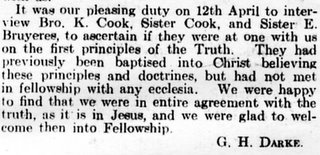
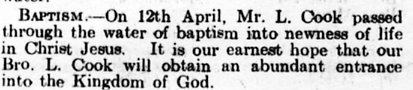
The Christadelphian Shield for June 5, 1941 has this intelligence from Granville (NSW) ecclesia about the baptism of my late father:


This was followed by a record that Granville ecclesia had received into fellowship three other people (including my late grandmother and late uncle) who had "previously been baptised into Christ believing these principles and doctrines". My grandmother had, in fact, been baptised in the Church of Christ and my uncle in an independant Christian Assembly, but after joining the Christadelphians they were members of Granville and then Yagoona ecclesias until they died, without ever being re-baptised by Christadelphians. The report says these three "had not met in fellowship with any ecclesia" although they had, in fact, been meeting and were "in fellowship" first with the Church of Christ and then with an independant Christian Assembly for some time before joining the Christadelphians.


* Peter Hemingray John Thomas - His Friends and His Faith 2003 p.145

Saturday, June 03, 2006

Early influences on Christadelphianism (9) - further conclusions

The Christadelphian community has been plagued with controversy and division since its inception. In an earlier series of posts (What did Christadelphians set out to be?) I looked at some of the early Christadelphian leaders who were forced out of the community.

There is some evidence that George Dowie (disfellowshipped by Roberts in 1864) and Robert Ashcroft (disfellowshipped by Roberts in 1884) in the UK allied themselves with Benjamin Wilson's group - the Brethren of the One Faith - in the US. (I've also wondered about how and why copies of Edward's Turney's Christadelphian Lamp found their way into the archives of the Church of God General Conference at the Atlanta Bible College - perhaps Turney, who had been disfellowshipped by Roberts in 1873, also made contact with believers in the Age to Come movement in the US).

These connections are interesting for a couple of reasons:
  • It shows that these men saw themselves as part of a movement which was wider than Christadelphianism, and they had a great deal in common with people in similar groups from which John Thomas had separated. Perhaps their own rejection at the hands of Thomas and Roberts compelled them to look again at the reasons why the leaders of the Age to Come movement in the US had similarly been rejected by Thomas, although this is speculation on my part.
  • It suggests that in taking a heavy-handed approach to brethren whose opinions differed to his own Robert Roberts was simply following a pattern which had been set by his mentor John Thomas.
Together, Roberts and Thomas were building a 'denomination'. Roberts tried to organise the denomination into an organisation with rules, a creed and a headquarters in Birmingham (with himself firmly in control). His organising abilities were such that he was successful to some extent, although almost half of all Christadelphians in the UK left his central fellowship in 1884-85 and the community has been splintered ever since.

However, the men from whom Thomas had withdrawn were part of a movement which sought to restore early Christianity. The Christian Connection of Elias Smith and Abner Jones tried to discover and restore the beliefs and practices of the first century church. In doing so they emphasised the Oness of God and the mortality of the soul as key parts of primitive Christianity. Joseph Marsh, who was baptised and ordained in the Christain Connection, contributed a great deal in teaching about the restoration of Israel and the Age to Come and establishing the Age to Come movement. The churches established by Barton Stone, Thomas Campbell and Alexander Campbell became known as the Restoration Movement because they were also endeavouring to restore primitive Christianity. To some extent they were successful and Christadelphianism owes many of its practices, beliefs and traditions to this movement.

Restorationism, the Age to Come movement, Adventism, the One Faith movement ('the Abrahamic Faith') and Christadelphianism were linked together and were part of a broader attempt to restore original Christianity. Each group or movement has been successful to varying extents, but does any one group have 'the whole truth'? I doubt it, and I believe there is still a great deal to be learned and gained from interacting with others whose spiritual journey has taken them down a slightly different path.

Almost every doctrine of Christadelphianism can be found within this movement because Christadelphianism came out of it. John Thomas didn't 'discover' anything new or unique or original. He learned it all from being involved with a community of believers, and not from studying the Bible alone. Surely there is a lesson here. I believe that Christadelphians as individuals and as ecclesias will develop, grow and prosper only to the extent that they see their place within the broader body of Christ and interact with others who have things in common, seeking ways to unite rather than reasons to divide, looking out rather than within, and building rather than tearing down.

Early influences on Christadelphianism (8) - conclusions

When we look at the various people who influenced John Thomas's thinking and with whom he was associated at various times, and the reasons why he separated from them, we see a pattern emerging.

Just to briefly recapitulate:

  • For some time Thomas was very friendly with George Storrs, the foremost proponent of conditional immortality (the mortality of the soul) in the US. After disagreeing about the importance of baptism they parted company, and Thomas wrote some critical words about "Mr" Storrs (no longer "brother Storrs").
  • It appears that John Thomas and Joseph Marsh were close friends for some time. After Thomas was re-baptised he tried to persuade Marsh to do the same. Marsh did not see the need to be re-baptised every time he changed his mind or learned something new, and disagreed with Thomas about this. Thomas persuaded Marsh's church to disfellowship him and later published some very unkind and critical comments about "friend Marsh".
  • Although they agreed on most things Thomas parted company with Benjamin Wilson mainly over the issue of whether the dead would be raised mortal or immortal. He subsequently published a series of personal and defamatory attacks on Wilson, including comments about Wilson's financial affairs.
Here is the pattern I see:

1. If Thomas was unable to persuade someone to agree with him he spilt from them, regardless of whatever they already had in common. Peter Hemingray (John Thomas: His Friends and His Faith) draws a similar conclusion. Referring to the split with Storrs he says: "John Thomas heard and was associated with many of the clamoring voices of the American Reformation, of whom George Storrs was one, but in the end he withdrew from them all" (p. 140, my emphasis).

2. After parting company with these men (and sometimes before parting company) John Thomas published highly critical comments about them. The criticisms were not only of their beliefs, but were often personal and defamatory. (In fact, I'm puzzled why Hemingray titled his book John Thomas: His Friends and His Faith - these men would hardly have considered Thomas their "friend" after the way they were treated. John Thomas: His Enemies and His Faith might have made a more accurate title).

3. Thomas almost always actively preached amongst the congregations associated with his former "friends" and tried to convince their supporters to withdraw fellowship from them and join his emerging denomination. This was so obvious to Thomas's contemporaries that one of them wrote:
"The doctor [Thomas] is very hard on the Adventists, Millerism, and Storrism. I fear he is ungrateful. For had it not been for the Advent movement, I do not believe that this day he would have a corporal's guard of followers. A broken-down ex-Campbellite, he goes north to take advantage of the movement, and is now building on other men's foundations, and all the while exposing its rottenness! Such at least is my opinion of his course."

(Nathaniel Field, Thomasism, Number III,
Expositor and Advocate
, Vol 29 No 24, May 15, 1859, 665)

In an editorial addition to this article Marsh wrote of Thomas's "manifest ingratitude to those who raised him from obscurity to his present notoriety among us".

Hemingray, a defender of John Thomas, substantiates this conclusion with a comment that
"before 1843 almost all his followers had been from the ranks of the Campbellites: after this time, they increasingly came from the Millerites" (p. 111).
By "Millerites" he is referring to the Adventists and the Age to Come movement (including the supporters of Storrs and Marsh).

Preaching amongst the churches from which he had "withdrawn" caused a great deal of resentment, for understandable reasons.

Was Thomas right to withdraw from people with whom he disagreed? Some would say that in doing so he was establishing the importance of "doctrinal purity". But how far does one need to go before the faith is "pure"? While Christadelphians would generally agree that withdrawing from Storrs over a matter as 'fundamental' as baptism was the right thing to do, it becomes questionable whether Marsh's refusal to be re-baptised was in the same category. By the time we get to the withdrawal from Wilson over mortal/immortal emergence it becomes even more questionable. In fact, to this day Christadelphians in North America are divided on that one and the question is still not settled.

Pragmatically, it might have been better if Thomas had stayed in contact and on friendly relations with the people from whom he split. Given time he may have convinced Storrs of the need for baptism. If he'd worked with Marsh, rather than against him, they may have found agreement on re-baptism. If he stayed with Wilson who knows what their combined talents and energies might have achieved. By sticking with his 'friends' Thomas may have eventually persuaded them of the rightness of his views, or he may have learned from them and grown in knowledge. Instead, he helped to divide and fragment a movement which was growing and impacting the broader church and impaired its effectiveness.

Acknowledgements

Before going any further with my series on early Christadelphian history I really should acknowledge and thank my sources.

In addition to primary source material I owe a huge debt to Janet Stilson, an historian with the Church of God General Conference, for providing me with copies of rare periodicals from the period, and for information generally. The following articles have provided valuable details:

A Brief History of the Church of God General Conference
Janet Silson, David Graham, Mark Mattison
Journal from the Radical Reformation, Vol 1 No. 1, Fall 1991

An Overview of the Leadership and Development of the Age to Come in the United States: 1832-1871
Jan Stilson, M.A.L.S.
Journal from the Radical Reformation, Vol. 10 No 1, Fall 2001

The Development of the Church of God Abrahamic faith: 1845-1921
Jan Stilson, B.Th., B.S., M.A.L.S.
Journal from the Radical Reformation, Vol. 11 No 1, Fall 2002

The Publishing Heritage in the Age-to-Come Movement 1800-1985
Jan Stilson
The Restitution Herald, Vol 75 No 1, October 1985

I'm also indebted to Greg Demmitt, Pastor of the Lakeshore Bible Church, for information on the Christologies of Alexander Campbell and Barton Stone.

Friday, June 02, 2006

Early influences on Christadelphianism (7)

I came across this quote today which I thought was relevant to this series:

No movement remains untouched by other's thought.
The worst men hold some truth.
The same is true for religious movements, theological systems, and creeds.

Diversion - John Glas

This is my blog, so I can indulge myself. You may have picked up that I enjoy history. This brief diversion about John Glas has little to do with the series on early influences on Christadelphianism, except that Glas indirectly influenced the founders of the Stone-Campbell Restoration Movement, and I am a physical descendant of John Glas (so please forgive me for the indulgence).

Thomas and Alexander Campbell and Barton Stone were all ex-Presbyterian ministers who had been influenced by reformers in Scotland, specifically John Glas, Robert Sandeman (Glas's son-in-law) and Robert and James Haldane. Glas (1695-1793) became known as the founder of the 'Scotch Baptists' becaused they practised adult baptism by immersion. An ordained minister in the Presbyterian church, Glas was determined early on to make the Word of God his sole rule of conduct. When he began preaching a series of lessons from the Shorter Catechism (Presbyterian Manual) he noted there were strong differences in it from the Bible.

He came to realise that the church was composed of those who had experienced the grace of Christ, had separated themselves from the world and gathered themselves in the church. He could see no place for State involvement in church affairs, and this brought him into conflict with the Civil authorities. In 1725 he started an independant church which he called a Society of Believers.

His teaching was regarded as close to treason and Glas was brought before a number of synod meetings before being suspended as a minister and deposed from the church ('the right boot of disfellowship'). However, in 1739 the General Assembly broke precedence and revoked the sentence of deposition and restored Glas as a minister, although it didn’t restore his licence as a minister of the church of Scotland. He was allowed to continue in ministry with independant churches. This showed a sign of softening of their stand against Congregationalism. With the assistance of his son-in-law the message spread and churches sprang up all over Scotland.

Sandeman migrated to North America where he established a church which later joined the Restoration Movement.

Incidentally, I am descended from one of John Glas's 15 children.

Early influences on Christadelphianism (6) - Barton Stone

Barton Stone (1772 - 1844).

Stone was one of the founders and prominent leaders in the Restoration Movement which gave birth to the Church of Christ and Disciples of Christ (together with Thomas and Alexander Campbell, and Walter Scott). This movement was influenced by the Christian Connection and others, and emphasised the need to return to original Christianity. Hence it became known as Restorationism. It grew from two main roots as the result of the preaching of the Campbells on the one hand and Stone independantly on the other. They subsequently combined their efforts, so Restorationism is sometimes called the Stone-Campbell Movement. It is the group John Thomas almost always called the Campbellites.

Stone was a great evangelist and once led a revival in which 20,000 people took part. By 1826 there were 15,000 members in 300 congregations founded by or associated with him. John Thomas was a member of the Restoration Movement ("Campbellites") from 1834 until his final split from them in 1847. There is no evidence he ever met Barton Stone. Interestingly, however, Stone rejected much of trinitarianism although he believed in pre-existence. Alexander Campbell rejected pre-existence. One can only wonder to what extent the discussion of this doctrine in the Restoration Movement of which John Thomas was a member influenced his own views on the matter.

Early influences on Christadelphianism (5) - Age to Come Adventism

Several people contributed to the development of Christadelphian theology. It is often claimed that John Thomas "discovered" the Truth and revived apostolic Christianity. However, almost all the "distinctive" doctrines of Christadelphianism were being taught and believed in the US and Britain even before John Thomas began to take an interest in these subjects. This list gives a brief overview of some of the most prominent writers and teachers of these ideas, but is hardly exhaustive.
  • George Storrs (1796-1879) - taught 'Conditional Immortality', that is, that the soul ceases to exist at death and that resurrection, not heaven-going, is the hope taught in the New Testament. Storrs taught that the wicked will be punished with everlasting destruction, not eternal hell-fire. Storrs was prominent in the Adventist movement which gave rise to the Advent Christian Church and the Sevent Day Adventist church. (He also influenced Charles Russell who founded the Bible Students, out of which came the Jehovah's Witnesses). He was probably the most influential preacher in America in teaching the mortality of the soul. John Thomas knew him and Storrs published articles by Thomas in his magazine The Bible Examiner. The relationship appears to have been friendly for some time, until Thomas severely criticised Storrs for not being baptised (1853). He stopped referring to him as "brother Storrs" and he became a "Mr". They parted company.
  • Elias Smith (1769-1846) - founded the Christian Connection together with Abner Jones. Smith was non-trinitarian and rejected the immortality of the soul and the popular views of hell. John Thomas belonged at one time to a church in Philadelphia (1833-34) founded by Elias Smith. In 1837 Alexander Campbell wrote in his magazine that John Thomas's views on the mortality of the soul had come from Elias Smith, although Thomas claimed that he had developed these ideas before reading Smith's works. However, it was while he was a member of the church in Philadelphia founded by Smith (1834) that Thomas wrote 34 questions to his father (a Congregational minister) indicating he was developing new ideas on the Kingdom of God and the nature of the soul.
  • Joseph Marsh (1802 - 1863) - I wrote about Marsh in an earlier post. He had been connected with Elias Smith and lated edited the magazine founded by Smith. As well as being non-trinitarian and believing in the mortality of the soul, Marsh also taught the restoration of Israel, the second coming and the Kingdom of God on earth. His book "The Age to Come" was so influential that he is sometimes attributed as the founder of the Age to Come Movement. John Thomas knew him, and had stayed in his home, although the relationship ended on a very sour note when Thomas persuaded Marsh's church to disfellowship him.
  • Benjamin Wilson (1817 - 1900) - referred to in a previous post, held and taught almost all the same "distinctive" doctrines as John Thomas, although disagreeing on whether the dead would be raised mortal or immortal. Thomas considered the difference important enough to part company with him.
The various individuals and congregations associated with Marsh and Wilson are sometimes referred to collectively as "Age to Come Adventists". Storrs, Miller, Smith and others were influential in the development of Adventism, emphasising the second coming of Christ but rejecting the idea of a future Kingdom of God on earth. Hence, the Adventists who believed in the restoration of Israel and the establishment of the Kingdom on earth in the Age to Come, became known as "Age to Come Adventists". The followers of Marsh generally used the name "Church of God", while Benjamin Wilson preferred "Brethren of the One Faith". Some of the congregations associated with Wilson also used the name "Abrahamic Faith". These groups often associated together, exchanged preachers and magazines, and sometimes shared church buildings. Many of the first Christadelphian ecclesias came from this movement. The Church of God congregations which had been founded by Marsh united with the "One Faith"/"Abrahamic Faith" congregations in 1921 and formed the Church of God General Conference (also known as Church of God of the Abrahamic Faith).

One thing is certain: the core doctrines taught by Thomas were already being taught by other preachers and upheld in many churches, including the Oneness of God, conditional immortality (mortality of the soul), the second coming, the restoration of Israel, and the Age to Come. Even the impersonal nature of the devil, sometimes regarded as 'distinctively Christadelphian', was being taught before Thomas (I may come back to this later).

In a future post in this series I hope to draw some conclusions about why Thomas dissociated himself from so many people with similar beliefs, and what this meant for the development of Christadelphianism.

Thursday, June 01, 2006

Early influences on Christadelphianism (4) - Benjamin Wilson

It did not take long for Joseph Marsh to recover from his troubles. Within a few months, Marsh began an evangelistic tour and attended a church conference at which he was appointed evangelist. After the death of Marsh in Michigan in the early 1860s, Benjamin Wilson and his nephew Thomas Wilson became more widely read and accepted among the leading exponents of the Age-to-Come doctrine, which among other things explained that the Jews would one day return to their land and become a nation. This doctrine was advanced long before the Zionist movement became a popular topic. Benjamin Wilson emigrated to the US from England in 1842 and settled in Geneva, Illinois, where he set up a publishing business. He was a skilled Bible scholar and had been trained in Biblical Greek.

After a few years, Wilson did what no man had done to date anywhere in the world. He produced an interlinear translation of the New Testament from the Greek text*. Under each line was a rough translation in English representing as closely as possible the meaning of the Greek language used in the passage. It was revolutionary, and very helpful to Bible scholars. The Age to Come people loved it. Problem was, it was not popular with the orthodox churches because it literally translated passages which had formerly been translated by others to represent orthodox teachings such as trinity, pre-existence and going to heaven.

An Overview of the Leadership and Development of the Age to Come in the United States: 1832-1871 by Jan Stilson, M.A. L. S

A Journal from the Radical Reformation, Vol 10, No. 1, Fall 2001

* The Emphatic Diaglott, published in 1864.


Benjamin Wilson edited and published The Gospel Banner and Millenial Advocate from 1853 to 1869 and his nephew Thomas Wilson edited and published The Herald of the Coming Kingdom and Christian Instructor (the two magazines combined in 1870). Both magazines were popular amongst believers in the Age to Come, and Benjamin Wilson travelled widely preaching and ministering to churches.

John Thomas first met Benjamin Wilson in 1856, although some years earlier they lived for a time in neighbouring cities in Illinois. At the beginning of their association Wilson and Thomas believed similarly. Joseph Marsh and Benjamin Wilson also knew of each other, although they apparently never met. Strangely, the followers of Marsh and Wilson succeeded in uniting their various congregations into the Church of God General Conference denomination in 1921, many years after their deaths.

While Thomas and Wilson had much in common, and got off to a friendly start, they eventually divided over the issue of whether believers would be resurrected mortal or immortal. Thomas insisted that it was necessary to believe in mortal emergence, although it seems that while Wilson and many of his supporters believed in immortal emergence they did not consider it to be a matter of fellowship. Thomas did. They went their separate ways.


Wednesday, May 31, 2006

Early influences on Christadelphianism (3) - Joseph Marsh

Unitarianism, of several types, seems to have developed in America at the end of the eighteenth century. Two or three groups shared a concern for a return to the "primitive gospel." One of these was the so-called Christian Connection, a minority revivalistic movement on the New England frontier. Another was the Freewill Baptists. At the beginning of the nineteenth century, the two groups contemplated merging, since both held similar doctrines, inclined toward primitivism, and practiced open communion. But as they expanded westward across New York State, the "Christians" began more and more to show Unitarian tendencies, which alienated them from the Baptists and turned them toward the followers of Barton Stone — and occasionally toward the Unitarians.

Joseph Marsh was born in Vermont in 1802. Early in Marsh's life his family moved to New York, where his parents were disfellowshiped by the Methodist Episcopal Church for rejecting the Trinity. In 1823, Marsh was baptized into the Christian Connection. The following year he entered the ministry.

In 1841, Marsh wrote fourteen influential articles entitled "The Church of God" in which he encouraged a return of the Church to New Testament principles. Marsh became the leading writer for the emerging Church of God, publishing first the Christian Palladium (1838-43) for the Christian connection, then Voice of Truth (1844-47), the Advent Harbinger, and, finally, the Bible Expositor. Through the Voice of Truth Marsh promoted the doctrine of the Age to Come and the restoration of the Jews to their homeland prior to Jesus' second coming. In 1851 he published a major work called The Age to Come where he carefully elaborated his ideas. He is regarded by many as the founder of the Age to Come Movement.

John Thomas and Joseph Marsh knew each other, probably meeting in 1842, and many of Thomas's early contacts were already readers of Marsh's magazines. After Thomas settled in New York he and Marsh exchanged ideas through their respective magazines. Through this exchange the two became friends, or so Marsh thought. It's possible that they influenced each other as both men were going through a period of change and development in their ideas. They had many things in common, including belief in the oneness of God, the mortality of the soul, the restoration of Israel and the Age to Come. Their friendship and association together could have achieved a great deal in spreading this message. Marsh invited Thomas to Rochester. Thomas stayed in Marsh's home and preached in his church.

However, in 1847 Thomas decided to be re-baptised (he had earlier been baptised by Walter Scott of the Disciples of Christ) after changing his beliefs on several points. He tried to persuade Marsh to do the same, but Marsh was not convinced that his baptism was in any way inadequate. Not content to 'agree to disagree' Thomas turned to Marsh's church (the Church of God in Rochester, New York) and eventually convinced them to disfellowship Marsh. Thereafter they preached in different areas, and in 1858 Thomas published a letter referring to Marsh's supporters as his "parasites".

Marsh's writings had a wide influence and several congregations began in Illinois as a result.

To be continued ...


Sunday, May 21, 2006

Early influences on Christadelphianism (2)

I commenced this series of messages over two months ago, intending to write about the people and movements which influenced John Thomas and the early Believers in the formulation of Christadelphian doctrine.

I put this 'on hold' for a couple of months for two reasons:
  1. An opportunity arose for me to visit the Atlanta Bible College and the Church of God General Conference headquarters, and spend some time in their archives. These archives contain some rare books and periodicals from the nineteenth century and I was privileged to look at some of the early literature of the movement which gave birth to Christadelphianism.
  2. I had heard about a book by Peter Hemingray called "John Thomas: His Friends and His Faith" and after ordering a copy I waited until it arrived to see if there was any information which would add further light to my own research, or which might even prove some of my conclusions to be wrong.

Peter Hemingray's book arrived, coincidentally, soon after I returned home from visiting the archives of the Atlanta Bible College. It is an excellent, well-researched, interesting work and adds some valuable information not found in the earlier biographies of John Thomas. It confirms that I've been on the right track about the development of John Thomas's views and the reasons for his split from some of his 'friends'.

In the next few posts I plan to briefly summarise some of the main influences on the formation of John Thomas's views. It will show that John Thomas was part of a broader movement of believers who had been trying to restore first century Christianity and, in the process, 'discovered' the truth about the Trinity, the mortality of the soul, and the coming kingdom of God. John Thomas did not start this movement. He was not the 'discoverer' of any of these beliefs. He was part of a movement. For some reason he choose to break from the movement and the people whose ideas he had learned and start his own denomination. I also hope to explore some of the reasons why he did this and why 'Christadelphianism' came into being as a seperate denomination.

Saturday, May 13, 2006

The first Christadelphians and the causes of disunity

Earlier in the week I came across volume 1 of Edward Turney's magazine The Christadelphian Lamp, published in 1874 - the year after Robert Roberts disfellowshipped him and his supporters.

A letter to the editor from Samuel Coffman, (one of the brethren for whom John Thomas coined the name 'Christadelphian' so they could claim exemption from military service as members of a denomination of conscientious objectors) caught my eye. He refers to the views on the sacrifice of Christ being promulgated by Robert Roberts, and the 'considerable private discussions' he had had with Dr Thomas prior to his death, and complained of the tyrannical and suppressive spirit on the part of Roberts.

Within 10 years of the name 'Christadelphian' being chosen for the new denomination, and only two or three years after Dr Thomas' death, it seems that Roberts was foisting on the brotherhood his own new interpretation of the atonement with a 'condemned Christ' and making acceptance of it a condition for fellowship.

Letters and articles from Samuel and John Coffman which appeared in The Christadelphian Lamp show that these 'first Christadelphians' sided with Edward Turney and the Suffolk Street fellowship in opposing both Roberts' authoritarianism and his peculiar explanation of the atonement. One wonders how different the denomination would have been if the advice of one of these first Christadelphians to 'lay aside prejudices and extremes' had been heeded.

Sunday, April 02, 2006

The first Christadelphians and politics (2)

I've just received some information from Peter Hemingray, author of John Thomas, His Friends and His Faith, about the registration of conscientious objectors during the American Civil War. I referred earlier to an incident when John Thomas successfully applied for exemption from military service on behalf of 10 believers in the South on the grounds that they were "ministers of religion", while in the North they applied for exemption as members of a denomination named "Christadelphians".

Peter Hemingray has pointed out that the brethren in Virginia were originally known as "Nazarines", rather than "Christadelphians", and refers to a petition* asking for absolute exemption from military service on behalf of the “The Nazarines.” The petition, addressed to John Letcher, who was Governor of Virginia 1860-64, commented on the problem of those exempted from military service being required to perform “non-combatant” service, as a Bill under consideration in the legislature proposed. The petition said: “This is a mistake, at least as far as the Christians called the ‘Nazarines’ are concerned… (we) do not recognize ourselves as citizens in any sense of any of the governments of this world. We therefore admit your right to tax our property. But we would as soon fall down and worship the golden image erected on the plains of Dura by Nebuchadnezzar, than we could yield our persons as the willing slaves of any human authority.”

Peter Hemingray says the petition must have been written in early 1862, for the Virginia Act was passed in March of that year. "Quite who wrote the petition", he wrote, "I do not know: Dr. Thomas seemed to have no knowledge of it for some time afterwards, and I can find no reference to it in the journals of the time. A pity! But I must assume that whoever wrote the petition was behind the inclusion of the 'Nazarines' in the later Confederate Act."

In the Ambassador for April 1865, Dr. Thomas wrote “The Confederate Congress passed an act, exempting them (the Christadelphians in Virginia) from military service, under the name of Nazarenes, on payment of 500 dollars. All are exempted who were members at the time of passing the act:..” On April 15 1863 the Senate passed an Act that said in part:

VIII Every minister of religion authorized to preach according to the rules of his sect, and now in the regular discharge of ministerial duty, and all persons who have been, since the sixteenth of April, eighteen hundred and sixty-two, and now are, members of the society of Friends, or the association of Dunkards, Nazarines, or Mennonists, in regular membership of their respective denominations: provided that such members shall furnish a substitute or pay a tax of five hundred dollars each into the public treasury.


"So whoever wrote the petition", says Hemingray, "was probably behind the inclusion of the 'Nazarines'.” Records show the Quakers and the Dunkards were particularly active from the time that conscription passed from State to Federal level, in April 1862. Their names were present when the first amendment to name whole religious denominations was passed in September of 1862. The “Nazarenes” were added by a joint committee of the two houses, without any recorded debate, on October 3 1862. (Nazarines and Nazarenes are used interchangeably in the record. And indeed Dr. Thomas uses “Nazarene” when he refers to the same incident later.) However, there is no mention as to who proposed the addition of “Nazarines.”

It seems that this Act of the Confederate Congress is the only official Act that has ever specifically named members of the Christadelphian denomination (albeit under a different name) as exempt from military service. It was passed in 1863 after at least six months of consideration. The brethren in Virginia were still known as “Nazarenes” into the 1870s (and should not be confused with the Church of the Nazarene which is a late nineteenth century offshoot of the Wesleyan “Holiness” movement, or the Nazarene fellowship - still in existence - which grew out of the offshoot from Christadelphianism following the 1873 disfellowship of Edward Turney and David Handley.)

Hemingray noted "It is also interesting that, until very recently, main-stream historians have been quite unable to identify who these 'Nazarines' were. Only recently did a diligent researcher follow the same trail as I did, and correctly identified the 'Nazarines' as coming from the group that a little later became known as Christadelphians**."

He also makes this interesting comment:

It is fascinating for the insistence on the very fundamental grounds of our stand then and now against military service: it is that our citizenship is in Heaven. It was not then, nor despite some of our literature, should it be now, primarily because we follow the command of Jesus to Peter, in Mt. 26:52; “Put up thy sword.” This is true, but it is not the cornerstone of our rejection of military service. Rather, it is because we take no part in politics, offer no opinions on our government, live at peace with the whole world and wait patiently for “a new heaven and a new earth.”

One reason this is particularly interesting is that the 'Nazarines' in Virginia were "unpolitical" while the 'Christadelphians' in Illinois (or some of them at least) were 'stalwart Republicans'. It's possible that while the Believers were united in being opposed to military service their reasons for doing so may have differed.


* This was re-published in The Christadelphian for Sept. 1940. It says it was “found among some old Christadelphian magazines,” and appears to be copied from an article appearing in the Christadelphian Advocate for June 1897, p166.

** Peter Brock, an historian of Pacifism, guesses at the connection on p 864 of his Pacifism in the United States.

Thursday, March 30, 2006

The first Christadelphians and politics

In an earlier post I noted how the name 'Christadelphian' was coined by John Thomas and first used in Ogle County, Illinois, in order to claim exemption from military service for Samuel Coffman and his family and others on the grounds of being members of a denomination with a conscientious objection to military service.

As they were the first to use the name 'Christadelphian' the Coffman's were, strictly speaking, the first Christadelphians.

The following information comes from the "Ogle Co. Portrait and Biographical Album" (Chapman Bros., Chicago, IL, 1886). John Coffman, son of Samuel Coffman, was a Justice of the Peace and Notary Public of Baileyville. The Ogle Co. Portrait and Biographical Album says of him that he was "one of the most progressive and prosperous citizens in the area" and goes on to say that "he is an active worker in public affairs and a zealous Republican in politics. He is also a member of the Christadelphian Church to which he gives his hearty support both in offerings and by his presence and labors" (my emphasis).

It seems the Coffman family generally may have been zealous Republicans. In a biographical note on Addison Coffman (another son of Samuel Coffman) in the "Biographical Record of Ogle Co." (S. J. Clarke Publishing Co., Chicago, IL, 1899) we read "Since casting his first presidential vote for Abraham Lincoln, in 1864, Mr. Coffman has been a stalwart supporter of the Republican party, but he has never cared for office, though he has served for three years as commissioner of highways. He is one of the leading and popular citizens of his community and wherever known he is held in high regard."

It's interesting that in the same year in which the Christadelphian denomination was born the first Christadelphians were actively involved in politics, supporting the Republican party and voting for Abraham Lincoln. This is especially interesting in view of the fact that later Christadelphians boasted that the denomination was "entirely unpolitical", and some ecclesias outlawed participation in politics (including voting). At what stage, I wonder, did Christadelphians shift from being stalwart and zealous supporters of political parties, actively involved in public affairs, to being "entirely unpolitical"? And why?

Tuesday, March 14, 2006

Early influences on Christadelphianism (1) - Did John Thomas discover 'the Truth'?

It has often been said (by Christadelphians) that John Thomas, founder of Christadelphianism, "discovered the Truth" in the 1840s. It seems he subscribed to this idea himself as he named his commentary on The Revelation Eureka - "I have found it!"

I have argued before that John Thomas did not "discover" anything. All the doctrinal distinctives held by Christadelphians can be traced to groups which were either contemporary to John Thomas or predated him. In fact, I will demonstrate in some future articles that John Thomas acquired all his major doctrines from groups or individuals with whom he was in contact. That's not to say these doctrines are either right or wrong - I simply want to look at the influences which acted on John Thomas and the early Christadelphians in shaping the denomination.

I am not alone in saying that John Thomas was an eclectic who acquired (rather than 'discovered') ideas. One of Thomas's early converts was Joseph Chamberlin, a Methodist minister who left Methodism and became a Christadelphian. In his weekly Christadelphian magazine The Aeon Chamberlin wrote:

Another distinguishing fact to be mentioned in regard to Dr. Thomas is, he was not remarkable for the enunciation or discovery of any ONE great truth. There is no one great doctrine which we can hang about his neck, as “justification by faith” is connected with the name of Luther, or “sanctification” with that of Wesley. He did not so much discover a brilliant star as give us a true astronomy; it was not so much the announcement of an unknown truth as the marvellous systematisation of many truths, and the disentanglement of the divine purposes from the web of error which tradition through centuries has woven…

So, nearly every teaching to be found in Dr. T.’s final publications may be found in some fragmentary form or another up and down the theological literature of the world, but nowhere can be found that harmonious system in which these parts are seen crystalising together…

Sketches of John Thomas, M.D.
Joseph Chamberlin, The Aeon, April 10, 1885

Thursday, February 09, 2006

What did Christadelphians set out to be? (9)

There were three main consequences of the events of 1864, 1873 and 1885 which were to have a lasting influence in Christadelphianism and change the direction of the movement. In the last two posts on this thread I looked at two of these consequences:

  • There was a shift from the openness to change, from the exciting and lively debate, and the tolerance of the early years, towards a rigid dogmatism.
  • As Christadelphians became less tolerant of alternative views there was a shift from diversity to division.
In this post I want to look at the third consequence:


3. With increasing organisation came an increase in authoritarianism.

One of the key factors in the growth of the Believers Movement and then Christadelphiansim was the development of some organisation. The Believers Movement was a lose alliance of churches and house meetings which shared a common understanding of many aspects of the Gospel, but were all autonomous and independant. While they worked together on many projects and exchanged speakers and magazines freely, independance can sometimes be a barrier to organisation. Robert Roberts appears to have been gifted in this area and Andrew Wilson noted that:
"The organising ability of Robert Roberts was very important: he gave the movement its rules, institutions, and much of its literature" (page 399).
However, the "rules, institutions and ... literature" proved to be a two-edged sword. Wilson also noted that:

"Roberts was held in high esteem by his brethren for his vigour; his application to ecclesial arrangements in Birmingham was immediate upon his arrival and energetic; simultaneously, he was engaged in controversy with the Aberdeen Campbellites [Churches of Christ]. Nevertheless, Roberts's efficiency and zeal appeared, in the eyes of some, to have an impetuous aspect to it; in 1864, he wrote of his 'strained relations with Dr. Thomas'; on other occasions, members of his family expressed reservations about his temperament."


As an example of of the last point, Wilson quotes from Roberts' own brother-in-law W. Norrie in his Early History of the Gospel of the Kingdom of God in Great Britain (Edinburgh 1904-1906). Referring to a John Wilson of Halifax and his falling out with Robert Roberts Norrie wrote:

“[he] was one of many brethren who were victimised because of their ‘disagreement in important principles’ with R. Roberts. In the particular ‘principle’ in which the two differed, I was convinced that Roberts was in the right, but I was equally confident that this disagreement did not warrant the cruel treatment to which he [John Wilson] was subjected on that account”.
The way in which Roberts disfellowshipped Dowie, Turney and Ashcroft and turned "Bro. Dealtry" into "Mr. Dealtry", and especially the way he took this action without the approval of his ecclesia, shows that Roberts was becoming an authoritarian. He didn't need to consult anyone - after all, he was the editor of The Christadelphian! (and he'd gotten rid of his competitors who edited The Messenger of the Churches, the Christadelphian Lamp, and other magazines).

Even John Thomas changed from being what Wilson described as an 'anarchist':

"To describe John Thomas as a spiritual anarchist would not do full justice to the profundity of his radicalism" (page 93).

He described John Thomas as "a pioneer, a discoverer ... What appealed to him was to wriggle free of what he considered the mental shackles imposed by orthodoxy, so he could soar high in the spiritual etherea and see vistas, within the Bible, of God's past, present and future plans”. He was opposed to hierarchies, rules, constitutions, creeds and statements of faith and believed that a minimum of organisation was preferable.

Yet, Wilson notes that "during the period approximately 1864 to his death in 1871, Thomas's views on ecclesiastical polity became rather more authoritarian than they had previously been".

It was to be on this point of authoritarianism that the Christadelphian denomination was eventually to explode in 1885.

However, this is not just a history lesson. Christadelphianism changed and left later generations of Believers with this legacy:


  1. There was a shift from the openness to change, from the exciting and lively debate, and the tolerance of the early years, towards a rigid dogmatism.
  2. As Christadelphians became less tolerant of alternative views there was a shift from diversity to division.
  3. With increasing organisation came an increase in authoritarianism.


I will take this up later and look at what can be done to get the Believers Movement back on track.

Monday, February 06, 2006

What did Christadelphians set out to be? (8)

The events of 1864, 1873 and 1885 changed the direction of the movement. I have already looked at one of the consequences of these events which were to have a lasting influence in Christadelphianism:

  • There was a shift from the openness to change, from the exciting and lively debate, and the tolerance of the early years, towards a rigid dogmatism.
There were two more major consequences, which I will look at over the next two posts in this thread.

2. As Christadelphians became less tolerant of alternative views there was a shift from diversity to division.

Between 1864 and 1885 there were at least 6 divisions within the Christadelphian denomination, including the major divisions caused by the disfellowships of George Dowie in 1864, Edward Turney in 1873 and Robert Ashcroft in 1885. Other 'minor' divisions (although not minor for the individuals involved) included the following.

  1. Charles Dealtry, who had been baptised by John Thomas, actively preached the Christadelphian faith between 1866 and 1868 and converted many people to Christadelphianism, especially in Whitby. He was denounced in 1868 for teaching that Jesus was the son of Joseph (although he was never disfellowshipped by any ecclesia). Roberts reported in The Ambassador that the converts made by "Mr. Dealtry" (he was no longer called "Bro Dealtry") in Whitby were to be "re-immersed and organized as a Christadelphian ecclesia".
  2. An unnamed ecclesia in 1876 was challenged by Roberts for teaching a doctrine he called "No Willism". It emphasised the divinity of Jesus and included the idea that Jesus pre-existed as Jehovah of the Old Testament, and therefore could have no other will than that of God Himself. Roberts responded by emphasising the humanity of Jesus in a series of articles and by 1877 it was thought that "No Willism" had been stamped out.
  3. Soon after a pamphlet was published by John Birkenhead entitled Letters on the Doctrine of God manifestation, and Extracts from the Most Recent and Advanced Writings of the Late JOHN THOMAS, M.D. It's clear that Thomas's Christology emphasised the divinity of Jesus to a greater extent than Roberts did, especially in his response to 'No Willism' which emphasised (or over-emphasised) the humanity of Jesus. Roberts responded to the pamphlet by querying whether Christ, as the manifestation of God, had a will of his own. He was clearly trying to link Birkenhead's ideas with the "No Willism" heresy he had endeavoured to stamp out. It's unknown how many people were affected, but Andrew Wilson commented that while the numbers were likely to be small "the amount of disturbance caused ... was substantial".
After 1885 the process of fragmentation continued, with another major division in 1894 (Resurrectional Responsibility).

Writing of the Christadelphian ‘proclivity for schism' in this period sociologist Bryan Wilson refers to a

"series of bitter schisms. Excommunication of members and of one ecclesia by another became a common pattern in the attempt to maintain purity of doctrine and association. Whilst undoubtedly some schisms were at least partly a consequence of struggles for informal influence between leading brethren, there was always a strong concern for obedience to the word of God which led to over-scrupulousness, to purging evil men who arose in the fellowship, and hence to divisiveness."

Bryan Wilson, Religious Sects a sociological study, World University Library, London, 1970, p 109.
In his Religion in Secular Society (C.A. Watts & Co, London, 1966, pp 211-212) Bryan Wilson writes of sects which

"have changed ... in a way rather less influenced by the immediate environment, and rather more in accordance with essentially internal pressures. Thus some revolutionist sects have tended over time...to become more preoccupied with the means of their own insulation from the wider society. They have tended to become more concerned with the condition of their own society, with their own inner holiness. Sometimes ... they have developed the proclivity for schism within, often over matters which to the outsider seem trivial in the extreme... The Christadelphians have shown marked tendencies in this direction." (My emphasis)

Robert Roberts himself confessed:
"A state of comparative prosperity ten years ago has been succeeded by one of strife, division and obstruction, and unutterable affliction has followed in the wake of ventures and expectations that seemed big with blessing"
(The Christadelphian, 1890.)


Bryan Wilson, in Social Aspects of Religious Sects (London University PhD thesis 1955), calculated on the basis of figures provided by Roberts in The Christadelphian that there were about 6,000 brethren in the 'central' fellowship in 1884, and less than 3,000 the year after. Andrew Wilson provides extensive statistical information to demonstrate the sudden and dramatic departure of a large number of brethren from Christadelphianism. In overall terms the loss was between 35% and 44% of the brethren in the U.K. compared to a national annual increase in population of about 10%.

Bryan Wilson wrote that "Barely a month passed without a division in some ecclesia."

Andrew Wilson summarised this period of schism this way (my emphases in bold):

"In the seventeen years between the formation of Baptised Believers in 1847 until the adopting of the editor's mantle by Robert Roberts in 1864, no divisions occurred within the movement. In the only slightly longer period of twenty-one years from 1864 to 1885 six major rifts disturbed the theological equanimity within Christadelphia, the last, in 1885, leaving the movement bereft of many members and devoid of momentum. There is undoubtedly some connection between these two facts: it is not impossible that the abrasiveness of Roberts's personality contributed to the friction involved, as some contemporary writers maintained. Second, Roberts's method of dealing with problems - on occasion involving the curtailment of exegesis by the imposition of a guillotine on further discussion - allowed these problems to be swept under the theological carpet, by very dint of having merely brushed them aside. Such strategies accounted, in part, for the recurrence, in similar and at times identical form, of problems throughout the history of Christadelphians." (p. 364)

Origins of the name "Christadelphian" (2)

In the "certificate" which John Thomas wrote for Samuel Coffman and "the brethren of Ogle County" (ten males in all) he refers to the Antipas Association of Christadelphians in New York as the publishers of a pamphlet called 'Yahweh Elohim'. He cites this as evidence that a denomination with the name "Christadelphian" was already in existence.

Yet Christadelphian tradition is quite definite that the name "Christadelphian" was born out of necessity due to the need to register a denomination of conscientious objectors during the American Civil War. Something doesn't add up here. Either (a) the name was invented for this purpose, as Roberts implies in his biography of John Thomas, and which has formed part of the Christadelphian tradition ever since, or (b) it was already in use in New York as a denominational title. Both can't be right.

And if the name "Christadelphian" was already in use in New York before the need to register a denomination, then it appears that John Thomas was already planning a new denomination - perhaps to break away from the Believers Movement.

In future messages, as I've already promised, I plan to look at some of the influences on the development of the Believers Movement up to this point in 1864, and what may have been in John Thomas's mind when he was planning a new denomination.


The full text of the "certificate" follows, for interest. There are some interesting expressions which give us a glimpse of how John Thomas saw himself within the "denomination". For example:
  • He refers to New York (where he lived at the time) as "the Radiating Centre" of the denomination.
  • He describes himself as "the personal instrumentality by which the Christian Association aforesaid in Britain and America have been developed within the last fifteen years", apparently taking sole credit for the development of the Believers Movement. But in future messages we will examine whether this is correct.

“This is to certify that S. W. Coffman and others (The names of the ten male members were given) constitute a Religious Association denominated herein, for the sake of distinguishing them from all other ‘Names and Denominations,’ Brethren in Christ, or, in one word, Christadelphians, and that said brethren are in fellowship with similar associations in England, Scotland, the British Provinces, New York and other cities of the North and South—New York being for the time present the Radiating Centre of their testimony to the people of the current age and generation of the world.”

“This is also to certify, that the Denomination constituted of the associations or ecclesias of this name conscientiously opposes, and earnestly protests against ‘Brethren in Christ’ having anything to do with politics in wordy strife, or armsbearing in the service of the Sin-powers of the world under any conceivable circumstances or conditions whatever; regarding it as a course of conduct disloyal to the Deity in Christ, their Lord and King, and perilous to their eternal welfare.”

“This being individually and collectively the conscientious conviction of all true Christadelphians, they claim and demand the rights and privileges so considerately accorded by the Congress of the United States in the statute made and provided for the exemption of members of a Denomination conscientiously opposed to bearing arms in the service of any human government.”

“This is also further to certify that the undersigned is the personal instrumentality by which the Christian Association aforesaid in Britain and America have been developed within the last fifteen years, and that therefore he knows assuredly that a conscientious, determined and uncompromising opposition to serving in the armies of ‘the Powers that be’ is their denominational characteristic. In confirmation of this, he appeals to the definition in respect to war on page 13 of a pamphlet entitled ‘Yahweh Elohim’ issued by the Antipas Association of Christadelphians assembling at 24 Cooper Institute, New York, and with which he ordinarily convenes. Advocates of war and desolation are not in fellowship with them, or with the undersigned,
John Thomas.”

Saturday, February 04, 2006

Origins of the name "Christadelphian"

In my last message I mentioned that I planned to post something about the registration of the name "Christadelphian" as a denominational name. Coincidentally, a short time later I came across the following comment in an article about the history of Christadelphians:

"Prior to 1861 and the American Civil War, Christadelphians were known simply as the "Brothers or sisters in Christ". However, with the outbreak of War in North America, believers had to register as Conscientious Objectors. The American authorities would not accept the term "Brothers or sisters in Christ" as it was too general, thus the word "Christadelphian" was coined by John Thomas, encapsulating the two Greek words which mean "Brothers and sisters in Christ"."

There is nothing very remarkable about this comment - I've seen similar comments dozens of times before - except that there is absolutely no historical evidence for it. It's possible that it's a Christadelphian "urban myth".

To date I have been unable to find any substantiating evidence for these statements:

(a) Prior to 1861 and the American Civil War, Christadelphians were known simply as the "Brothers or sisters in Christ".

(b) However, with the outbreak of War in North America, believers had to register as Conscientious Objectors

(c) The American authorities would not accept the term "Brothers or sisters in Christ" as it was too general ...

The information I have is this:

(a) The churches which were later to be called Christadelphian initially resisted a denominational name. Throughout the USA and Britain these churches generally went by the names of Believers, Baptised Believers, the Royal Association of Believers, Baptised Believers in the Kingdom of God, and other similar names. They generally referred to each other simply as "believers". I'm unaware of any documentary evidence that they regularly called themselves "Brothers or sisters in Christ".

(b) It was at the home of Jacob Coffman in Illinois that John Thomas, Jacob and Samuel Coffman met to form the new denomination, Christadelphians, during the final years of the Civil War. This was done, apparently, to protect the members from military duty.

There are no records in Ogle county which bear witness to the outcome of this meeting. Nothing is recorded at the county courthouse, although there are dozens of transactions by the Coffmans regarding their real estate transactions, and dozens more recordings by other denominations to register their trustees and board members in order to conduct church business.

If John Thomas did not register Christadelphians as a new denomination within the county, he may have registered it through the war department. If this is so, the records have not been located to document it, although historical researchers have searched for them.

What benefit was there in registering Christadelphians as a denomination during the Civil War? There was no exemption given to clergy in the Union states. The Union’s Militia Act of 1862 did not provide exemption for clergy or conscientious objectors. The only way a man could avoid the military was to pay $300 and hire a substitute. In an interview with the great great grandson of Sam Coffman, Mr. Ralph Coffman confirmed that Samuel W. Coffman did not serve in the Civil War. However, there are no family records available to determine if he hired a substitute, nor could this be determined via a search of Civil War records*.

Presumably, denominations had to register with the federal government and be recognised as pacifists, and to receive tax-free status. An Income Tax was imposed during the Civil War. Those commonly recognized included Shakers, Quakers, and Mennonites. The historical record does not mention the Christadelphians as a recognised pacifist denomination.

Robert Roberts, in Dr Thomas: His Life and Work, provides details of a "certificate" written by John Thomas for the Coffmans. He writes: "the applicants went before a notary public to affirm the genuineness of his signature, and the truth of the certificate in substance and in fact. The County seal was affixed and the document handed to Brother Coffman for safe keeping until such time as it should be required". However, this was not registration as a denomination.

The Civil War involved two governments. Did John Thomas also register his new denomination in the south? He travelled in the south during the Civil War and it would seem that there would be impetus to register a denomination in the south more than in the Union. However, there is no evidence that he registered the Christadelphians with the Confederate government. The Confederate exemption laws were quite lenient to clergy and conscientious objectors, however, even though they desperately needed the manpower. Due to this, he wouldn’t have needed to register his denomination. In fact, Robert Roberts gave details in Dr Thomas: His Life and Work of an incident where ten brethren were granted exemption from military service in the South on the basis that they were "ministers of religion" (chapter 50). So, where is the evidence that Christadelphians were registered anywhere as conscientious objectors?

(c) As there is no evidence that Christadelphians were registered as a denomination or as conscientious objectors, there is also no evidence that 'The American authorities would not accept the term "Brothers or sisters in Christ" as it was too general'. In fact, there is a denomination in the United States called "Brethren in Christ" and they have been in existence longer than Christadelphians (the Brethren in Christ Church in North America began sometime between 1775 and 1788, near the present town of Marietta in Lancaster County, Pennsylvania). Of Anabaptist origins they are also conscientious objectors. Their website says: "At the time of the Civil War in the United States, the Brethren decided to record themselves under the present name of “Brethren in Christ." So, it appears to be simply untrue that 'The American authorities would not accept the term "Brothers or sisters in Christ" as it was too general'.

There is little doubt that John Thomas coined the name "Christadelphian", and that it happened during the American Civil War for the purposes of having membership in a denomination with conscientious objection to military service. But there is no evidence the name or denomination were ever registered with the authorities, and the story as to why "Christadelphian" was adopted is told by Roberts this way:

To assist them in their endeavour to gain exemption from service, they [the Coffmans] desired the Doctor to write something that they might put in to certify the truth of their claims to have a conscientious objection to military service. This raised a question; how was he to describe them in a way that they should be clearly distinguished from all other claimants? Hitherto there had been no particular name for them; they had been baptised believers; in New York they had adopted the title “The Royal Association of Believers,” but that was obviously unsuitable for the purpose of securing exemption from military service.

“I did not know a better denomination that could be given to such a class of believers (writes the Doctor) than ‘Brethren in Christ.’ This declares their true status, and as officials prefer words to phrases, the same fact is expressed in another form by the word Christadelphians, Christou adelphoi, Christ’s brethren.”
The Coffman's went on their way with a "certificate" written and signed by John Thomas saying they were members of a "denomination" called "Christadelphians" and "they claim and demand the rights and privileges so considerately accorded by the Congress of the United States in the statute made and provided for the exemption of members of a Denomination conscientiously opposed to bearing arms in the service of any human government." Thus the Christadelphian denomination was born and named (but not registered).

"Christadelphian" was adopted because John Thomas supposed that "officials prefer words to phrases", but the story which I've heard a hundred times that "the authorities would not accept the term 'Brothers or sisters in Christ' as it was too general" is simply a myth, as is the story that John Thomas registered his new denomination with the American authorities.

* This information comes from an article by Church of God General Conference historian Jan Stilson: "An Overview of the Leadership and Development of the Age to Come in the United States: 1832-1871" in A Journal for the Radical Reformation Volume 10, No. 1, Fall 2001.

What did Christadelphians set out to be? (7)

To summarise before moving on, early Christadelphianism grew out of the Believers Movement. It wasn't until 1864 that many of these Believers churches began to adopt the new denominational name coined by John Thomas: Christadelphians (I plan to post something later about the registration of this denominational name).

There were a number of things which characterised the Believers movement and early Christadelphians, and which contributed to the growth and success of the movement. So far I have mentioned the following ones:

  1. Christadelphians set out to be people with a spirit of discovery; people who are guided by the Word of God but who reject creeds and statements of faith as having any authority; people who have a pioneering drive and ambition to find the truth for themselves and in allowing the Bible to interpret itself.
  2. Christadelphians set out to have open minds. They set out to study, read, learn and mature in their faith and would change their minds frequently in the process. They set out to be "teachable" and open to new ideas and eager to explore and discuss them.
  3. Christadelphians originally saw their place within the Body of Christ, and sought both to learn and to influence as they grew in grace and knowledge. They recognised and appreciated the valuable contribution of other Christians and would also endeavour to share their own perspectives in the hope that the whole Body of Christ would come to maturity.
  4. Christadelphians set out to have a simple faith and to tolerate diversity of opinions on many matters.

In my next 3 messages I gave a brief summary of some of the events of 1864, 1873 and 1885 which changed the direction of the movement. There were 3 main consequences of these events which were to have a lasting influence in Christadelphianism, and I will look at these over the next few messages.

1. There was a shift from the openness to change, from the exciting and lively debate, and the tolerance of the early years, towards a rigid dogmatism.

John Thomas had himself said, when challenged for having changed his mind yet again:
"Must I ever hold to one belief for the sake of consistency? May such a calamity never befall me. I will change my mind every day if need be until I get it right at last.”
Robert Roberts began to propogate the view that John Thomas had discovered "all truth". He admitted outright "to the charge of holding ‘that the knowledge of Scripture, in the writings of Dr Thomas, has reached a finality', we plead guilty." He made his view clear that "in the writings of Dr Thomas, the truth is developed as a finality, and that they are a depot of the Christian doctrine" (The Christadelphian, September, 1874, pp. 408-9. My emphasis).

Elsewhere, Roberts wrote:
"There is but one safe position, and in that we mean by the favour of God, to entrench ourselves ‘for better or for worse' viz., THE WHOLE TRUTH AS BROUGHT TO LIFE BY DR. THOMAS...We yield not a slavish deference to the judgment of Dr. Thomas; but we rejoice to be able to see that by the grace of God, he exhumed for us the whole truth; and for this we shall stand till death or the Lord's coming end the fight" (The Christadelphian December, 1873, p. 564. His emphasis).


Many brethren realised that something was very definitely not right. John Thomas never claimed to have "the whole truth" or to have developed the truth "as a finality". To say "the knowledge of Scripture, in the writings of Dr. Thomas, has reached a finality" was not simply a rash overstatement arising out of enthusiasm for Thomas's ideas. It was repeated, and with such force that it was intended to silence anyone who held a contrary view. Roberts' infatuation with John Thomas was coming perilously close to idolatry.

While Thomas changed his mind as he matured and was exposed to new ideas (in later messages I will look at some of the influences on his changing theology), Roberts rarely had a new idea. Much of his magazine was devoted to publishing and re-publishing the writings of John Thomas (on the rare occasions when his magazine didn't include something from "the Doctor" he apologised to his readers), and to defending Thomas's ideas. But then, if Thomas had found "the whole truth", there could be no possibility of "new ideas" or "better ways" or a "clearer understanding" of anything. Matched against some very competent Bible scholars in the Christadelphian community Roberts was clearly out of his depth, so by simply defending Thomas he was on safer ground. It gave him a way out. Roberts was definitely good at simplifying Thomas's writings in less verbose language, and was more of an "organiser", but he lacked originality, creativity, and independance of thought.

When Roberts contradicted himself, rather than admit to changing his mind or being persuaded of a better way of understanding, his explanations and resulting theology became increasingly complex in order to accomodate his contradictory statements. This is well illustrated in his writings on the Atonement. In The Blood of Christ he rarely quoted Scripture and relied heavily on "logic" to defend his views (and his "logic" included racist statements about the mental abilities of Indians and aborigines which have been deleted from some later editions). To read this work alongside The Slain Lamb by the same author one could be excused for thinking they were by a different author. To maintain the appearance of consistency his reasoning became more complex and tortured. By contrast, Thomas's understanding of the atonement was relatively simple and he made much less of an attempt to explain the mechanics of the cross.

It was clear to many Christadelphians that Thomas simply couldn't have found "the whole truth" (as if any man could!) and the more Roberts elevated Thomas to the status of discoverer-and-revealer-of-all-truth the more other brethren questioned it. During the 1885 controversy Roberts "went to excessive lengths to defend his leader against a man who suggested that Thomas's views were not authorative" (Andrew Wilson, History of the Christadelphians p.291). In a footnote Andrew Wilson says:

"After the controversy had blown over, a number of brethren on Roberts's side in the issue freely admitted that the discussion between Ashcroft and Roberts over Inspiration had shown up defects in John Thomas's linguistic skills. For example, The Bible Lightstand, Vol ii [1885], pp 359-360, where bro H.B. Smither wrote: "The controversy has taught us that our noble brother, Dr. Thomas, was no scholar, and that his Hebrew and Greek were satisfactory only to himself and a few devotees".

Roberts quoted from private correspondance from Ashcroft in The Christadelphian which he said was an attack on Thomas, and Ashcroft then defended his statement from his private letter in a reply published in The Aeon:

'I may say that my private allusion to Dr. Thomas was intended to restrain the immoderate and fulsome panegyrism of him which is so prominent a feature in his successor's writings. This I am persuaded cannot be other than displeasing to him who "will not give his glory to another." The Dr. himself admitted that he "wrote some chaff". I have said nothing stronger than this.'

More than any other man, moreso than Thomas himself, Roberts was turning Christadelphianism into Thomasism, and a thoroughly Robertsian form of Thomasism at that.

No wonder Believers began leaving the Christadelphian movement in droves, some going back to churches in the Believers Movement which had not joined Christadelphianism.