Wednesday, April 26, 2006

A religious spirit

GToday's message from J. Lee Grady (Charisma Online) is about the warning signs of toxic religion. Grady makes the point that "legalistic religion is poisonous" and provides eight characteristics of a religious spirit.

He says:

1. A religious spirit views God as a cold, harsh, distant taskmaster rather than an approachable, loving Father. When we base our relationship with God on our ability to perform spiritual duties, we deny the power of grace. God does not love us because we pray, read our Bibles, attend church or witness, yet millions of Christians think God is mad if they don’t perform these and other duties perfectly. As a result they struggle to find true intimacy with Jesus.

2. A religious spirit places emphasis on doing outward things to show others that God accepts him. We deceive ourselves into believing that we can win God’s approval through a religious dress code, certain spiritual disciplines, particular music styles or even doctrinal positions.

3. A religious spirit develops traditions and formulas to accomplish spiritual goals. We trust in our liturgies, denominational policies or man-made programs to obtain results that only God alone can give.

4. A religious spirit becomes joyless, cynical and hypercritical. This can turn a home or a church completely sour. Then, whenever genuine joy and love are expressed, this becomes a threat to those who have lost the simplicity of true faith.

5. A religious spirit becomes prideful and isolated, thinking that his righteousness is special and that he cannot associate with other believers who have different standards. Churches that allow these attitudes become elitist—and dangerously vulnerable to deception or cult-like practices.

6. A religious spirit develops a harsh, judgmental attitude toward sinners, yet those who ingest this poison typically struggle with sinful habits that they cannot admit to anyone else. Religious people rarely interact with nonbelievers because they don’t want their own superior morals to be tainted by them.

7. A religious spirit rejects progressive revelation and refuses to embrace change. This is why many churches become irrelevant to society. They become so focused on what God did 50 years ago that they become stuck in a time warp—and cannot move forward when the Holy Spirit begins to speak in new ways. When religious groups refuse to shift with God’s new directives, they become “old wineskins” and God must find more flexible vessels that are willing to implement His changes.

8. A religious spirit persecutes those who disagree with his self-righteous views and becomes angry whenever the message of grace threatens to undermine his religiosity. An angry religious person will use gossip and slander to assassinate other peoples’ character and may even use violence to prove his point. Jesus, in fact, warned His disciples: “There will even come a time when anyone who kills you will think he’s doing God a favor” (John 16:2, The Message).


Grady concludes with this appeal: "If the poison of religion has seeped into your life, ask Him today to pour a fresh understanding of His grace into your barren spirit".

Sunday, April 02, 2006

The first Christadelphians and politics (2)

I've just received some information from Peter Hemingray, author of John Thomas, His Friends and His Faith, about the registration of conscientious objectors during the American Civil War. I referred earlier to an incident when John Thomas successfully applied for exemption from military service on behalf of 10 believers in the South on the grounds that they were "ministers of religion", while in the North they applied for exemption as members of a denomination named "Christadelphians".

Peter Hemingray has pointed out that the brethren in Virginia were originally known as "Nazarines", rather than "Christadelphians", and refers to a petition* asking for absolute exemption from military service on behalf of the “The Nazarines.” The petition, addressed to John Letcher, who was Governor of Virginia 1860-64, commented on the problem of those exempted from military service being required to perform “non-combatant” service, as a Bill under consideration in the legislature proposed. The petition said: “This is a mistake, at least as far as the Christians called the ‘Nazarines’ are concerned… (we) do not recognize ourselves as citizens in any sense of any of the governments of this world. We therefore admit your right to tax our property. But we would as soon fall down and worship the golden image erected on the plains of Dura by Nebuchadnezzar, than we could yield our persons as the willing slaves of any human authority.”

Peter Hemingray says the petition must have been written in early 1862, for the Virginia Act was passed in March of that year. "Quite who wrote the petition", he wrote, "I do not know: Dr. Thomas seemed to have no knowledge of it for some time afterwards, and I can find no reference to it in the journals of the time. A pity! But I must assume that whoever wrote the petition was behind the inclusion of the 'Nazarines' in the later Confederate Act."

In the Ambassador for April 1865, Dr. Thomas wrote “The Confederate Congress passed an act, exempting them (the Christadelphians in Virginia) from military service, under the name of Nazarenes, on payment of 500 dollars. All are exempted who were members at the time of passing the act:..” On April 15 1863 the Senate passed an Act that said in part:

VIII Every minister of religion authorized to preach according to the rules of his sect, and now in the regular discharge of ministerial duty, and all persons who have been, since the sixteenth of April, eighteen hundred and sixty-two, and now are, members of the society of Friends, or the association of Dunkards, Nazarines, or Mennonists, in regular membership of their respective denominations: provided that such members shall furnish a substitute or pay a tax of five hundred dollars each into the public treasury.


"So whoever wrote the petition", says Hemingray, "was probably behind the inclusion of the 'Nazarines'.” Records show the Quakers and the Dunkards were particularly active from the time that conscription passed from State to Federal level, in April 1862. Their names were present when the first amendment to name whole religious denominations was passed in September of 1862. The “Nazarenes” were added by a joint committee of the two houses, without any recorded debate, on October 3 1862. (Nazarines and Nazarenes are used interchangeably in the record. And indeed Dr. Thomas uses “Nazarene” when he refers to the same incident later.) However, there is no mention as to who proposed the addition of “Nazarines.”

It seems that this Act of the Confederate Congress is the only official Act that has ever specifically named members of the Christadelphian denomination (albeit under a different name) as exempt from military service. It was passed in 1863 after at least six months of consideration. The brethren in Virginia were still known as “Nazarenes” into the 1870s (and should not be confused with the Church of the Nazarene which is a late nineteenth century offshoot of the Wesleyan “Holiness” movement, or the Nazarene fellowship - still in existence - which grew out of the offshoot from Christadelphianism following the 1873 disfellowship of Edward Turney and David Handley.)

Hemingray noted "It is also interesting that, until very recently, main-stream historians have been quite unable to identify who these 'Nazarines' were. Only recently did a diligent researcher follow the same trail as I did, and correctly identified the 'Nazarines' as coming from the group that a little later became known as Christadelphians**."

He also makes this interesting comment:

It is fascinating for the insistence on the very fundamental grounds of our stand then and now against military service: it is that our citizenship is in Heaven. It was not then, nor despite some of our literature, should it be now, primarily because we follow the command of Jesus to Peter, in Mt. 26:52; “Put up thy sword.” This is true, but it is not the cornerstone of our rejection of military service. Rather, it is because we take no part in politics, offer no opinions on our government, live at peace with the whole world and wait patiently for “a new heaven and a new earth.”

One reason this is particularly interesting is that the 'Nazarines' in Virginia were "unpolitical" while the 'Christadelphians' in Illinois (or some of them at least) were 'stalwart Republicans'. It's possible that while the Believers were united in being opposed to military service their reasons for doing so may have differed.


* This was re-published in The Christadelphian for Sept. 1940. It says it was “found among some old Christadelphian magazines,” and appears to be copied from an article appearing in the Christadelphian Advocate for June 1897, p166.

** Peter Brock, an historian of Pacifism, guesses at the connection on p 864 of his Pacifism in the United States.

Thursday, March 30, 2006

The first Christadelphians and politics

In an earlier post I noted how the name 'Christadelphian' was coined by John Thomas and first used in Ogle County, Illinois, in order to claim exemption from military service for Samuel Coffman and his family and others on the grounds of being members of a denomination with a conscientious objection to military service.

As they were the first to use the name 'Christadelphian' the Coffman's were, strictly speaking, the first Christadelphians.

The following information comes from the "Ogle Co. Portrait and Biographical Album" (Chapman Bros., Chicago, IL, 1886). John Coffman, son of Samuel Coffman, was a Justice of the Peace and Notary Public of Baileyville. The Ogle Co. Portrait and Biographical Album says of him that he was "one of the most progressive and prosperous citizens in the area" and goes on to say that "he is an active worker in public affairs and a zealous Republican in politics. He is also a member of the Christadelphian Church to which he gives his hearty support both in offerings and by his presence and labors" (my emphasis).

It seems the Coffman family generally may have been zealous Republicans. In a biographical note on Addison Coffman (another son of Samuel Coffman) in the "Biographical Record of Ogle Co." (S. J. Clarke Publishing Co., Chicago, IL, 1899) we read "Since casting his first presidential vote for Abraham Lincoln, in 1864, Mr. Coffman has been a stalwart supporter of the Republican party, but he has never cared for office, though he has served for three years as commissioner of highways. He is one of the leading and popular citizens of his community and wherever known he is held in high regard."

It's interesting that in the same year in which the Christadelphian denomination was born the first Christadelphians were actively involved in politics, supporting the Republican party and voting for Abraham Lincoln. This is especially interesting in view of the fact that later Christadelphians boasted that the denomination was "entirely unpolitical", and some ecclesias outlawed participation in politics (including voting). At what stage, I wonder, did Christadelphians shift from being stalwart and zealous supporters of political parties, actively involved in public affairs, to being "entirely unpolitical"? And why?

Tuesday, March 14, 2006

Early influences on Christadelphianism (1) - Did John Thomas discover 'the Truth'?

It has often been said (by Christadelphians) that John Thomas, founder of Christadelphianism, "discovered the Truth" in the 1840s. It seems he subscribed to this idea himself as he named his commentary on The Revelation Eureka - "I have found it!"

I have argued before that John Thomas did not "discover" anything. All the doctrinal distinctives held by Christadelphians can be traced to groups which were either contemporary to John Thomas or predated him. In fact, I will demonstrate in some future articles that John Thomas acquired all his major doctrines from groups or individuals with whom he was in contact. That's not to say these doctrines are either right or wrong - I simply want to look at the influences which acted on John Thomas and the early Christadelphians in shaping the denomination.

I am not alone in saying that John Thomas was an eclectic who acquired (rather than 'discovered') ideas. One of Thomas's early converts was Joseph Chamberlin, a Methodist minister who left Methodism and became a Christadelphian. In his weekly Christadelphian magazine The Aeon Chamberlin wrote:

Another distinguishing fact to be mentioned in regard to Dr. Thomas is, he was not remarkable for the enunciation or discovery of any ONE great truth. There is no one great doctrine which we can hang about his neck, as “justification by faith” is connected with the name of Luther, or “sanctification” with that of Wesley. He did not so much discover a brilliant star as give us a true astronomy; it was not so much the announcement of an unknown truth as the marvellous systematisation of many truths, and the disentanglement of the divine purposes from the web of error which tradition through centuries has woven…

So, nearly every teaching to be found in Dr. T.’s final publications may be found in some fragmentary form or another up and down the theological literature of the world, but nowhere can be found that harmonious system in which these parts are seen crystalising together…

Sketches of John Thomas, M.D.
Joseph Chamberlin, The Aeon, April 10, 1885

Monday, March 13, 2006

Where have I been?

You may have noticed that I haven't posted anything on my blog for over a week. I'd promised to write some more on several threads, as well as some others I'd like to start. However, I've been going through some major restructuring at work and my work-load has increased considerably (hopefully just for the time being). On top of that we have been organising the wedding of our eldest daughter in less than a month from now (and I've discovered just how much work is involved with wedding-planning!)

As well as the other ministry projects we're involved with my time and resources have been stretched to the limit. God does that every now and then I've realised. By stretching us He often develop new strengths in us, or we find that some of our limitations are actually self-imposed.

Anyway, I hope to resume blogging very shortly. I plan to get back into some history with a short series on Early influences on Christadelphianism, with some articles on people such as Benjamin Wilson, author of The Emphatic Diaglott which was once on almost every Christadelphian bookshelf (Jan Stilson from the Church of God General Conference has sent me some microfilmed copies of Wilson's magazine The Gospel Banner which has some excellent material from the period 1858-1868).

I hope to write some more on Jesus' Gospel of the Kingdom under the heading 'I will build my church'. Jesus came preaching the kingdom (and almost never used the word 'church') while Paul built churches (and rarely used the word 'kingdom'). What's that about?

Wednesday, March 01, 2006

The Lord's table - applying the principles.

I believe Jesus intended that we should remember Him by regularly sharing meals together (call them eucharistic meals if you like). This would be the perfectly logical way to live out His message about living in the Kingdom of God, as kingdom-people. Jesus teachings about the Kingdom focussed on living in community, and at the last supper He used the language of Jeremiah to announce that the age of the new covenant was beginning, when God would deal with His covenant-people in a new way. He tied together "remembering" with looking forward, and spoke of the messianic banquet in the age to come when His new-covenant community would come together in a climactic meal.

The language of kingdom and covenants directs us to think in terms of community. Paul picks it up by using the Greek word used in the Septuagint for the community of God's people when they assembled together - ekklesia. What Jesus announced in His Gospel of the Kingdom Paul developed with his practical advice about assembling together as God's people - His church/ekklesia - and living in community.

However, if we were to remember Jesus in the way I believe He intended there would be implications for the way we "do church". Here are just a few suggestions:


1. Our focus would change from the 'assembly hall' to the 'assembled people'. God wants to dwell among His people, not in bricks-and-mortar buildings. Many of the people we are called to reach will never go near our buildings (which, by the way, sit empty most of the week). We must take Christ to the marketplace and meet people where they are, not where we are. We must meet people with the Gospel at their point of need. Formal religious services might be nice (especially for Christians), but for most people they are irrelevant. If our only interaction with other people where Christ is mentioned is inside a 'church' (or ecclesial hall), and in a structured setting, then it is artificial.

2. The emphasis would change from platforms to people. Too many of our spiritual 'conversations' are really monologues. Some people only share their religious experiences from the safety of a platform or pulpit, during an exhortation or sermon. We get used to the idea of people expounding the Bible from a position of authority ('the platform'), rather than to thrashing out the implications for our lives in real-life settings. In some ecclesias the selection of platform speakers is carefully controlled to ensure that only the 'official' view is ever taught, and the ecclesia is poorer for not hearing what God has been teaching the members in the pews through their daily encounters with Him.

3. The focus would change from membership to community. It's possible to be an active member of an ecclesia and not ever deal with other members in community. Someone can attend all the meetings, be active on committees, teach Sunday School, and be a speaker, without ever really getting to know other members of the ecclesia. What do the other members do for their living? Do you know their families? How do they relax? What are their interests? Do you know anything about their struggles, their accomplishments, their spiritual progress? Do you really know them at all? Do they really know you?

Take everyone out of their ecclesial halls and churches and put them in homes, around meal tables. Take them out of their suits and 'Sunday best' and put them in comfortable clothes. Take away their speaking notes and the commentaries in their wide-margin Bibles. Now let them interact with each other. Let them talk about their week. Ask them about what God has done for them. Let the conversations flow naturally and unstructured. Do this week after week and watch relationships develop and friendships form. Watch how community happens. And see how miracles happen when Jesus is remembered by breaking bread and drinking wine as part of a meal together, in the way He intended.

Sunday, February 26, 2006

The Lord's table - postcript : eating in an "unworthy manner"

At the end of the section of his letter to the Corinthians dealing with "the Lord's table", Paul wrote: "Therefore, whoever eats the bread or drinks the cup of the Lord in an unworthy manner will be guilty of sinning against the body and blood of the Lord" (1 Cor 11:27).

What is it to eat in "an unworthy manner"? Some Christadelphians have used this verse to defend their idea of "guilt by association" and as a reason for denying the bread and wine ('Communion') to people who do not share the same doctrinal distinctives, and even to other Christadelphians who disagree on doctrinal details.

In the context of the Corinthian division between rich and poor (see previous message) it seems certain that in Paul's mind to eat or drink "in an unworthy manner" would be to do so in such a way that our Lord's teachings about bringing together all classes and types of people (characterised by His pattern of 'table fellowship') were ignored. The Corinthian rich treated the poor with contempt, and so their meal was 'not the Lord's supper' according to Paul.

Any religious service, regardless of whether or not 'Communion' or 'breaking of bread' is a feature, if it flies in the face of our Lord's inclusiveness by denying participation to any member of the Body of Christ, is 'not the Lord's supper'. There is no reason to think that a mere token consumption of a morsel of bread and a sip of wine is 'the Lord's Supper', especially if it is based on exclusivism and denies access to anyone.

In fact, those Christadelphians who are exclusive in their fellowship practices may themselves be guilty of eating and drinking "in an unworthy manner". To celebrate breaking of bread "without recognizing the body of the Lord" is to bring judgment on ones self. Paul is saying that those who are 'in Christ' are the body of Christ and must be treated in love.

The Lord's table (12) - the Last Supper was no ordinary meal

The last supper was obviously no ordinary meal. So what was so special about it, why was it different, and how, and what are we meant to learn from it?

It's clear that the last supper was the Passover meal - certainly no ordinary meal - which was meant to remind Israel of their deliverance from Egypt. Our Lord re-interpreted it as a celebration of our deliverance from evil. Even aside from the fact that this was a special meal in Israel's calendar of feasts and commemorations, the Lord knew that this was to be no ordinary meal: "I have eagerly desired to eat this Passover with you before I suffer" (Luke 22:15). John explains further: "It was just before the Passover Feast. Jesus knew that the time had come for him to leave this world and go to the Father. Having loved his own who were in the world, he now showed them the full extent of his love (John 13:1).

In hindsight we know that this was to be a special meal for the Lord because it was to be his last meal before his death. He asked that it be commemorated "in remembrance of me", although He did not specify how, or how often. Some denominations commemorate the Last Supper once a year, at Passover (and 1 Cor 5:6-8 may suggest that early Christians celebrated the Passover annually as a Christian Festival). Some celebrate it daily; others weekly or quarterly. Some Christians celebrate it whenever they get together.

In the absence of any clear instructions in the Bible about this, the church has had to rely on tradition and the scant evidence in the Bible and early Christian writings about the practices of the early church. Luke tells us that the practice of the early Jerusalem church was to meet for "the breaking of bread" and "they broke bread in their homes", apparently daily (Acts 2:42-47). In Troas they met "on the first day of the week" (Acts 20:7). In Corinth a collection was made on the first day of the week and it's reasonable to suppose that a church meeting took place on the same day and that this is when they had the meal which Paul describes in 1 Cor 11:17-34. The only detailed account we have received is this record in 1 Corinthians, which was part of Paul's correction of certain abuses in the church. If the Corinthians hadn't been celebrating the Lord's Supper in "an unworthy manner" we would have had no information at all about the tradition of the early church.

Meals in first century Judaism.

For the Jews in general every meal was 'religious' in the sense that it was accompanied by the giving of thanks to God. Jewish daily meals began with a prayer of thanksgiving associated with the breaking of bread, and concluded with a further prayer of thanksgiving ("grace before meals" and "grace after meals" are still elements of the daily meals of the orthodox). Wine was included in weekly sabbath meals and on special occasions, and there is some evidence that a prayer was said over each cup of wine.

At the last supper the eating of the bread and the drinking of wine was separated by the meal (see for example the words "after the supper he took the cup" in Luke 22:20 and 1 Cor 11:25), and a prayer for said for each, corresponding with grace before and after meals.

The Lords Supper in Corinth

In the Hellenistic (Greek-speaking) world it was common among the wealthy for meals with invited guests to be in two stages: the main meal was eaten first, followed by a "symposium" which consisted of desserts and drinks, accompanied by speeches and discussion. Some guests would be invited for the first stage, and further guests would be invited to the symposium. (There is also some evidence that on some ocasions the symposium was 'open' for anyone who was not invited but who wished to listen to the speeches and discussion to stand around the outside, although not joining in the desserts and drinks).

The main problem in Corinth arose out of tensions between the rich and poor. For the first few centuries of Christianity meetings were held in homes and not in church buildings. The size of meetings was dictated by the size of the largest home. Obviously meetings would therefore usually be in the homes of the wealthiest members. This seems to have been the case in Corinth. While we don't know exactly what was going wrong in Corinth, we do know that a distinction was being made between rich and poor. There are two main possibilities:
  1. The rich were arriving early (perhaps while the poor were still working) and enjoying a large meal together with fine food. The poor would arrive later with their own scanty food (possibly for the 'symposium'). The bread and wine of the Lord's Supper were brought together and taken at the end of the meal (rather than the bread at the beginning and the wine at the end, with the meal in between, as it happened at the last supper).
  2. The rich and poor were eating at the same time, but bringing their own food - the rich eating and drinking well, with meat and delicacies, and the poor with scanty food, perhaps only bread. Although the rich opened their houses to the poor they did so in a way which emphasised the social divisions. There was over-indulgence on the part of the rich, and feelkings of envy on the part of the poor.
The Corinthian practice meant that the meal had lost its character as the Lord's supper (11:20). Paul's response was to instruct the church to welcome one another graciously ("wait for each other" v. 33), and to share their food so that nobody felt disadvantaged. There was no suggestion that they should stop eating together at all. In fact, the meal was so central to the Lord's Supper that Jude refers to the meetings of the church as "love feasts" (v. 12).

In the earlier messages I've written in this series I think it's been clear that there is a pattern in the way the Gospel-writers record the meals where our Lord was present. Either by example or through His words the Lord taught that meals should reflect the abundant generosity and graciousness of God. We should invite to our tables the poor, the sick, the disabled, the 'sinners', the 'unclean' and the disenfranchised. They should be places where we celebrate and share the forgiveness of God, and look forward as a kind of foretaste to the messianic banquet in the age to come. The Corinthian practice created a division in the church between the rich and poor, which was contrary to this message of Jesus. It was therefore not "the Lord's supper" because it went so violently against the spirit of His message.

The Lord's table was inclusive; the Corinthian table was exclusive. The Lord's table brought together people from opposite ends of the social spectrum; the Corinthian table created a division in the Body of Christ. The Lord's table celebrated forgiveness. The Corinthian table created envy. The Lord's table proclaimed His self-giving, demonstrated in His death; the Corinthian table was self-centred. At the Lord's table people examined themselves; at the Corinthian table they judged each other.

In determining how the Lord intended us to "do this", and in deciding how the church today should celebrate the Lord's Supper, we should keep in mind these important factors:

  1. Our Lord's pattern of table-fellowship was to be welcoming, inviting, inclusive, forgiving and generous in spirit.
  2. The last supper was a meal which began and ended with prayers of thanksgiving, focussing on the self-giving of our Lord.
  3. The early church met together in homes to share a meal and to celebrate 'the Lord's supper' on a regular basis.
  4. The celebration of the Lord's supper in the early church probably followed the pattern of "grace before meals" (over the bread), the meal, and then "grace after meals" (over the cup). The Corinthians appear to have departed from this practice and were strongly rebuked by Paul.
  5. The last supper was a festive meal. The early church may have celebrated 'the Lord's supper' as both an annual festive event, and as a regular (usually weekly) coming together for a meal.
  6. By remembering Jesus in eating bread and drinking wine, and giving thanks, any 'ordinary meal' is sanctified. If it arises out of the same spirit which characterised our Lord's table fellowship then an 'ordinary meal' becomes 'the Lord's Supper'.

Saturday, February 25, 2006

The Lord's table (11) - the Last Supper and the sacraments/ordinances

Did Jesus intend that bread and wine should be used as sacraments?* What was the reason for using these two 'emblems' and how should the church observe communion today?

* A sacrament, in the Western tradition, is often defined as an outward, visible sign that conveys an inward, spiritual grace (and to Protestants the word conveys would be understood in the sense that it is a visible symbol or reminder of invisible grace). While the Catholic and Orthodox churches believe there are seven sacraments, most Protestant churches consider there are only two, Baptism and the Eucharist (or Communion), and these are sometimes called ordinances rather than sacraments. Denominations which do not believe in sacramental theology may nevertheless refer to some ordinances as a "sacrament" in an effort to underscore their belief in the sanctity of the institution (and I have occasionally heard the word 'sacrament' used in Christadelphian meetings to refer to the 'breaking of bread', although it is uncommon).

Christadelphians, as with many Protestant groups, believe that Christians should observe the two ordinances of Baptism and Breaking of Bread as 'commandments of Christ'. The purpose of this message is to look at what Jesus intended when He said, at the last supper, "do this in remembrance of me".

The synoptists (Matthew, Mark and Luke) are unanimous that the last supper was a Passover meal, and Paul provides some additional commentary (in 1 Corinthians) which confirms this. The following list shows some of the elements of the Passover meal which are referred to in the Gospels or in Paul's letter.

  1. Jesus referred to the meal as the Passover: ""I have eagerly desired to eat this Passover with you before I suffer" (Luke 22:15).
  2. Paul refers to the use of unleavened bread (1 Cor 5:7-8) as an aspect of the Passover meal with significance to Christian Communion.
  3. The 'cup of blessing' (1 Cor 10:16 KJV or 'cup of thansgiving' NIV) was the third of four cups of wine which were drank at Passover (the four cups were the cup of sanctification, the cup of wrath, the cup of blessing or redemption, and the cup of acceptance or praise). Luke specifically refers to two of these cups (Luke 22:17 and 20).
  4. Paul refers to the lamb which was a central feature of the Passover meal in his comment that "Christ, our Passover lamb, has been sacrificed" (1 Cor 5:7 NIV - the Greek word pascha strictly speaking means simply 'Passover' [so KJV et al]. It may also refer to the Passover lamb or meal and clearly has the meaning of 'lamb' here as it "has been sacrificed").
  5. Jesus used the words "do this in remembrance of me" (1 Cor 11:24-25 and Luke 22:19). The purpose of the Passover was that "you may remember the time of your departure from Egypt" (Deut 16:3).
  6. The purpose of the Passover for Israel was that they might remember their deliverance from Egypt, and Jesus refers to the wine as a symbol of His "blood of the covenant, which is poured out for many for the forgiveness of sins" (Matt 26:28) and may have been making an allusion to deliverance from sin as a connection to Passover.
For many Christians, including Christadelphians, the primary focus of Communion is on the death of Christ as an atonement for sins. This is especially so in relation to the communion 'cup' as a symbol of shed blood. However, it's important to note that the Passover lamb was not sacrificed as an atonement, and Jesus' reference to the wine as a symbol of blood was to the "blood of the covenant". Sacrifice in confirmation of a covenant was never for atonement.

How did Jesus understand His own death?

Jesus' primary message during His ministry was about the Kingdom of God (see my earlier messages about the Gospel of the Kingdom, commencing with 'The Gospel in the Gospels'). Jesus taught that people could be set free by faith. He taught that God is forgiving and wants to give us the Kingdom. He modeled a life of dependance on God and enjoying freedom within that relationship. He never taught that atonement or reconciliation would come through His crucifixion, and although He predicted His death by execution on several occasions He never once referred to His death as the means of salvation.

There is only one saying of Jesus in the whole of the Gospels which might appear to contradict this: what's commonly called 'the ransom saying' in Mark 10:45 and Matt 20:28. "The Son of Man did not come to be served, but to serve, and to give his life as a ransom for many." What did Jesus mean? The context of this saying is a dispute between the sons of Zebedee about who would be greatest in the kingdom of God. Jesus called His disciples together and taught them about true greatness, culminating in this saying where He sets Himself forward as an example of selfless service and clarifies what He meant earlier about drinking from the cup he drinks and being baptised with the baptism with which He is baptised. The Greek word lyton, translated as 'ransom', was used of the price paid to free slaves and the related verb lytoo was used of deliverance in a general way. When used metaphorically it does not imply that payment is given to any individual, although the term stresses that freedom is accomplished at a great cost. When Jesus said the Son of Man came to "give his life" he is not referring solely to His death. The words immediately preceeding this - the Son of Man came to serve - reveals that He has in mind a life of service, and not simply the culmination of that life.

During the last supper Jesus referred to His blood as 'the blood of the covenant', referring to the sacrifice which sealed a covenant. He is undoubtedly referring to the blood with which Moses sealed the covenant in Exodus 24:8 and the new covenant of Jeremiah 31:31-34. The words in Jeremiah refer to the community of God's people receiving God's law in their hearts and minds and is contrasted with the exodus from Egypt ("It will not be like the covenant I made with their forefathers when I took them by the hand to lead them out of Egypt"). Jesus undoubtedly had Jeremiah's words in mind at this Passover-celebration from Egypt, and Jeremiah revealed that the new covenant will be different to the old, as the new community of the covenant-people will be different from the old community. The emphasis again is on the Kingdom which Jesus is inaugurating.

For Jesus the 'last supper' was the first of a new type of Passover - a remembrance of the deliverance from the bondage of sin and the institution of the new covenant and a new community of covenant-people. The Kingdom of God had come and this meal was a foretaste of the Messianic banquet of which he had spoken so many times.

The bread and wine are symbols of His body and blood - not a dead body or the loss of blood which would extinguish a life, but His whole life given over completely in service to God. They speak of a lifetime of service in the Kingdom of God, not a few hours on the cross. The purpose of re-enacting this meal "in remembrance of me" is to recall His life-long devotion, His teachings and ethics, and His central message of the Kingdom as the community of God's people. The Eucharist, or Communion, is a celebration of thanksgiving (the word 'Eucharist' comes from the Greek eucharistia meaning 'thansgiving' which recalls the words of Luke 22:17-19 "he gave thanks". 'Eucharist' is one of the oldest Christian words for the service of communion, and was used in the Didache). It is a thanksgiving for His life of service which culminated in a supreme sacrifice, His teachings, the deliverance from sin, God's gift of salvation, the new covenant which Jesus inaugurated, and the Kingdom-community over which He is King.

The Passover lamb was not sacrificed as an atonement for sins - there were other offerings which brought atonement, but not this one. It's purpose was to recall the blood which was painted on the doorposts of the Israelities in Egypt so that the angel of death would 'pass over' and not slay their firstborn sons. Hence it was a symbol of God's protection. So Paul's reference to Christ as "our Passover lamb" was not to His death as an atonement, but to the protection given to the people of God and their covenant-relationship with Him.

There is no suggestion, either in the Gospels or in Paul's writings, that there is any sacramental benefit from re-enacting the last supper, unless we understand it in the sense that the act of remembering keeps us connected to the source of grace. We are forgiven because of God's abundant generosity, and because of His righteousness, not because of our observance of rituals. Our forgiveness is not dependant on celebrating Communion, and does not come through it. Nor is forgiveness withheld because we might share the bread and wine with someone who is 'unworthy'. Paul emphasises that if anyone eats or drinks "in an unworthy manner" he eats and drinks judgment "on himself" (1 Cor 11:27-29). There is no hint of "guilt by association" when it comes to the Lord's table.

In my next message I want to suggest how I think Jesus intended us to "do this in remembrance" and how the church could do this today.

Sunday, February 19, 2006

The Lord's table (10) - who was at the Last Supper?


We have artists like Leonardo Da Vinci to thank for giving the impression that the 'Last Supper' was eaten at a table with Jesus seated in the centre. Da Vinci, however, was wrong.

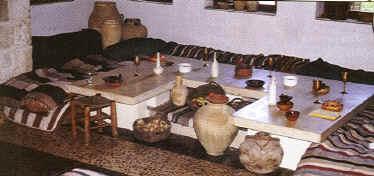
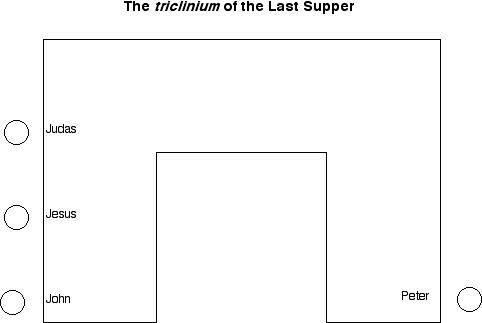
The Synoptic Gospels (Matthew, Mark and Luke) are clear that the last supper was the Jewish Passover meal and that it was eaten in a reclining position, as was customary. According to the practice at the time, the table would have been close to the floor and the participants reclined on cushions. Alfred Edershem (The Life and Times of Jesus the Messiah) and other scholars have explained how the guests would have been seated. The meal would have been eaten at a three-sided table called a triclinium.


Edersheim carefully analysed the conversations and other recorded details of the last supper and demonstrated that we can actually work out the seating positions of four participants at the meal.


I won't go into the details here as to how we know this seating arrangement, but I can provide the details later if anyone is interested.

Another important thing which Edersheim brings to our attention is the number of people who would have been celebrating the Passover in Jerusalem in the time of Christ. This was one of the obligatory feasts when a large number of pilgrims would have been in the city.

It was necessary that the meal be eaten indoors, in groups, and following certain procedures which were carefully laid down in the Law and by tradition. Jerusalem on Passover night was a crowded city and space was at a premium. (By the way, if you have any doubts that the Last Supper was actually the Passover, Matthew, Mark and Luke were unanimous that it was - Mark even specifies that it was on the day when the Paasover lambs were sacrificed [Mk 14:12] - and the comment in John 18:28 that appears to contradict this can easily be reconciled with the Synoptists once we understand the terminology related to the Feasts of Israel. John refers to a claim by the Chief Priests that defilement would make it impossible for them to eat the Passover. By the time of Christ Passover day and the feast of unleavened bread which followed Passover were referred to collectively as "Passover". John's reference is to the priests being unable to join in with the festival meals during the week-long "Passover" festival, and not to the Passover meal itself which had already happened the night before. Any other interpretation puts John in conflict with Matthew, Mark and Luke).

To find a vacant "large upper room" (Mark 14:15; Luke 22:12) in Jerusalem at Passover would have well nigh on impossible. At best they would have arranged to have shared a large room, with other groups of between 10 and 20 people (the numbers specified by Jewish law). For several families or groups to have gathered together in one large room, and then to have eaten the meal around their individual tables would have been such a common practice that the Jewish Law (the Mishnah) explained the regulations for such cases.

Luke refers to a group of 120 "all together in one place" in Jerusalem a short time after (Acts 2:1). Elsewhere he refers to the Jerusalem church meeting at the home of John Mark (Acts 12:12) and there is some circumstantial evidence that the last supper was held in the same home (let me know if you'd like me to provide it).

It is extremely likely that Jesus and the Twelve celebrated Passover in a large room which could have accomodated 120 people. They probably shared the room with several other groups, possibly with other disciples, especially the ones who travelled around the country with them. This helps to explain why private conversations between Peter and John, John and Jesus, and Jesus and Judas , were not heard by the others present. There would have been considerable background noise.

Of course, I cannot "prove" that there were more than 13 present at the last supper, but I don't need to. The number of people present at the meal does not alter anything I've previously said about the nature of this meal. However, those who insist that this meal was a small, exclusive, private gathering have a bit of explaining to do.

Throughout the Gospels we find different types of meals where Jesus was present: from meals with disciples or friends to meals with His religious enemies; meals with crowds of thousands, to small, intimate gatherings. Each setting has lessons to teach us. One thing that was common to them all was that Jesus turned no one away. He taught His disciples and the exclusivist Pharisees to open their meals and celebrations to all who were disenfranchised, rejected, despised and considered 'unclean'. At His last supper he welcomed the one who would soon betray him, a disciple who was about to deny knowing him, and friends who were arguing about which of them should have the most prominent positions, in denial of all He had taught them about servanthood. In fact, within hours all of them would desert him (Matthew 26:56; Mark 14:50). Even knowing that he was about to eat with men who were weak, wavering, even treacherous, men who would deny knowing him or even betray him, he welcomed them all and greatly desired to have this meal with them (Luke 22:15). Such was our Lord's inclusiveness.

Friday, February 17, 2006

The Night He Was Betrayed

Just as some 'background' to the posts on the Last Supper here is an article which I wrote several years ago and which was published in The Christadelphian (August 1987, p 284).


“THE NIGHT HE WAS BETRAYED”


The purpose of this article is to draw together the threads which run through the Gospels in relation to the betrayal of Jesus; to link together some apparently unrelated happenings and to piece together the details of the plot to kill Jesus. We shall examine Judas’ motives and the attitudes of the other disciples and Jesus himself, to him. We hope to solve some of the puzzles which surround this fateful night and will see why it will always be remembered as “the night he was betrayed” (1 Cor. 11: 23).

What Motivated Judas to Betray Jesus?

Judas’ disillusionment may have begun about twelve months before this final, fateful Passover. Following the feeding of the 5,000 the people tried to make Jesus their king and the Twelve had probably joined forces with the crowd, or possibly even led them, in their zeal to see Jesus enthroned in his rightful place as the Son of David and Messiah of Israel. This is made plain enough by the fact that Jesus “constrained” his disciples to leave the scene while he dismissed the crowd (Matt 14:22, A.V., cp. John 6:15); the Twelve were apparently a hindrance to him and, for the time being, he was better off with them well out of the way. The next day some of the same crowd came to hear Jesus teach in the synagogue at Capernaum, but they found his teachings either incomprehensible or unacceptable and “many of his disciples turned back and no longer followed him” (John 6:60, 66). Aware that the Twelve had been sympathetic with the Messianic expectations of the crowd, Jesus asked if they too wanted to leave and singled out Judas for special mention: “Have I not chosen you, the Twelve? Yet one of you is a devil! (He meant Judas who later was to betray him)” (John 6: 67-71). Why this special reference at this time to Judas? Had he been a ringleader in the attempt to make Jesus a king, or did he too wish to leave with the others who were disillusioned?

But disillusionment alone was not enough to cause Judas to betray Jesus. Pride had to be combined with it. This happened at Bethany when again Judas was the ringleader or spokesman for the Twelve in objecting to Mary’s waste of very expensive perfume, and was then himself rebuked for failing to understand that it was “a beautiful thing” which she had done (Matt. 26: 6-13; cp. John 12:1-8). Matthew records this incident between the plot by the chief priests to kill Jesus and Judas’ visit to them, and Mark also records Judas’ offer to betray Jesus immediately after the Bethany incident. This was not simply to get the chronology right but because the Bethany incident was central to the betrayal. Luke’s version, when compared with the other synoptic writers, confirms this:


* The chief priests plot to kill Jesus.

* The anointing at Bethany

* Judas goes to the chief priests.

Matthew 26:1-16


* The anointing at Bethany

* Judas goes to the chief priests.

Mark 14:1-10


* The chief priests plot to kill Jesus.

* Satan enters Judas.

* Judas goes to the chief priests.

Luke 22:1-6


Luke’s mention of Satan, in the light of this comparison, seems to be referring somehow to the Bethany incident. It could mean that it was at this particular time that Judas completely surrendered to his human nature and was angered by his humiliation to the extent of wanting to seek vengeance.

John gives us another motive: Judas was a thief and helped himself to their common purse (John 12:6). Certainly this was a reason for his objection to this waste of expensive perfume. Although none of the Gospel writers actually give Judas’ avarice as a reason for the betrayal, it is possible that Paul had it in mind when he wrote: “The love of money is a root of all kinds of evil. Some people, eager for money, have wandered from the faith and pierced themselves with many griefs” (1 Tim. 6:10). Admittedly, 30 silver coins was not an enormous sum (about four months’ wages for a labourer) (1) , but Mark’s and Luke’s accounts that the chief priests “promised to give him money”, when compared with Matthew’s record that they “counted out for him 30 silver coins”, could easily imply that they paid him a deposit with more to follow when the prisoner was secured.

The Conspiracy with the Sanhedrin

The chief priests and elders “plotted to arrest Jesus in some cunning way and kill him” (Matt. 26:4). Before Jesus arrived in Jerusalem for the Passover they “had given orders that if anyone found out where Jesus was, he should report it so that they might arrest him” (John 11:57). However, they made one stipulation: “But not during the Feast, or thee may be a riot among the people” (Matt. 26:5). Luke adds that “they were afraid of the people” (Luke 22:2). There was another reason why they wanted to avoid crowds. On three earlier occasions attempts had been made to kill Jesus and he had escaped (Luke 4:16-30; John 8:59; 10:22-39). On the two later occasions, both in the temple, Jesus’ escape was made possible by slipping through the crowds. Here was how Judas could help: “He watched for an opportunity to hand Jesus over to them when no crowd was present” (Luke 22:6).

The chief priests had made one restriction only - “not during the Feast” - and yet, on Judas’ advice, they set aside this one requirement. As it turned out, Judas was to obtain information of such importance that they would arrest Jesus at what had been earlier considered to be the worst possible time. To discover what this information was, we need to look at what transpired in the upper room.

The Upper Room

Soon after Jesus and the Twelve entered the upper room a dispute arose among the disciples “as to which of them was considered to be the greatest” (Luke 22:24). It was not the first time; a similar dispute had erupted a few days earlier over who would sit on Jesus’ left and right hands in his glory (Matt. 20:20-28; Mark 10:35-45). The dispute may have re-erupted over the same issue, this time prompted by the seating arrangements. It is apparent that John was on Jesus’ right (John 13:23-25) and Judas most likely was on his left. This is indicated by the fact that Judas was in close proximity to Jesus and their conversation was unheard by the others (2). These two disciples detected something about Jesus’ state of mind that night. While all four Gospel writers record Jesus’ prediction, “One of you will betray me”, John alone notes that while Jesus said this he was “troubled in spirit” (John 13:21). Judas also noticed this troubled disposition, and was later to find his knowledge useful.

The reaction of the others to Jesus’ prediction is remarkable. First “they looked on one another doubting of whom he spake” (John 13:22); secondly, “they began to question among themselves which of them it was” (Luke 22:23); and finally, “they began to be sorrowful and to say ‘Is it I?’ “ (Mark 14:19). They looked to themselves and focused on their own doubts and failings, rather than the faults of others. They may have thought that Jesus was referring to their earlier dispute as a kind of betrayal, a denial of his teaching and spirit. Paul no doubt alludes to their introspection when, in the context of the breaking of bread, he says “Let a man examine himself” (1 Cor. 11:28).

Peter asked John to find out from the Lord who would betray him. We hear nothing of Peter following up this request and asking John who it was who had been identified. Could it be that Jesus’ prediction of Peter’s denials had been understood by that apostle to be the answer to his question? Had his worst fears (“Is it I?”) been confirmed?

Judas’ Rendezvous with the Chief Priests

Jesus told John that he would identify the betrayer by giving him a piece of bread which he had dipped in the dish. He gave it to Judas. “As soon as Judas took the bread, Satan entered into him” (John 13:27). Had Judas heard what Jesus had said to John and was he now humiliated again by being identified in this way? If so, then his anger would have been rekindled and inflamed and Judas again surrendered to his human feelings.

He quickly left the room and went to the chief priests with some important information. “Jesus is in an unusual state of mind; he is ‘troubled in spirit’ and speaking of being betrayed; this would be the psychologically right moment to arrest Jesus because he would not resist or try to escape”. Such an approach by Judas seems to be indicated in Psalm 41 which is partially cited in John 13;18: “All my enemies whisper together against me; they imagine the worst for me, saying, ‘A vile disease has beset him; he will never get up from the place where he lies’. Even my close friend, whom I trusted, he who shared my bread, has lifted up his heel against me” (Psa. 41: 8-9).

Psalm 55 was written in the same historical context as Psalm 41: the rebellion of Absolom and Ahithophel’s betrayal of David. No doubt it equally applies to Judas’ betrayal of Jesus. “If an enemy were insulting me, I could endure it; if a foe were raising himself against me, I could hide from him. But it is you, a man like myself, my companion, my close friend, with whom I once enjoyed sweet fellowship as we walked with the throng at the house of God” (Psa. 55: 12-14). Was there any special way in which Jesus and Judas were “close friends” enjoying “sweet fellowship in the house of God”? It seems highly likely that Judas was the only Judaean among the Twelve (Iscariot is probably derived from Ish Kerioth - a man of Kerioth in Judaea) and therefore the only disciple likely to have had a formal religious education. This may have given him a good knowledge of Scripture, enabling him to discuss Scripture with Jesus on a different level to the others and therefore enjoying a special relationship. The expressions, “a man like myself, my companion, my close friend whom I trusted” certainly imply a special relationship, the last expression possibly referring to his office as treasurer, the only special office, as far the we are aware, to be held by any of the Twelve. Judas’ position on Jesus’ left at the last supper was probably a token of this relationship, as John’s position on Jesus’ right was because he was “the disciple he loved”. Judas was probably above suspicion as far as the other disciples were concerned; it certainly appears that they were blissfully unaware of his dealings with the common purse.

It is almost certain that it was this “vile disease”, this unusual depression or troubled spirit, which Judas used to persuade the chief priests to set aside their one stipulation that Jesus was not to be arrested during the Feast. They acted quickly and sent a delegation to Pilate to arrange a contingent of soldiers and a high-ranking Roman official to escort them to the place where Jesus was to be arrested (3). No doubt Pilate was also notified to expect a trial first thing the following morning before Jesus’ supporters could rally to his defence (4).

Gethsemane

In the meantime Jesus and the Eleven had left the upper room and gone to Gethsemane. Jesus’ troubled state of mind had become more intense, so that he would say, “My soul is exceeding sorrowful” (Matt. 26:38). He “offered up prayers and petitions, with loud cries and tears to the one who could save him from death” (Heb. 5:7).

“The Father heard; an angel there
Sustain’d the Son of God in prayer.”

Jesus’ prayer was heard and he was strengthened by an angel so that he could pray more earnestly (Luke 22: 43-44). As the Apostle records: “He endured for the joy that was set before him” (Heb. 12:2).

It was soon after this that Judas arrived with the Roman soldiers and members of the Sanhedrin. He had a pre-arranged signal for them: “The one I kiss is the man.” Why was such a signal necessary? Could not Judas simply point out the man to them? He must have wanted to avoid any appearance of complicity in the arrest so that he could retain his place among the Twelve - apparently believing that things were not over and that Jesus would simply be punished and released and no-one would know of his involvement. This signal would arouse no suspicion, being the usual greeting between a Rabbi and his disciple. The soldiers must have been instructed to observe from a distance and wait for a suitable time before coming out of the darkness (5). Judas was overly keen to give the impression that all was well. The Greek word used in the Gospels (kataphilein) means ‘to kiss tenderly or repeatedly, as one would a lover’. He would then have mingled with the other disciples who would be unaware that anything was wrong. By the time the soldiers came forward to arrest Jesus, Judas had made sure that his tracks had been covered. There is still one more clue leading to this conclusion.

At the High Priest’s House

John tells us that Peter and an unnamed disciple who was known to the High Priest followed Jesus to the house of Annas. It has often been assumed that this anonymous disciple was John himself, although the evidence for this is wanting. Why was John known to the High Priest? Why was not John’s Galilean accent noticed, as Peter’s was (Luke 22:59)? There was only one disciple whom we know for certain was known to the High Priest, and who had no Galilean accent - Judas! Judas had covered his tracks so well that Peter was still unaware of his involvement in Jesus’ arrest, and so the two of them followed Jesus to the High Priest’s house together. We do know for certain that Judas was there because he was present when the Sanhedrin came to its verdict and he saw Jesus condemned (Matt. 27:1-3).

Judas’ Remorse

Why was Judas suddenly “seized with remorse”? (Matt. 27:3). Events must have turned out very differently from what he anticipated. He could not have expected Jesus to be condemned to death; perhaps he only expected a flogging or similar treatment and his desire for vengeance because of his humiliation would have been satisified.

Judas had seen Jesus’ trial through to the end. He had started, with Peter, at the house of Annas. It was as Jesus was being led from Annas to the house of Caiaphas that he looked on Peter, who had in the meantime denied knowing him, and Peter ran from the scene in tears (Luke 22:61-62). Judas, however, followed as Jesus was interrogated by the Sanhedrin at Caiaphas’ house and then taken to the Temple precincts, where the ‘legal’ trial was conducted in the early hours of the morning (6) in the “Chamber of Hewn Stone”. It is likely that Judas was also at this final trial in the Temple precincts because it was into the actual Temple sanctuary itself (7) that Judas flung his thirty silver coins. The strong verb used to describe this act indicates that he did so in angry defiance (8).

Judas may even have felt tricked because the chief priests had not revealed their real intentions to him. Whatever he had hoped to achieve he did not want, nor did he expect, the death of Jesus. He knew Jesus to be underserving of death yet he was now faced with the terrible reality that Jesus was about to die because of him. “I have sinned, for I have betrayed innocent blood.” Judas, like Cain, felt that his sin was greater than he could be forgiven (Gen. 4:13, R.V. margin) and, like Ahithophel the betrayer of David (2 Sam. 17:23), he went and hanged himself.

Conclusion

We need to remember that from the beginning Jesus viewed Judas as a potential follower and disciple. They shared a closeness and developed a friendship as a result of their mutual interest in the things of God. But Judas was never a committed follower. His highest title for Jesus was “Rabbi” (Matt. 26:25), never “Lord”. He is a continual warning to all those half-hearted disciples who wish to be identified in some way with Jesus, his teachings or his followers, yet can never break free of their attachment to the world or their picture of what Jesus ought to be like. They eventually follow the same path of apostasy and “to their loss they crucify the Son of God afresh” (Heb. 6:6).

We need to realise that Judas’ apostasy was not sudden; it was a long process during which he nurtured his disillusionment and anger at being humiliated. Long before the betrayal he had turned from Jesus and sought satisfaction in wordly gain. His moment of realisation came at last when he discovered that his plans had gone horribly wrong and he had killed the one who had loved him. No one else was to blame; it was by his own choice that he left his apostolic ministry “to go where he belongs” (Acts 1:25).


Endnotes:

1. The stater or tetradrachmon was valued at 4 denarri. As a denarius was worth about a day’s wage (Matt. 20:1-16) Judas’ 30 silver coins would have been roughly equal to 120 days’ wages.

2. John 13:28, cp. Matt. 26:25. The others were not aware that Jesus had identified the betrayer to both John and Judas.

3. Gk. speira (John 18:3) is a technical term for a cohort of Roman soldiers and would not be used to describe Temple Police. Gk. chiliarch (John 18:12) is a military tribune, probably the commander of the Antonia fortress. The detachment of soldiers was large enough to warrant his presence at Jesus’ arrest.

4. John 18:29-34 indicates that the Sanhedrin had been so confident that Pilate would ratify their decision that they initially came without formally prepared charges. This implies that they had discussed the case with him the previous night and therefore did not expect formal charges to be required. Luke 23:1-2 pictures a scene of Jesus’ accusers hurriedly thinking up charges to satisfy Pilate. This provides the most likely explanation for the dreams had by Pilate’s wife (Matt. 27:19). She would have overheard the discussion late the previous night and her conscience had caused her to dream about the conspiracy to condemn “this righteous man”.

5. This is probably what is meant by the words, “Then the men stepped forward” (Matt. 26:50).

6. Matt 27:1 and Mark 15:1 record a trial “very early in the morning” when the Sanhedrin reached a decision. Luke records this trial fully (22:66; 23:1) saying that it was “at daybreak”. This was because the interrogation by the Sanhedrin during the night could not legally be called a trial.

7. Matt. 27:5. It was into the Naos, the actual Temple, rather than the Hieron, the Temple precincts, that Judas threw the money. He probably stood at the barrier between the Court of the Israelites and the Court of the Priests and threw the money across it into the Court of the Priests

8. Gk. rhipto has this meaning, according to R.V.G. Tasker in the Tyndale Commentary on Matthew.

Thursday, February 16, 2006

The Lord's table (9) - the Last Supper (continued)

I've been asked to write some more material on the theme of our Lord's table fellowship practices, especially in relation to the 'Last Supper'.

I plan to write something on 3 things in particular:

1. Who was at the last supper? It's important to answer this question because some people claim that the intimacy of the occasion, the limited number (our Lord and 12 'guests'), and the secrecy surrounding the preparation of the meal indicate that when it comes to celebrating communion our Lord set an example of exclusivism (which should consequently be imitated by the church, so the argument goes). This flies in the face of Jesus' pattern of inclusivism, so the question of who was there is important.

2. The Last Supper and the sacraments. Did Jesus intend that bread and wine should be used as sacraments? What was the reason for using these two 'emblems' and how should the church observe communion today?

3. This was obviously no ordinary meal. So what was so special about it, why was it different, and how, and what are we meant to learn from it?

I'm going to be very busy next week so I will try to post as much as I can beforehand. My apologies in advance if I don't get to write much. I also haven't forgotten the other series I've started but not yet finished. It will all come together, eventually, by God's grace.

Tuesday, February 14, 2006

Christadelphian authoritarianism today

I gave some examples in recent posts of the trend towards authoritarianism in the Christadelphian movement. However, these weren't isolated events in history - there is strong evidence of authoritarianism in some parts of Christadelphianism today.

Here is just one example. The Adelaide Suburban Young People recently sent a letter to their member ecclesias emphasising the need to ensure their young people "conform" (their word) to certain dress standards which they will "enforce at the door" (their expression). Their letter is below, with my emphasis.


Suburban Young Peoples’ Activities

16 January 2006

To the Recorders of the Adelaide Suburban, Glenlock, Mildura, Murray Bridge and Victor Harbor Ecclesias, and the IEAC.

Dear Brethren,
Loving greetings.

Over many years the Suburban Young Peoples Activities have become a valuable part of our Ecclesial life for young people. This facility provides a balance of activities to cater for their social and spiritual needs in a world that can give them nothing of lasting value. These activities draw together young people from a whole range of social and ecclesial circles, and yet united in a course of life, which can develop within them an appreciation for the ways of God. The worth of these activities in developing and promoting the spirit of the Truth in the Ecclesial environment both now and into the future is inestimable.

Amongst the young people, we have a wide variation of opinions on standards in relation to dress and attitude. Attention needs to be given to ensure our young people understand and conform to the accepted inter-ecclesial standards. This is nothing new and is something that has been constantly addressed in order to maintain a wholesome atmosphere in all that is done. Human nature is very persistent in attempting to promote “individual” standards based on current trends and not to conform to an agreed higher standard. It is essential to understand that the Suburban Young People’s environment is not the arena where these values are meant to be taught. They must be taught and promoted in the home environment, and supported by the Ecclesia so that they are naturally expected within the scope of the Suburban Young People’s activities. The wholesome atmosphere we have long enjoyed does not just happen, it has to be cultivated. Sadly non-compliance is often an issue and the work of hosting becomes exceedingly difficult when confronted by rebellion and the denial of respect for the rules and standards we ask our young people to respect.

We are seeking the renewed support of all Ecclesias who have young people from their meeting attending the Suburban Young People’s activities. Every young person and their parents should be aware of what is expected before they participate in these activities. The booklet “The Things We Stand For” plainly outlines the acceptable standards for young people’s activities. These booklets, along with introductory letters to each young person when they first attend and their parents should be considered and understood so that areas of non-conformance are minimised at all activities. Attendance at Suburban Young People’s functions is open to any young person fifteen years of age and is conditional on adhering to these standards. Please be aware that they must have already turned fifteen to be eligible for attendance.

There are a growing number of young people attending from Ecclesias which have not traditionally been associated with our Suburban Young People’s activities. They are most welcome to join us but are subject to the same rules and standards as everyone else. Young people involved with them should make them aware of the accepted standards before leaving home as we prefer not to have to deal with these issues at our first point of welcome.

There are currently a number of things that need to be addressed so that we can continue with a clear understanding of our position on dress and behaviour.

• There is a growing trend towards sloppiness in dress. The booklet “The Things We Stand For” clearly outlines what is required. For classes formal wear comparable to that of a Sunday morning meeting.
With particular reference to the boys, a collar and tie is expected to be worn. Jeans and sneakers are not classified as formal wear and should not be worn at study classes. Shirts must be of a suitable style to enable them to be tucked in as untucked shirts are unacceptable.
For the girls, modest dress is required. Interpretation here is always a problem but common sense needs to be used. Obvious immodest dress is unacceptable and anything that is borderline should be avoided. The hosts’ decision on an individual basis is final and must be respected. Remember that the style of dress should also be formal, not sloppy or provocative.
Head coverings are required to be worn by all girls, whether baptised or not. It seems the wonderful principle of the head covering is largely misunderstood. We will address the principle with the young people separately but please be aware that it is a standard which is not negotiable.
It is our intention to enforce matters of dress at the door. There would be no problem if young people all adhere to the simple requirements. There can be no real excuse for non-conformity. There may be parents that are unsupportive of our position on these matters but the accepted standards are not negotiable. Please put in the effort as it is not our desire to make a show of any young person. If they fail to wear a tie or head-covering, the hosts will provide one for them. There is no satisfactory excuse.
• Attendance at study classes is for the primary purpose of scriptural learning. Everyone attending must do so on the basis of respecting the purpose of this activity. We are finding that some are distracting others or disrupting the proceedings with childish behaviour. Disinterest in the meeting should not be displayed. This can result in a number of things such as foolish behaviour during hymns and prayers, frequent toilet breaks, constant talking throughout the meeting, notes back and forth, SMS messaging to others in the meeting, laughter or other forms of distraction. Sadly It is often evident amongst the same minority group each meeting.
• The Study class meetings start at the set time of 7:30 pm but many see no need to make the effort to arrive on time. Some even arriving half an hour late. This on its own is a distraction as seating is sought for the late comers. Parents need to ensure their young people leave home with adequate time to arrive well before the start time. This will help to set the proper sense of decorum of the meeting.

The hosts have been appointed to oversee these activities for the good of the whole group. We enjoy the role we play, and it is a very positive work as we watch young men and women develop within the activities of the Truth. We understand the many trials and experiences our young people face in a world that is so determined to defile their conscience and destroy the Godly principles. At times, some of this influence can become evident in their behaviour. The responsibility of the hosts is to make decisions to maintain an appropriate level of decorum.

If disciplinary action is required, the decisions of the hosts must be respected by the young people, and supported by their parents and their ecclesias. In the first instance the matter will be discussed with the young person. If this cannot be resolved, then the issue will be raised with their parents. If no improvement in the situation is evident, the matter will be referred to their home Ecclesia and the young person instructed not to attend any Suburban Young Peoples’ activities until the matters are resolved to the satisfaction of the President. This may also include referring the matter to the IEAC for direction. We would hope that such measures would never be necessary, but if the course of action is known, there can be no surprises or excuses.

As a whole, we have a wonderful group of young people. In all that we do, we seek to glorify our Heavenly Father. To that end we would seek your earnest support to maintain the spirit which strives to imitate the example of our Lord, who served his Father in the spirit of holiness with a zeal and passion in self denial.

Could you please distribute this information amongst your ecclesia so that all parents and young people understand the seriousness of the matters we have raised. Additional copies of the booklet “The Things We Stand For” are available on request.


On behalf of the Adelaide Suburban Young People
Bro Rob Scott (President)


It's made clear that the young people will not be permitted to think for themselves, and that even their parents opinions will not be taken into consideration. The role of parents has been taken over by the authorities in the youth group. "There may be parents that are unsupportive of our position on these matters but the accepted standards are not negotiable." The rules have been made and will be enforced. Even visitors from unaffiliated ecclesias will be "subject to the same rules."

No wonder that their young people are restless and inattentive in the classes when those in control are demanding adherence to "rules" rather than providing a message which is stimulating, relevant and life-changing.

Thursday, February 09, 2006

What did Christadelphians set out to be? (9)

There were three main consequences of the events of 1864, 1873 and 1885 which were to have a lasting influence in Christadelphianism and change the direction of the movement. In the last two posts on this thread I looked at two of these consequences:

  • There was a shift from the openness to change, from the exciting and lively debate, and the tolerance of the early years, towards a rigid dogmatism.
  • As Christadelphians became less tolerant of alternative views there was a shift from diversity to division.
In this post I want to look at the third consequence:


3. With increasing organisation came an increase in authoritarianism.

One of the key factors in the growth of the Believers Movement and then Christadelphiansim was the development of some organisation. The Believers Movement was a lose alliance of churches and house meetings which shared a common understanding of many aspects of the Gospel, but were all autonomous and independant. While they worked together on many projects and exchanged speakers and magazines freely, independance can sometimes be a barrier to organisation. Robert Roberts appears to have been gifted in this area and Andrew Wilson noted that:
"The organising ability of Robert Roberts was very important: he gave the movement its rules, institutions, and much of its literature" (page 399).
However, the "rules, institutions and ... literature" proved to be a two-edged sword. Wilson also noted that:

"Roberts was held in high esteem by his brethren for his vigour; his application to ecclesial arrangements in Birmingham was immediate upon his arrival and energetic; simultaneously, he was engaged in controversy with the Aberdeen Campbellites [Churches of Christ]. Nevertheless, Roberts's efficiency and zeal appeared, in the eyes of some, to have an impetuous aspect to it; in 1864, he wrote of his 'strained relations with Dr. Thomas'; on other occasions, members of his family expressed reservations about his temperament."


As an example of of the last point, Wilson quotes from Roberts' own brother-in-law W. Norrie in his Early History of the Gospel of the Kingdom of God in Great Britain (Edinburgh 1904-1906). Referring to a John Wilson of Halifax and his falling out with Robert Roberts Norrie wrote:

“[he] was one of many brethren who were victimised because of their ‘disagreement in important principles’ with R. Roberts. In the particular ‘principle’ in which the two differed, I was convinced that Roberts was in the right, but I was equally confident that this disagreement did not warrant the cruel treatment to which he [John Wilson] was subjected on that account”.
The way in which Roberts disfellowshipped Dowie, Turney and Ashcroft and turned "Bro. Dealtry" into "Mr. Dealtry", and especially the way he took this action without the approval of his ecclesia, shows that Roberts was becoming an authoritarian. He didn't need to consult anyone - after all, he was the editor of The Christadelphian! (and he'd gotten rid of his competitors who edited The Messenger of the Churches, the Christadelphian Lamp, and other magazines).

Even John Thomas changed from being what Wilson described as an 'anarchist':

"To describe John Thomas as a spiritual anarchist would not do full justice to the profundity of his radicalism" (page 93).

He described John Thomas as "a pioneer, a discoverer ... What appealed to him was to wriggle free of what he considered the mental shackles imposed by orthodoxy, so he could soar high in the spiritual etherea and see vistas, within the Bible, of God's past, present and future plans”. He was opposed to hierarchies, rules, constitutions, creeds and statements of faith and believed that a minimum of organisation was preferable.

Yet, Wilson notes that "during the period approximately 1864 to his death in 1871, Thomas's views on ecclesiastical polity became rather more authoritarian than they had previously been".

It was to be on this point of authoritarianism that the Christadelphian denomination was eventually to explode in 1885.

However, this is not just a history lesson. Christadelphianism changed and left later generations of Believers with this legacy:


  1. There was a shift from the openness to change, from the exciting and lively debate, and the tolerance of the early years, towards a rigid dogmatism.
  2. As Christadelphians became less tolerant of alternative views there was a shift from diversity to division.
  3. With increasing organisation came an increase in authoritarianism.


I will take this up later and look at what can be done to get the Believers Movement back on track.

Monday, February 06, 2006

What did Christadelphians set out to be? (8)

The events of 1864, 1873 and 1885 changed the direction of the movement. I have already looked at one of the consequences of these events which were to have a lasting influence in Christadelphianism:

  • There was a shift from the openness to change, from the exciting and lively debate, and the tolerance of the early years, towards a rigid dogmatism.
There were two more major consequences, which I will look at over the next two posts in this thread.

2. As Christadelphians became less tolerant of alternative views there was a shift from diversity to division.

Between 1864 and 1885 there were at least 6 divisions within the Christadelphian denomination, including the major divisions caused by the disfellowships of George Dowie in 1864, Edward Turney in 1873 and Robert Ashcroft in 1885. Other 'minor' divisions (although not minor for the individuals involved) included the following.

  1. Charles Dealtry, who had been baptised by John Thomas, actively preached the Christadelphian faith between 1866 and 1868 and converted many people to Christadelphianism, especially in Whitby. He was denounced in 1868 for teaching that Jesus was the son of Joseph (although he was never disfellowshipped by any ecclesia). Roberts reported in The Ambassador that the converts made by "Mr. Dealtry" (he was no longer called "Bro Dealtry") in Whitby were to be "re-immersed and organized as a Christadelphian ecclesia".
  2. An unnamed ecclesia in 1876 was challenged by Roberts for teaching a doctrine he called "No Willism". It emphasised the divinity of Jesus and included the idea that Jesus pre-existed as Jehovah of the Old Testament, and therefore could have no other will than that of God Himself. Roberts responded by emphasising the humanity of Jesus in a series of articles and by 1877 it was thought that "No Willism" had been stamped out.
  3. Soon after a pamphlet was published by John Birkenhead entitled Letters on the Doctrine of God manifestation, and Extracts from the Most Recent and Advanced Writings of the Late JOHN THOMAS, M.D. It's clear that Thomas's Christology emphasised the divinity of Jesus to a greater extent than Roberts did, especially in his response to 'No Willism' which emphasised (or over-emphasised) the humanity of Jesus. Roberts responded to the pamphlet by querying whether Christ, as the manifestation of God, had a will of his own. He was clearly trying to link Birkenhead's ideas with the "No Willism" heresy he had endeavoured to stamp out. It's unknown how many people were affected, but Andrew Wilson commented that while the numbers were likely to be small "the amount of disturbance caused ... was substantial".
After 1885 the process of fragmentation continued, with another major division in 1894 (Resurrectional Responsibility).

Writing of the Christadelphian ‘proclivity for schism' in this period sociologist Bryan Wilson refers to a

"series of bitter schisms. Excommunication of members and of one ecclesia by another became a common pattern in the attempt to maintain purity of doctrine and association. Whilst undoubtedly some schisms were at least partly a consequence of struggles for informal influence between leading brethren, there was always a strong concern for obedience to the word of God which led to over-scrupulousness, to purging evil men who arose in the fellowship, and hence to divisiveness."

Bryan Wilson, Religious Sects a sociological study, World University Library, London, 1970, p 109.
In his Religion in Secular Society (C.A. Watts & Co, London, 1966, pp 211-212) Bryan Wilson writes of sects which

"have changed ... in a way rather less influenced by the immediate environment, and rather more in accordance with essentially internal pressures. Thus some revolutionist sects have tended over time...to become more preoccupied with the means of their own insulation from the wider society. They have tended to become more concerned with the condition of their own society, with their own inner holiness. Sometimes ... they have developed the proclivity for schism within, often over matters which to the outsider seem trivial in the extreme... The Christadelphians have shown marked tendencies in this direction." (My emphasis)

Robert Roberts himself confessed:
"A state of comparative prosperity ten years ago has been succeeded by one of strife, division and obstruction, and unutterable affliction has followed in the wake of ventures and expectations that seemed big with blessing"
(The Christadelphian, 1890.)


Bryan Wilson, in Social Aspects of Religious Sects (London University PhD thesis 1955), calculated on the basis of figures provided by Roberts in The Christadelphian that there were about 6,000 brethren in the 'central' fellowship in 1884, and less than 3,000 the year after. Andrew Wilson provides extensive statistical information to demonstrate the sudden and dramatic departure of a large number of brethren from Christadelphianism. In overall terms the loss was between 35% and 44% of the brethren in the U.K. compared to a national annual increase in population of about 10%.

Bryan Wilson wrote that "Barely a month passed without a division in some ecclesia."

Andrew Wilson summarised this period of schism this way (my emphases in bold):

"In the seventeen years between the formation of Baptised Believers in 1847 until the adopting of the editor's mantle by Robert Roberts in 1864, no divisions occurred within the movement. In the only slightly longer period of twenty-one years from 1864 to 1885 six major rifts disturbed the theological equanimity within Christadelphia, the last, in 1885, leaving the movement bereft of many members and devoid of momentum. There is undoubtedly some connection between these two facts: it is not impossible that the abrasiveness of Roberts's personality contributed to the friction involved, as some contemporary writers maintained. Second, Roberts's method of dealing with problems - on occasion involving the curtailment of exegesis by the imposition of a guillotine on further discussion - allowed these problems to be swept under the theological carpet, by very dint of having merely brushed them aside. Such strategies accounted, in part, for the recurrence, in similar and at times identical form, of problems throughout the history of Christadelphians." (p. 364)