Sunday, June 18, 2006

"I will build my church" (2)

Nearly six months ago I began a series on this theme, but only got as far as the first post.

I plan to take it up again, so here is a brief overview of what I plan to write about.

Have you ever wondered why Jesus hardly ever talked about "church"? In fact, the word church occurs only twice in the Gospels, both times in Matthew. What Jesus talked about repeatedly was the Kingdom, and it's not until we get to Acts that the word ekklesia/church is used as the usual way to describe the people of God.

I'd like to explore what Jesus meant by "church" when He said "I will build my church" (Matthew 16:18).
  • What exactly did Jesus intend to build?
  • Is this reflected in the way anyone actually does church?
  • Is it reflected in Christadelphian ecclesias?
This series will also tie together some threads from the series I've written about the characteristics of Christian leaders (i.e what leadership means in the church Jesus is building) and the earlier posts on the Gospel of the Kingdom and the Lord's table.

Friday, June 09, 2006

House church "heretics"

Matt Green of Ministry Today has commented on George Barna's Revolution released last year and his controversial vision of the future that sees 70 percent of the church worshipping in non-traditional settings such as house churches within the next 20 years.

He noted that an argument against the house church movement popped up in a recent article in the Washington Post, where it is suggested that house churches are more vulnerable to heresy, because they lack the accountability of established churches and denominations.

Matt Green writes:

The Reformation was a movement of doctrinal purification that emerged from the decay of institutional heresy. Apparently the strong "leadership" of generations of popes, bishops and priests was inadequate to protect the church from doctrines and practices so bizarre they would be considered downright cultish by today's standards. An indulgence anyone? In fact, as many would argue, the leaders were the ones who concocted these abberations to begin with! It was when the exclusive right to interpret the Word of God was pried from the grasp of clergy that the laity discovered that they had been duped. Then, like now, the church is not in need of more leaders, it's in need of more readers - believers who will embrace the responsibility of their own spiritual health and stop subcontracting it to paid clergy. However flawed, the house church movement is one attempt to correct this imbalance.
Well, those of us who believe that the Gospel needs to be rescued from institutional Christianity would find agreement with that.

Green goes on to say:

No, house churches are the least likely seedbeds of heresy. In fact, they are the natural offspring of the Reformation's cry: Ecclesia reformata, semper reformanda ("The church reformed and always to be reformed"). As with any renewal movement, there will be pockets of excess and room for correction. For instance, in the coming years, the house church movement will have to tackle challenges of elitism, leadership, accountability and - of course - heresy. But like the rest of the Body, they won't be facing these alone (see Matt. 18:20).
My favourite comment in his article is this:

"... doctrine (like political power) should not be preserved by an ecclesiastical elite. It must be articulated, taught, transmitted and understood by the laity."

Monday, June 05, 2006

"Be perfect"

Many Christians understand Jesus' sermon on the mount as an "ideal" for Christian living, albeit an unrealistic or impossible ideal. This view is reinforced by the time we get to the first 'climax' in the sermon: "Be perfect, just as your Father in heaven is perfect" (Matt 5:48). This seems like an impossibly high ideal if Jesus is speaking of moral perfection. However, the word translated "perfect" (Greek teleios) means "complete, whole, full-grown or fully integrated". In the context it means to be all-inclusive. In the sermon it follows the command to love our enemies (and connects to it with a "therefore"): "Love your enemies and pray for those who persecute you, that you may be sons of your Father in heaven. He causes his sun to rise on the evil and the good, and sends rain on the righteous and the unrighteous ... Therefore, be perfect ...". Jesus is saying that God loves both the evil and the good person, both the righteous and unrighteous person. We too should love our enemies as well as our friends. "Therefore, be all-inclusive, as your Father is all-inclusive".

In earlier messages I've emphasised that Jesus' message was the Gospel of the Kingdom. The sermon on the mount is the largest body of teaching in the gospels and encompasses the core teachings of Jesus. It begins with a reference to the Kingdom (the beatitudes begin and end with "... for theirs is the Kingdom of heaven"). Understanding the sermon on the mount is crucial to understanding the Gospel of the Kingdom.

John Thomas, and Christadelphians generally, have been right in identifying the centrality of the Kingdom to the Gospel. However, in his "exposition of the Kingdom of God" (Elpis Israel) John Thomas pays little attention to the sermon on the mount. Christadelphianism primarily sees the Kingdom as something which is future, and the sermon on the mount as a code of behaviour which, if followed to the best of ones limited ability, will be rewarded with a place in the future Kingdom. Christadelphains do not see the sermon as being substantially about the Kingdom. To this way of thinking the Olivet prophecy (Matt 24, Mark 13, Luke 21) with its future eschatology and its apocalyptic language is kingdom stuff, but not the sermon on the mount. Apart from the words "the meek will inherit the earth" the sermon on the mount would rarely rate a mention in a Christadelphian exposition of the Kingdom. Yet Matthew says Jesus came "preaching the Kingdom of God" (4:23) and immediately launches into his account of the sermon on the mount (chapters 5-7). This is the heart of Jesus' kingdom-message, and the first climax in the sermon is "Love your enemies ... be all-inclusive, as your Father is all-inclusive, loving good and bad, righteous and unrighteous".

This is the opposite of exclusivism, of withdrawing from others in order to maintain doctrinal purity. Jesus' kingdom-message here stands in stark contrast to the attitude of the Pharisees, and to John Thomas. In his exposition of the Kingdom Thomas missed this point completely.

If you missed my posts on the Lord's table, dealing with His table-fellowship practices, go back and read them now. You will see that in both His behaviour and in His sermon on the mount Jesus is teaching that Kingdom-people are inclusive, not exclusive. They are unconcerned with defilement by others because they radiate holiness. They look for common ground rather than points of disagreement. They tear down walls rather than erecting barriers. Theirs is a ministry of reconciliation, rather than withdrawing from others.

This message follows on from my series on early influences on Christadelphianism. If Thomas had remained connected with all those with whom he had so much in common and worked with them rather than against them, how different might things have been. If Roberts had recognised the talents and the contributions of early Christadelphian leaders rather than forcing them out of the community, how different might the community have been. Instead of the constant fighting, controversies, divisions and disfellowships, those who had been taught or influenced by Thomas might have recognised their place within a broader body of believers who genuinely endeavoured to restore the beliefs and practices of early Christianity. They may have had a greater influence for good on the Christian world than they did. Is it too late to change?


For those of you who may have been receiving my articles on "Understanding Jesus' Teachings" I apologise for the hiatus in writing. I plan to resume the series shortly with some articles on the sermon on the mount and the Gospel of the Kingdom.

Saturday, June 03, 2006

Early influences on Christadelphianism (9) - further conclusions

The Christadelphian community has been plagued with controversy and division since its inception. In an earlier series of posts (What did Christadelphians set out to be?) I looked at some of the early Christadelphian leaders who were forced out of the community.

There is some evidence that George Dowie (disfellowshipped by Roberts in 1864) and Robert Ashcroft (disfellowshipped by Roberts in 1884) in the UK allied themselves with Benjamin Wilson's group - the Brethren of the One Faith - in the US. (I've also wondered about how and why copies of Edward's Turney's Christadelphian Lamp found their way into the archives of the Church of God General Conference at the Atlanta Bible College - perhaps Turney, who had been disfellowshipped by Roberts in 1873, also made contact with believers in the Age to Come movement in the US).

These connections are interesting for a couple of reasons:
  • It shows that these men saw themselves as part of a movement which was wider than Christadelphianism, and they had a great deal in common with people in similar groups from which John Thomas had separated. Perhaps their own rejection at the hands of Thomas and Roberts compelled them to look again at the reasons why the leaders of the Age to Come movement in the US had similarly been rejected by Thomas, although this is speculation on my part.
  • It suggests that in taking a heavy-handed approach to brethren whose opinions differed to his own Robert Roberts was simply following a pattern which had been set by his mentor John Thomas.
Together, Roberts and Thomas were building a 'denomination'. Roberts tried to organise the denomination into an organisation with rules, a creed and a headquarters in Birmingham (with himself firmly in control). His organising abilities were such that he was successful to some extent, although almost half of all Christadelphians in the UK left his central fellowship in 1884-85 and the community has been splintered ever since.

However, the men from whom Thomas had withdrawn were part of a movement which sought to restore early Christianity. The Christian Connection of Elias Smith and Abner Jones tried to discover and restore the beliefs and practices of the first century church. In doing so they emphasised the Oness of God and the mortality of the soul as key parts of primitive Christianity. Joseph Marsh, who was baptised and ordained in the Christain Connection, contributed a great deal in teaching about the restoration of Israel and the Age to Come and establishing the Age to Come movement. The churches established by Barton Stone, Thomas Campbell and Alexander Campbell became known as the Restoration Movement because they were also endeavouring to restore primitive Christianity. To some extent they were successful and Christadelphianism owes many of its practices, beliefs and traditions to this movement.

Restorationism, the Age to Come movement, Adventism, the One Faith movement ('the Abrahamic Faith') and Christadelphianism were linked together and were part of a broader attempt to restore original Christianity. Each group or movement has been successful to varying extents, but does any one group have 'the whole truth'? I doubt it, and I believe there is still a great deal to be learned and gained from interacting with others whose spiritual journey has taken them down a slightly different path.

Almost every doctrine of Christadelphianism can be found within this movement because Christadelphianism came out of it. John Thomas didn't 'discover' anything new or unique or original. He learned it all from being involved with a community of believers, and not from studying the Bible alone. Surely there is a lesson here. I believe that Christadelphians as individuals and as ecclesias will develop, grow and prosper only to the extent that they see their place within the broader body of Christ and interact with others who have things in common, seeking ways to unite rather than reasons to divide, looking out rather than within, and building rather than tearing down.

Early influences on Christadelphianism (8) - conclusions

When we look at the various people who influenced John Thomas's thinking and with whom he was associated at various times, and the reasons why he separated from them, we see a pattern emerging.

Just to briefly recapitulate:

  • For some time Thomas was very friendly with George Storrs, the foremost proponent of conditional immortality (the mortality of the soul) in the US. After disagreeing about the importance of baptism they parted company, and Thomas wrote some critical words about "Mr" Storrs (no longer "brother Storrs").
  • It appears that John Thomas and Joseph Marsh were close friends for some time. After Thomas was re-baptised he tried to persuade Marsh to do the same. Marsh did not see the need to be re-baptised every time he changed his mind or learned something new, and disagreed with Thomas about this. Thomas persuaded Marsh's church to disfellowship him and later published some very unkind and critical comments about "friend Marsh".
  • Although they agreed on most things Thomas parted company with Benjamin Wilson mainly over the issue of whether the dead would be raised mortal or immortal. He subsequently published a series of personal and defamatory attacks on Wilson, including comments about Wilson's financial affairs.
Here is the pattern I see:

1. If Thomas was unable to persuade someone to agree with him he spilt from them, regardless of whatever they already had in common. Peter Hemingray (John Thomas: His Friends and His Faith) draws a similar conclusion. Referring to the split with Storrs he says: "John Thomas heard and was associated with many of the clamoring voices of the American Reformation, of whom George Storrs was one, but in the end he withdrew from them all" (p. 140, my emphasis).

2. After parting company with these men (and sometimes before parting company) John Thomas published highly critical comments about them. The criticisms were not only of their beliefs, but were often personal and defamatory. (In fact, I'm puzzled why Hemingray titled his book John Thomas: His Friends and His Faith - these men would hardly have considered Thomas their "friend" after the way they were treated. John Thomas: His Enemies and His Faith might have made a more accurate title).

3. Thomas almost always actively preached amongst the congregations associated with his former "friends" and tried to convince their supporters to withdraw fellowship from them and join his emerging denomination. This was so obvious to Thomas's contemporaries that one of them wrote:
"The doctor [Thomas] is very hard on the Adventists, Millerism, and Storrism. I fear he is ungrateful. For had it not been for the Advent movement, I do not believe that this day he would have a corporal's guard of followers. A broken-down ex-Campbellite, he goes north to take advantage of the movement, and is now building on other men's foundations, and all the while exposing its rottenness! Such at least is my opinion of his course."

(Nathaniel Field, Thomasism, Number III,
Expositor and Advocate
, Vol 29 No 24, May 15, 1859, 665)

In an editorial addition to this article Marsh wrote of Thomas's "manifest ingratitude to those who raised him from obscurity to his present notoriety among us".

Hemingray, a defender of John Thomas, substantiates this conclusion with a comment that
"before 1843 almost all his followers had been from the ranks of the Campbellites: after this time, they increasingly came from the Millerites" (p. 111).
By "Millerites" he is referring to the Adventists and the Age to Come movement (including the supporters of Storrs and Marsh).

Preaching amongst the churches from which he had "withdrawn" caused a great deal of resentment, for understandable reasons.

Was Thomas right to withdraw from people with whom he disagreed? Some would say that in doing so he was establishing the importance of "doctrinal purity". But how far does one need to go before the faith is "pure"? While Christadelphians would generally agree that withdrawing from Storrs over a matter as 'fundamental' as baptism was the right thing to do, it becomes questionable whether Marsh's refusal to be re-baptised was in the same category. By the time we get to the withdrawal from Wilson over mortal/immortal emergence it becomes even more questionable. In fact, to this day Christadelphians in North America are divided on that one and the question is still not settled.

Pragmatically, it might have been better if Thomas had stayed in contact and on friendly relations with the people from whom he split. Given time he may have convinced Storrs of the need for baptism. If he'd worked with Marsh, rather than against him, they may have found agreement on re-baptism. If he stayed with Wilson who knows what their combined talents and energies might have achieved. By sticking with his 'friends' Thomas may have eventually persuaded them of the rightness of his views, or he may have learned from them and grown in knowledge. Instead, he helped to divide and fragment a movement which was growing and impacting the broader church and impaired its effectiveness.

Acknowledgements

Before going any further with my series on early Christadelphian history I really should acknowledge and thank my sources.

In addition to primary source material I owe a huge debt to Janet Stilson, an historian with the Church of God General Conference, for providing me with copies of rare periodicals from the period, and for information generally. The following articles have provided valuable details:

A Brief History of the Church of God General Conference
Janet Silson, David Graham, Mark Mattison
Journal from the Radical Reformation, Vol 1 No. 1, Fall 1991

An Overview of the Leadership and Development of the Age to Come in the United States: 1832-1871
Jan Stilson, M.A.L.S.
Journal from the Radical Reformation, Vol. 10 No 1, Fall 2001

The Development of the Church of God Abrahamic faith: 1845-1921
Jan Stilson, B.Th., B.S., M.A.L.S.
Journal from the Radical Reformation, Vol. 11 No 1, Fall 2002

The Publishing Heritage in the Age-to-Come Movement 1800-1985
Jan Stilson
The Restitution Herald, Vol 75 No 1, October 1985

I'm also indebted to Greg Demmitt, Pastor of the Lakeshore Bible Church, for information on the Christologies of Alexander Campbell and Barton Stone.

Friday, June 02, 2006

Early influences on Christadelphianism (7)

I came across this quote today which I thought was relevant to this series:

No movement remains untouched by other's thought.
The worst men hold some truth.
The same is true for religious movements, theological systems, and creeds.

Diversion - John Glas

This is my blog, so I can indulge myself. You may have picked up that I enjoy history. This brief diversion about John Glas has little to do with the series on early influences on Christadelphianism, except that Glas indirectly influenced the founders of the Stone-Campbell Restoration Movement, and I am a physical descendant of John Glas (so please forgive me for the indulgence).

Thomas and Alexander Campbell and Barton Stone were all ex-Presbyterian ministers who had been influenced by reformers in Scotland, specifically John Glas, Robert Sandeman (Glas's son-in-law) and Robert and James Haldane. Glas (1695-1793) became known as the founder of the 'Scotch Baptists' becaused they practised adult baptism by immersion. An ordained minister in the Presbyterian church, Glas was determined early on to make the Word of God his sole rule of conduct. When he began preaching a series of lessons from the Shorter Catechism (Presbyterian Manual) he noted there were strong differences in it from the Bible.

He came to realise that the church was composed of those who had experienced the grace of Christ, had separated themselves from the world and gathered themselves in the church. He could see no place for State involvement in church affairs, and this brought him into conflict with the Civil authorities. In 1725 he started an independant church which he called a Society of Believers.

His teaching was regarded as close to treason and Glas was brought before a number of synod meetings before being suspended as a minister and deposed from the church ('the right boot of disfellowship'). However, in 1739 the General Assembly broke precedence and revoked the sentence of deposition and restored Glas as a minister, although it didn’t restore his licence as a minister of the church of Scotland. He was allowed to continue in ministry with independant churches. This showed a sign of softening of their stand against Congregationalism. With the assistance of his son-in-law the message spread and churches sprang up all over Scotland.

Sandeman migrated to North America where he established a church which later joined the Restoration Movement.

Incidentally, I am descended from one of John Glas's 15 children.

Early influences on Christadelphianism (6) - Barton Stone

Barton Stone (1772 - 1844).

Stone was one of the founders and prominent leaders in the Restoration Movement which gave birth to the Church of Christ and Disciples of Christ (together with Thomas and Alexander Campbell, and Walter Scott). This movement was influenced by the Christian Connection and others, and emphasised the need to return to original Christianity. Hence it became known as Restorationism. It grew from two main roots as the result of the preaching of the Campbells on the one hand and Stone independantly on the other. They subsequently combined their efforts, so Restorationism is sometimes called the Stone-Campbell Movement. It is the group John Thomas almost always called the Campbellites.

Stone was a great evangelist and once led a revival in which 20,000 people took part. By 1826 there were 15,000 members in 300 congregations founded by or associated with him. John Thomas was a member of the Restoration Movement ("Campbellites") from 1834 until his final split from them in 1847. There is no evidence he ever met Barton Stone. Interestingly, however, Stone rejected much of trinitarianism although he believed in pre-existence. Alexander Campbell rejected pre-existence. One can only wonder to what extent the discussion of this doctrine in the Restoration Movement of which John Thomas was a member influenced his own views on the matter.

Early influences on Christadelphianism (5) - Age to Come Adventism

Several people contributed to the development of Christadelphian theology. It is often claimed that John Thomas "discovered" the Truth and revived apostolic Christianity. However, almost all the "distinctive" doctrines of Christadelphianism were being taught and believed in the US and Britain even before John Thomas began to take an interest in these subjects. This list gives a brief overview of some of the most prominent writers and teachers of these ideas, but is hardly exhaustive.
  • George Storrs (1796-1879) - taught 'Conditional Immortality', that is, that the soul ceases to exist at death and that resurrection, not heaven-going, is the hope taught in the New Testament. Storrs taught that the wicked will be punished with everlasting destruction, not eternal hell-fire. Storrs was prominent in the Adventist movement which gave rise to the Advent Christian Church and the Sevent Day Adventist church. (He also influenced Charles Russell who founded the Bible Students, out of which came the Jehovah's Witnesses). He was probably the most influential preacher in America in teaching the mortality of the soul. John Thomas knew him and Storrs published articles by Thomas in his magazine The Bible Examiner. The relationship appears to have been friendly for some time, until Thomas severely criticised Storrs for not being baptised (1853). He stopped referring to him as "brother Storrs" and he became a "Mr". They parted company.
  • Elias Smith (1769-1846) - founded the Christian Connection together with Abner Jones. Smith was non-trinitarian and rejected the immortality of the soul and the popular views of hell. John Thomas belonged at one time to a church in Philadelphia (1833-34) founded by Elias Smith. In 1837 Alexander Campbell wrote in his magazine that John Thomas's views on the mortality of the soul had come from Elias Smith, although Thomas claimed that he had developed these ideas before reading Smith's works. However, it was while he was a member of the church in Philadelphia founded by Smith (1834) that Thomas wrote 34 questions to his father (a Congregational minister) indicating he was developing new ideas on the Kingdom of God and the nature of the soul.
  • Joseph Marsh (1802 - 1863) - I wrote about Marsh in an earlier post. He had been connected with Elias Smith and lated edited the magazine founded by Smith. As well as being non-trinitarian and believing in the mortality of the soul, Marsh also taught the restoration of Israel, the second coming and the Kingdom of God on earth. His book "The Age to Come" was so influential that he is sometimes attributed as the founder of the Age to Come Movement. John Thomas knew him, and had stayed in his home, although the relationship ended on a very sour note when Thomas persuaded Marsh's church to disfellowship him.
  • Benjamin Wilson (1817 - 1900) - referred to in a previous post, held and taught almost all the same "distinctive" doctrines as John Thomas, although disagreeing on whether the dead would be raised mortal or immortal. Thomas considered the difference important enough to part company with him.
The various individuals and congregations associated with Marsh and Wilson are sometimes referred to collectively as "Age to Come Adventists". Storrs, Miller, Smith and others were influential in the development of Adventism, emphasising the second coming of Christ but rejecting the idea of a future Kingdom of God on earth. Hence, the Adventists who believed in the restoration of Israel and the establishment of the Kingdom on earth in the Age to Come, became known as "Age to Come Adventists". The followers of Marsh generally used the name "Church of God", while Benjamin Wilson preferred "Brethren of the One Faith". Some of the congregations associated with Wilson also used the name "Abrahamic Faith". These groups often associated together, exchanged preachers and magazines, and sometimes shared church buildings. Many of the first Christadelphian ecclesias came from this movement. The Church of God congregations which had been founded by Marsh united with the "One Faith"/"Abrahamic Faith" congregations in 1921 and formed the Church of God General Conference (also known as Church of God of the Abrahamic Faith).

One thing is certain: the core doctrines taught by Thomas were already being taught by other preachers and upheld in many churches, including the Oneness of God, conditional immortality (mortality of the soul), the second coming, the restoration of Israel, and the Age to Come. Even the impersonal nature of the devil, sometimes regarded as 'distinctively Christadelphian', was being taught before Thomas (I may come back to this later).

In a future post in this series I hope to draw some conclusions about why Thomas dissociated himself from so many people with similar beliefs, and what this meant for the development of Christadelphianism.

Thursday, June 01, 2006

Early influences on Christadelphianism (4) - Benjamin Wilson

It did not take long for Joseph Marsh to recover from his troubles. Within a few months, Marsh began an evangelistic tour and attended a church conference at which he was appointed evangelist. After the death of Marsh in Michigan in the early 1860s, Benjamin Wilson and his nephew Thomas Wilson became more widely read and accepted among the leading exponents of the Age-to-Come doctrine, which among other things explained that the Jews would one day return to their land and become a nation. This doctrine was advanced long before the Zionist movement became a popular topic. Benjamin Wilson emigrated to the US from England in 1842 and settled in Geneva, Illinois, where he set up a publishing business. He was a skilled Bible scholar and had been trained in Biblical Greek.

After a few years, Wilson did what no man had done to date anywhere in the world. He produced an interlinear translation of the New Testament from the Greek text*. Under each line was a rough translation in English representing as closely as possible the meaning of the Greek language used in the passage. It was revolutionary, and very helpful to Bible scholars. The Age to Come people loved it. Problem was, it was not popular with the orthodox churches because it literally translated passages which had formerly been translated by others to represent orthodox teachings such as trinity, pre-existence and going to heaven.

An Overview of the Leadership and Development of the Age to Come in the United States: 1832-1871 by Jan Stilson, M.A. L. S

A Journal from the Radical Reformation, Vol 10, No. 1, Fall 2001

* The Emphatic Diaglott, published in 1864.


Benjamin Wilson edited and published The Gospel Banner and Millenial Advocate from 1853 to 1869 and his nephew Thomas Wilson edited and published The Herald of the Coming Kingdom and Christian Instructor (the two magazines combined in 1870). Both magazines were popular amongst believers in the Age to Come, and Benjamin Wilson travelled widely preaching and ministering to churches.

John Thomas first met Benjamin Wilson in 1856, although some years earlier they lived for a time in neighbouring cities in Illinois. At the beginning of their association Wilson and Thomas believed similarly. Joseph Marsh and Benjamin Wilson also knew of each other, although they apparently never met. Strangely, the followers of Marsh and Wilson succeeded in uniting their various congregations into the Church of God General Conference denomination in 1921, many years after their deaths.

While Thomas and Wilson had much in common, and got off to a friendly start, they eventually divided over the issue of whether believers would be resurrected mortal or immortal. Thomas insisted that it was necessary to believe in mortal emergence, although it seems that while Wilson and many of his supporters believed in immortal emergence they did not consider it to be a matter of fellowship. Thomas did. They went their separate ways.


Wednesday, May 31, 2006

Early influences on Christadelphianism (3) - Joseph Marsh

Unitarianism, of several types, seems to have developed in America at the end of the eighteenth century. Two or three groups shared a concern for a return to the "primitive gospel." One of these was the so-called Christian Connection, a minority revivalistic movement on the New England frontier. Another was the Freewill Baptists. At the beginning of the nineteenth century, the two groups contemplated merging, since both held similar doctrines, inclined toward primitivism, and practiced open communion. But as they expanded westward across New York State, the "Christians" began more and more to show Unitarian tendencies, which alienated them from the Baptists and turned them toward the followers of Barton Stone — and occasionally toward the Unitarians.

Joseph Marsh was born in Vermont in 1802. Early in Marsh's life his family moved to New York, where his parents were disfellowshiped by the Methodist Episcopal Church for rejecting the Trinity. In 1823, Marsh was baptized into the Christian Connection. The following year he entered the ministry.

In 1841, Marsh wrote fourteen influential articles entitled "The Church of God" in which he encouraged a return of the Church to New Testament principles. Marsh became the leading writer for the emerging Church of God, publishing first the Christian Palladium (1838-43) for the Christian connection, then Voice of Truth (1844-47), the Advent Harbinger, and, finally, the Bible Expositor. Through the Voice of Truth Marsh promoted the doctrine of the Age to Come and the restoration of the Jews to their homeland prior to Jesus' second coming. In 1851 he published a major work called The Age to Come where he carefully elaborated his ideas. He is regarded by many as the founder of the Age to Come Movement.

John Thomas and Joseph Marsh knew each other, probably meeting in 1842, and many of Thomas's early contacts were already readers of Marsh's magazines. After Thomas settled in New York he and Marsh exchanged ideas through their respective magazines. Through this exchange the two became friends, or so Marsh thought. It's possible that they influenced each other as both men were going through a period of change and development in their ideas. They had many things in common, including belief in the oneness of God, the mortality of the soul, the restoration of Israel and the Age to Come. Their friendship and association together could have achieved a great deal in spreading this message. Marsh invited Thomas to Rochester. Thomas stayed in Marsh's home and preached in his church.

However, in 1847 Thomas decided to be re-baptised (he had earlier been baptised by Walter Scott of the Disciples of Christ) after changing his beliefs on several points. He tried to persuade Marsh to do the same, but Marsh was not convinced that his baptism was in any way inadequate. Not content to 'agree to disagree' Thomas turned to Marsh's church (the Church of God in Rochester, New York) and eventually convinced them to disfellowship Marsh. Thereafter they preached in different areas, and in 1858 Thomas published a letter referring to Marsh's supporters as his "parasites".

Marsh's writings had a wide influence and several congregations began in Illinois as a result.

To be continued ...


Tuesday, May 30, 2006

Unity and diversity

In his Unity and Diversity in the New Testament British New Testament scholar James Dunn concludes that there's a marked degree of diversity within the first-century Church; there are many different expressions of the Faith within the New Testament; there was no single normative form of Christianity in the first century. Their only unifying factor, he says, was their allegiance to Jesus.

In his Christian Unity and Christian Diversity Oxford professor John Macquarrie argues that diversity is just as essential as unity to the well-being of the Christian church.

'To combine unity with freedom is a very difficult task, and the temptations to uniformity are very great... A stark unity freezes the church and inhibits development. A sheer diversity would dissipate the church and cause her to disappear. Only unity and diversity together can be fruitful.'

G.K.Chesterton wrote somewhere that "All heresy is a narrowing down unduly of what is essentially a complex reality. Each part of the church needs the other parts."

What binds us together as Christians is not the 'purity' of our doctrinal viewpoint, nor the way we worship and serve the Lord, but our common allegiance to Jesus as Lord, and our being children of the same Father, united by the same Spirit.

Sunday, May 21, 2006

Early influences on Christadelphianism (2)

I commenced this series of messages over two months ago, intending to write about the people and movements which influenced John Thomas and the early Believers in the formulation of Christadelphian doctrine.

I put this 'on hold' for a couple of months for two reasons:
  1. An opportunity arose for me to visit the Atlanta Bible College and the Church of God General Conference headquarters, and spend some time in their archives. These archives contain some rare books and periodicals from the nineteenth century and I was privileged to look at some of the early literature of the movement which gave birth to Christadelphianism.
  2. I had heard about a book by Peter Hemingray called "John Thomas: His Friends and His Faith" and after ordering a copy I waited until it arrived to see if there was any information which would add further light to my own research, or which might even prove some of my conclusions to be wrong.

Peter Hemingray's book arrived, coincidentally, soon after I returned home from visiting the archives of the Atlanta Bible College. It is an excellent, well-researched, interesting work and adds some valuable information not found in the earlier biographies of John Thomas. It confirms that I've been on the right track about the development of John Thomas's views and the reasons for his split from some of his 'friends'.

In the next few posts I plan to briefly summarise some of the main influences on the formation of John Thomas's views. It will show that John Thomas was part of a broader movement of believers who had been trying to restore first century Christianity and, in the process, 'discovered' the truth about the Trinity, the mortality of the soul, and the coming kingdom of God. John Thomas did not start this movement. He was not the 'discoverer' of any of these beliefs. He was part of a movement. For some reason he choose to break from the movement and the people whose ideas he had learned and start his own denomination. I also hope to explore some of the reasons why he did this and why 'Christadelphianism' came into being as a seperate denomination.

Wednesday, May 17, 2006

The James Ossuary

See the link below for breaking news supporting the authenticity of the James Ossuary inscription.

http://www.bib-arch.org/bswbOOossuary_krumbeinsummary.asp

The ossuary inscribed "James, son of Joseph, brother of Jesus" has recently been studied by Professor Wolfgang E. Krumbein, a world-renowned authority. He has reached startling conclusions that will change the debate over this highly controversial artifact. Israeli antiquities collector Oded Golan is currently being tried in criminal court for forging the now-famous James ossuary inscription ("James, son of Joseph, brother of Jesus"). This new report by a leading German scientist, however, may blow the case out of the water.

Saturday, May 13, 2006

The first Christadelphians and the causes of disunity

Earlier in the week I came across volume 1 of Edward Turney's magazine The Christadelphian Lamp, published in 1874 - the year after Robert Roberts disfellowshipped him and his supporters.

A letter to the editor from Samuel Coffman, (one of the brethren for whom John Thomas coined the name 'Christadelphian' so they could claim exemption from military service as members of a denomination of conscientious objectors) caught my eye. He refers to the views on the sacrifice of Christ being promulgated by Robert Roberts, and the 'considerable private discussions' he had had with Dr Thomas prior to his death, and complained of the tyrannical and suppressive spirit on the part of Roberts.

Within 10 years of the name 'Christadelphian' being chosen for the new denomination, and only two or three years after Dr Thomas' death, it seems that Roberts was foisting on the brotherhood his own new interpretation of the atonement with a 'condemned Christ' and making acceptance of it a condition for fellowship.

Letters and articles from Samuel and John Coffman which appeared in The Christadelphian Lamp show that these 'first Christadelphians' sided with Edward Turney and the Suffolk Street fellowship in opposing both Roberts' authoritarianism and his peculiar explanation of the atonement. One wonders how different the denomination would have been if the advice of one of these first Christadelphians to 'lay aside prejudices and extremes' had been heeded.

Wednesday, April 26, 2006

A religious spirit

GToday's message from J. Lee Grady (Charisma Online) is about the warning signs of toxic religion. Grady makes the point that "legalistic religion is poisonous" and provides eight characteristics of a religious spirit.

He says:

1. A religious spirit views God as a cold, harsh, distant taskmaster rather than an approachable, loving Father. When we base our relationship with God on our ability to perform spiritual duties, we deny the power of grace. God does not love us because we pray, read our Bibles, attend church or witness, yet millions of Christians think God is mad if they don’t perform these and other duties perfectly. As a result they struggle to find true intimacy with Jesus.

2. A religious spirit places emphasis on doing outward things to show others that God accepts him. We deceive ourselves into believing that we can win God’s approval through a religious dress code, certain spiritual disciplines, particular music styles or even doctrinal positions.

3. A religious spirit develops traditions and formulas to accomplish spiritual goals. We trust in our liturgies, denominational policies or man-made programs to obtain results that only God alone can give.

4. A religious spirit becomes joyless, cynical and hypercritical. This can turn a home or a church completely sour. Then, whenever genuine joy and love are expressed, this becomes a threat to those who have lost the simplicity of true faith.

5. A religious spirit becomes prideful and isolated, thinking that his righteousness is special and that he cannot associate with other believers who have different standards. Churches that allow these attitudes become elitist—and dangerously vulnerable to deception or cult-like practices.

6. A religious spirit develops a harsh, judgmental attitude toward sinners, yet those who ingest this poison typically struggle with sinful habits that they cannot admit to anyone else. Religious people rarely interact with nonbelievers because they don’t want their own superior morals to be tainted by them.

7. A religious spirit rejects progressive revelation and refuses to embrace change. This is why many churches become irrelevant to society. They become so focused on what God did 50 years ago that they become stuck in a time warp—and cannot move forward when the Holy Spirit begins to speak in new ways. When religious groups refuse to shift with God’s new directives, they become “old wineskins” and God must find more flexible vessels that are willing to implement His changes.

8. A religious spirit persecutes those who disagree with his self-righteous views and becomes angry whenever the message of grace threatens to undermine his religiosity. An angry religious person will use gossip and slander to assassinate other peoples’ character and may even use violence to prove his point. Jesus, in fact, warned His disciples: “There will even come a time when anyone who kills you will think he’s doing God a favor” (John 16:2, The Message).


Grady concludes with this appeal: "If the poison of religion has seeped into your life, ask Him today to pour a fresh understanding of His grace into your barren spirit".

Sunday, April 02, 2006

The first Christadelphians and politics (2)

I've just received some information from Peter Hemingray, author of John Thomas, His Friends and His Faith, about the registration of conscientious objectors during the American Civil War. I referred earlier to an incident when John Thomas successfully applied for exemption from military service on behalf of 10 believers in the South on the grounds that they were "ministers of religion", while in the North they applied for exemption as members of a denomination named "Christadelphians".

Peter Hemingray has pointed out that the brethren in Virginia were originally known as "Nazarines", rather than "Christadelphians", and refers to a petition* asking for absolute exemption from military service on behalf of the “The Nazarines.” The petition, addressed to John Letcher, who was Governor of Virginia 1860-64, commented on the problem of those exempted from military service being required to perform “non-combatant” service, as a Bill under consideration in the legislature proposed. The petition said: “This is a mistake, at least as far as the Christians called the ‘Nazarines’ are concerned… (we) do not recognize ourselves as citizens in any sense of any of the governments of this world. We therefore admit your right to tax our property. But we would as soon fall down and worship the golden image erected on the plains of Dura by Nebuchadnezzar, than we could yield our persons as the willing slaves of any human authority.”

Peter Hemingray says the petition must have been written in early 1862, for the Virginia Act was passed in March of that year. "Quite who wrote the petition", he wrote, "I do not know: Dr. Thomas seemed to have no knowledge of it for some time afterwards, and I can find no reference to it in the journals of the time. A pity! But I must assume that whoever wrote the petition was behind the inclusion of the 'Nazarines' in the later Confederate Act."

In the Ambassador for April 1865, Dr. Thomas wrote “The Confederate Congress passed an act, exempting them (the Christadelphians in Virginia) from military service, under the name of Nazarenes, on payment of 500 dollars. All are exempted who were members at the time of passing the act:..” On April 15 1863 the Senate passed an Act that said in part:

VIII Every minister of religion authorized to preach according to the rules of his sect, and now in the regular discharge of ministerial duty, and all persons who have been, since the sixteenth of April, eighteen hundred and sixty-two, and now are, members of the society of Friends, or the association of Dunkards, Nazarines, or Mennonists, in regular membership of their respective denominations: provided that such members shall furnish a substitute or pay a tax of five hundred dollars each into the public treasury.


"So whoever wrote the petition", says Hemingray, "was probably behind the inclusion of the 'Nazarines'.” Records show the Quakers and the Dunkards were particularly active from the time that conscription passed from State to Federal level, in April 1862. Their names were present when the first amendment to name whole religious denominations was passed in September of 1862. The “Nazarenes” were added by a joint committee of the two houses, without any recorded debate, on October 3 1862. (Nazarines and Nazarenes are used interchangeably in the record. And indeed Dr. Thomas uses “Nazarene” when he refers to the same incident later.) However, there is no mention as to who proposed the addition of “Nazarines.”

It seems that this Act of the Confederate Congress is the only official Act that has ever specifically named members of the Christadelphian denomination (albeit under a different name) as exempt from military service. It was passed in 1863 after at least six months of consideration. The brethren in Virginia were still known as “Nazarenes” into the 1870s (and should not be confused with the Church of the Nazarene which is a late nineteenth century offshoot of the Wesleyan “Holiness” movement, or the Nazarene fellowship - still in existence - which grew out of the offshoot from Christadelphianism following the 1873 disfellowship of Edward Turney and David Handley.)

Hemingray noted "It is also interesting that, until very recently, main-stream historians have been quite unable to identify who these 'Nazarines' were. Only recently did a diligent researcher follow the same trail as I did, and correctly identified the 'Nazarines' as coming from the group that a little later became known as Christadelphians**."

He also makes this interesting comment:

It is fascinating for the insistence on the very fundamental grounds of our stand then and now against military service: it is that our citizenship is in Heaven. It was not then, nor despite some of our literature, should it be now, primarily because we follow the command of Jesus to Peter, in Mt. 26:52; “Put up thy sword.” This is true, but it is not the cornerstone of our rejection of military service. Rather, it is because we take no part in politics, offer no opinions on our government, live at peace with the whole world and wait patiently for “a new heaven and a new earth.”

One reason this is particularly interesting is that the 'Nazarines' in Virginia were "unpolitical" while the 'Christadelphians' in Illinois (or some of them at least) were 'stalwart Republicans'. It's possible that while the Believers were united in being opposed to military service their reasons for doing so may have differed.


* This was re-published in The Christadelphian for Sept. 1940. It says it was “found among some old Christadelphian magazines,” and appears to be copied from an article appearing in the Christadelphian Advocate for June 1897, p166.

** Peter Brock, an historian of Pacifism, guesses at the connection on p 864 of his Pacifism in the United States.

Thursday, March 30, 2006

The first Christadelphians and politics

In an earlier post I noted how the name 'Christadelphian' was coined by John Thomas and first used in Ogle County, Illinois, in order to claim exemption from military service for Samuel Coffman and his family and others on the grounds of being members of a denomination with a conscientious objection to military service.

As they were the first to use the name 'Christadelphian' the Coffman's were, strictly speaking, the first Christadelphians.

The following information comes from the "Ogle Co. Portrait and Biographical Album" (Chapman Bros., Chicago, IL, 1886). John Coffman, son of Samuel Coffman, was a Justice of the Peace and Notary Public of Baileyville. The Ogle Co. Portrait and Biographical Album says of him that he was "one of the most progressive and prosperous citizens in the area" and goes on to say that "he is an active worker in public affairs and a zealous Republican in politics. He is also a member of the Christadelphian Church to which he gives his hearty support both in offerings and by his presence and labors" (my emphasis).

It seems the Coffman family generally may have been zealous Republicans. In a biographical note on Addison Coffman (another son of Samuel Coffman) in the "Biographical Record of Ogle Co." (S. J. Clarke Publishing Co., Chicago, IL, 1899) we read "Since casting his first presidential vote for Abraham Lincoln, in 1864, Mr. Coffman has been a stalwart supporter of the Republican party, but he has never cared for office, though he has served for three years as commissioner of highways. He is one of the leading and popular citizens of his community and wherever known he is held in high regard."

It's interesting that in the same year in which the Christadelphian denomination was born the first Christadelphians were actively involved in politics, supporting the Republican party and voting for Abraham Lincoln. This is especially interesting in view of the fact that later Christadelphians boasted that the denomination was "entirely unpolitical", and some ecclesias outlawed participation in politics (including voting). At what stage, I wonder, did Christadelphians shift from being stalwart and zealous supporters of political parties, actively involved in public affairs, to being "entirely unpolitical"? And why?

Tuesday, March 14, 2006

Early influences on Christadelphianism (1) - Did John Thomas discover 'the Truth'?

It has often been said (by Christadelphians) that John Thomas, founder of Christadelphianism, "discovered the Truth" in the 1840s. It seems he subscribed to this idea himself as he named his commentary on The Revelation Eureka - "I have found it!"

I have argued before that John Thomas did not "discover" anything. All the doctrinal distinctives held by Christadelphians can be traced to groups which were either contemporary to John Thomas or predated him. In fact, I will demonstrate in some future articles that John Thomas acquired all his major doctrines from groups or individuals with whom he was in contact. That's not to say these doctrines are either right or wrong - I simply want to look at the influences which acted on John Thomas and the early Christadelphians in shaping the denomination.

I am not alone in saying that John Thomas was an eclectic who acquired (rather than 'discovered') ideas. One of Thomas's early converts was Joseph Chamberlin, a Methodist minister who left Methodism and became a Christadelphian. In his weekly Christadelphian magazine The Aeon Chamberlin wrote:

Another distinguishing fact to be mentioned in regard to Dr. Thomas is, he was not remarkable for the enunciation or discovery of any ONE great truth. There is no one great doctrine which we can hang about his neck, as “justification by faith” is connected with the name of Luther, or “sanctification” with that of Wesley. He did not so much discover a brilliant star as give us a true astronomy; it was not so much the announcement of an unknown truth as the marvellous systematisation of many truths, and the disentanglement of the divine purposes from the web of error which tradition through centuries has woven…

So, nearly every teaching to be found in Dr. T.’s final publications may be found in some fragmentary form or another up and down the theological literature of the world, but nowhere can be found that harmonious system in which these parts are seen crystalising together…

Sketches of John Thomas, M.D.
Joseph Chamberlin, The Aeon, April 10, 1885

Monday, March 13, 2006

Where have I been?

You may have noticed that I haven't posted anything on my blog for over a week. I'd promised to write some more on several threads, as well as some others I'd like to start. However, I've been going through some major restructuring at work and my work-load has increased considerably (hopefully just for the time being). On top of that we have been organising the wedding of our eldest daughter in less than a month from now (and I've discovered just how much work is involved with wedding-planning!)

As well as the other ministry projects we're involved with my time and resources have been stretched to the limit. God does that every now and then I've realised. By stretching us He often develop new strengths in us, or we find that some of our limitations are actually self-imposed.

Anyway, I hope to resume blogging very shortly. I plan to get back into some history with a short series on Early influences on Christadelphianism, with some articles on people such as Benjamin Wilson, author of The Emphatic Diaglott which was once on almost every Christadelphian bookshelf (Jan Stilson from the Church of God General Conference has sent me some microfilmed copies of Wilson's magazine The Gospel Banner which has some excellent material from the period 1858-1868).

I hope to write some more on Jesus' Gospel of the Kingdom under the heading 'I will build my church'. Jesus came preaching the kingdom (and almost never used the word 'church') while Paul built churches (and rarely used the word 'kingdom'). What's that about?

Wednesday, March 01, 2006

The Lord's table - applying the principles.

I believe Jesus intended that we should remember Him by regularly sharing meals together (call them eucharistic meals if you like). This would be the perfectly logical way to live out His message about living in the Kingdom of God, as kingdom-people. Jesus teachings about the Kingdom focussed on living in community, and at the last supper He used the language of Jeremiah to announce that the age of the new covenant was beginning, when God would deal with His covenant-people in a new way. He tied together "remembering" with looking forward, and spoke of the messianic banquet in the age to come when His new-covenant community would come together in a climactic meal.

The language of kingdom and covenants directs us to think in terms of community. Paul picks it up by using the Greek word used in the Septuagint for the community of God's people when they assembled together - ekklesia. What Jesus announced in His Gospel of the Kingdom Paul developed with his practical advice about assembling together as God's people - His church/ekklesia - and living in community.

However, if we were to remember Jesus in the way I believe He intended there would be implications for the way we "do church". Here are just a few suggestions:


1. Our focus would change from the 'assembly hall' to the 'assembled people'. God wants to dwell among His people, not in bricks-and-mortar buildings. Many of the people we are called to reach will never go near our buildings (which, by the way, sit empty most of the week). We must take Christ to the marketplace and meet people where they are, not where we are. We must meet people with the Gospel at their point of need. Formal religious services might be nice (especially for Christians), but for most people they are irrelevant. If our only interaction with other people where Christ is mentioned is inside a 'church' (or ecclesial hall), and in a structured setting, then it is artificial.

2. The emphasis would change from platforms to people. Too many of our spiritual 'conversations' are really monologues. Some people only share their religious experiences from the safety of a platform or pulpit, during an exhortation or sermon. We get used to the idea of people expounding the Bible from a position of authority ('the platform'), rather than to thrashing out the implications for our lives in real-life settings. In some ecclesias the selection of platform speakers is carefully controlled to ensure that only the 'official' view is ever taught, and the ecclesia is poorer for not hearing what God has been teaching the members in the pews through their daily encounters with Him.

3. The focus would change from membership to community. It's possible to be an active member of an ecclesia and not ever deal with other members in community. Someone can attend all the meetings, be active on committees, teach Sunday School, and be a speaker, without ever really getting to know other members of the ecclesia. What do the other members do for their living? Do you know their families? How do they relax? What are their interests? Do you know anything about their struggles, their accomplishments, their spiritual progress? Do you really know them at all? Do they really know you?

Take everyone out of their ecclesial halls and churches and put them in homes, around meal tables. Take them out of their suits and 'Sunday best' and put them in comfortable clothes. Take away their speaking notes and the commentaries in their wide-margin Bibles. Now let them interact with each other. Let them talk about their week. Ask them about what God has done for them. Let the conversations flow naturally and unstructured. Do this week after week and watch relationships develop and friendships form. Watch how community happens. And see how miracles happen when Jesus is remembered by breaking bread and drinking wine as part of a meal together, in the way He intended.

Sunday, February 26, 2006

The Lord's table - postcript : eating in an "unworthy manner"

At the end of the section of his letter to the Corinthians dealing with "the Lord's table", Paul wrote: "Therefore, whoever eats the bread or drinks the cup of the Lord in an unworthy manner will be guilty of sinning against the body and blood of the Lord" (1 Cor 11:27).

What is it to eat in "an unworthy manner"? Some Christadelphians have used this verse to defend their idea of "guilt by association" and as a reason for denying the bread and wine ('Communion') to people who do not share the same doctrinal distinctives, and even to other Christadelphians who disagree on doctrinal details.

In the context of the Corinthian division between rich and poor (see previous message) it seems certain that in Paul's mind to eat or drink "in an unworthy manner" would be to do so in such a way that our Lord's teachings about bringing together all classes and types of people (characterised by His pattern of 'table fellowship') were ignored. The Corinthian rich treated the poor with contempt, and so their meal was 'not the Lord's supper' according to Paul.

Any religious service, regardless of whether or not 'Communion' or 'breaking of bread' is a feature, if it flies in the face of our Lord's inclusiveness by denying participation to any member of the Body of Christ, is 'not the Lord's supper'. There is no reason to think that a mere token consumption of a morsel of bread and a sip of wine is 'the Lord's Supper', especially if it is based on exclusivism and denies access to anyone.

In fact, those Christadelphians who are exclusive in their fellowship practices may themselves be guilty of eating and drinking "in an unworthy manner". To celebrate breaking of bread "without recognizing the body of the Lord" is to bring judgment on ones self. Paul is saying that those who are 'in Christ' are the body of Christ and must be treated in love.

The Lord's table (12) - the Last Supper was no ordinary meal

The last supper was obviously no ordinary meal. So what was so special about it, why was it different, and how, and what are we meant to learn from it?

It's clear that the last supper was the Passover meal - certainly no ordinary meal - which was meant to remind Israel of their deliverance from Egypt. Our Lord re-interpreted it as a celebration of our deliverance from evil. Even aside from the fact that this was a special meal in Israel's calendar of feasts and commemorations, the Lord knew that this was to be no ordinary meal: "I have eagerly desired to eat this Passover with you before I suffer" (Luke 22:15). John explains further: "It was just before the Passover Feast. Jesus knew that the time had come for him to leave this world and go to the Father. Having loved his own who were in the world, he now showed them the full extent of his love (John 13:1).

In hindsight we know that this was to be a special meal for the Lord because it was to be his last meal before his death. He asked that it be commemorated "in remembrance of me", although He did not specify how, or how often. Some denominations commemorate the Last Supper once a year, at Passover (and 1 Cor 5:6-8 may suggest that early Christians celebrated the Passover annually as a Christian Festival). Some celebrate it daily; others weekly or quarterly. Some Christians celebrate it whenever they get together.

In the absence of any clear instructions in the Bible about this, the church has had to rely on tradition and the scant evidence in the Bible and early Christian writings about the practices of the early church. Luke tells us that the practice of the early Jerusalem church was to meet for "the breaking of bread" and "they broke bread in their homes", apparently daily (Acts 2:42-47). In Troas they met "on the first day of the week" (Acts 20:7). In Corinth a collection was made on the first day of the week and it's reasonable to suppose that a church meeting took place on the same day and that this is when they had the meal which Paul describes in 1 Cor 11:17-34. The only detailed account we have received is this record in 1 Corinthians, which was part of Paul's correction of certain abuses in the church. If the Corinthians hadn't been celebrating the Lord's Supper in "an unworthy manner" we would have had no information at all about the tradition of the early church.

Meals in first century Judaism.

For the Jews in general every meal was 'religious' in the sense that it was accompanied by the giving of thanks to God. Jewish daily meals began with a prayer of thanksgiving associated with the breaking of bread, and concluded with a further prayer of thanksgiving ("grace before meals" and "grace after meals" are still elements of the daily meals of the orthodox). Wine was included in weekly sabbath meals and on special occasions, and there is some evidence that a prayer was said over each cup of wine.

At the last supper the eating of the bread and the drinking of wine was separated by the meal (see for example the words "after the supper he took the cup" in Luke 22:20 and 1 Cor 11:25), and a prayer for said for each, corresponding with grace before and after meals.

The Lords Supper in Corinth

In the Hellenistic (Greek-speaking) world it was common among the wealthy for meals with invited guests to be in two stages: the main meal was eaten first, followed by a "symposium" which consisted of desserts and drinks, accompanied by speeches and discussion. Some guests would be invited for the first stage, and further guests would be invited to the symposium. (There is also some evidence that on some ocasions the symposium was 'open' for anyone who was not invited but who wished to listen to the speeches and discussion to stand around the outside, although not joining in the desserts and drinks).

The main problem in Corinth arose out of tensions between the rich and poor. For the first few centuries of Christianity meetings were held in homes and not in church buildings. The size of meetings was dictated by the size of the largest home. Obviously meetings would therefore usually be in the homes of the wealthiest members. This seems to have been the case in Corinth. While we don't know exactly what was going wrong in Corinth, we do know that a distinction was being made between rich and poor. There are two main possibilities:
  1. The rich were arriving early (perhaps while the poor were still working) and enjoying a large meal together with fine food. The poor would arrive later with their own scanty food (possibly for the 'symposium'). The bread and wine of the Lord's Supper were brought together and taken at the end of the meal (rather than the bread at the beginning and the wine at the end, with the meal in between, as it happened at the last supper).
  2. The rich and poor were eating at the same time, but bringing their own food - the rich eating and drinking well, with meat and delicacies, and the poor with scanty food, perhaps only bread. Although the rich opened their houses to the poor they did so in a way which emphasised the social divisions. There was over-indulgence on the part of the rich, and feelkings of envy on the part of the poor.
The Corinthian practice meant that the meal had lost its character as the Lord's supper (11:20). Paul's response was to instruct the church to welcome one another graciously ("wait for each other" v. 33), and to share their food so that nobody felt disadvantaged. There was no suggestion that they should stop eating together at all. In fact, the meal was so central to the Lord's Supper that Jude refers to the meetings of the church as "love feasts" (v. 12).

In the earlier messages I've written in this series I think it's been clear that there is a pattern in the way the Gospel-writers record the meals where our Lord was present. Either by example or through His words the Lord taught that meals should reflect the abundant generosity and graciousness of God. We should invite to our tables the poor, the sick, the disabled, the 'sinners', the 'unclean' and the disenfranchised. They should be places where we celebrate and share the forgiveness of God, and look forward as a kind of foretaste to the messianic banquet in the age to come. The Corinthian practice created a division in the church between the rich and poor, which was contrary to this message of Jesus. It was therefore not "the Lord's supper" because it went so violently against the spirit of His message.

The Lord's table was inclusive; the Corinthian table was exclusive. The Lord's table brought together people from opposite ends of the social spectrum; the Corinthian table created a division in the Body of Christ. The Lord's table celebrated forgiveness. The Corinthian table created envy. The Lord's table proclaimed His self-giving, demonstrated in His death; the Corinthian table was self-centred. At the Lord's table people examined themselves; at the Corinthian table they judged each other.

In determining how the Lord intended us to "do this", and in deciding how the church today should celebrate the Lord's Supper, we should keep in mind these important factors:

  1. Our Lord's pattern of table-fellowship was to be welcoming, inviting, inclusive, forgiving and generous in spirit.
  2. The last supper was a meal which began and ended with prayers of thanksgiving, focussing on the self-giving of our Lord.
  3. The early church met together in homes to share a meal and to celebrate 'the Lord's supper' on a regular basis.
  4. The celebration of the Lord's supper in the early church probably followed the pattern of "grace before meals" (over the bread), the meal, and then "grace after meals" (over the cup). The Corinthians appear to have departed from this practice and were strongly rebuked by Paul.
  5. The last supper was a festive meal. The early church may have celebrated 'the Lord's supper' as both an annual festive event, and as a regular (usually weekly) coming together for a meal.
  6. By remembering Jesus in eating bread and drinking wine, and giving thanks, any 'ordinary meal' is sanctified. If it arises out of the same spirit which characterised our Lord's table fellowship then an 'ordinary meal' becomes 'the Lord's Supper'.

Saturday, February 25, 2006

The Lord's table (11) - the Last Supper and the sacraments/ordinances

Did Jesus intend that bread and wine should be used as sacraments?* What was the reason for using these two 'emblems' and how should the church observe communion today?

* A sacrament, in the Western tradition, is often defined as an outward, visible sign that conveys an inward, spiritual grace (and to Protestants the word conveys would be understood in the sense that it is a visible symbol or reminder of invisible grace). While the Catholic and Orthodox churches believe there are seven sacraments, most Protestant churches consider there are only two, Baptism and the Eucharist (or Communion), and these are sometimes called ordinances rather than sacraments. Denominations which do not believe in sacramental theology may nevertheless refer to some ordinances as a "sacrament" in an effort to underscore their belief in the sanctity of the institution (and I have occasionally heard the word 'sacrament' used in Christadelphian meetings to refer to the 'breaking of bread', although it is uncommon).

Christadelphians, as with many Protestant groups, believe that Christians should observe the two ordinances of Baptism and Breaking of Bread as 'commandments of Christ'. The purpose of this message is to look at what Jesus intended when He said, at the last supper, "do this in remembrance of me".

The synoptists (Matthew, Mark and Luke) are unanimous that the last supper was a Passover meal, and Paul provides some additional commentary (in 1 Corinthians) which confirms this. The following list shows some of the elements of the Passover meal which are referred to in the Gospels or in Paul's letter.

  1. Jesus referred to the meal as the Passover: ""I have eagerly desired to eat this Passover with you before I suffer" (Luke 22:15).
  2. Paul refers to the use of unleavened bread (1 Cor 5:7-8) as an aspect of the Passover meal with significance to Christian Communion.
  3. The 'cup of blessing' (1 Cor 10:16 KJV or 'cup of thansgiving' NIV) was the third of four cups of wine which were drank at Passover (the four cups were the cup of sanctification, the cup of wrath, the cup of blessing or redemption, and the cup of acceptance or praise). Luke specifically refers to two of these cups (Luke 22:17 and 20).
  4. Paul refers to the lamb which was a central feature of the Passover meal in his comment that "Christ, our Passover lamb, has been sacrificed" (1 Cor 5:7 NIV - the Greek word pascha strictly speaking means simply 'Passover' [so KJV et al]. It may also refer to the Passover lamb or meal and clearly has the meaning of 'lamb' here as it "has been sacrificed").
  5. Jesus used the words "do this in remembrance of me" (1 Cor 11:24-25 and Luke 22:19). The purpose of the Passover was that "you may remember the time of your departure from Egypt" (Deut 16:3).
  6. The purpose of the Passover for Israel was that they might remember their deliverance from Egypt, and Jesus refers to the wine as a symbol of His "blood of the covenant, which is poured out for many for the forgiveness of sins" (Matt 26:28) and may have been making an allusion to deliverance from sin as a connection to Passover.
For many Christians, including Christadelphians, the primary focus of Communion is on the death of Christ as an atonement for sins. This is especially so in relation to the communion 'cup' as a symbol of shed blood. However, it's important to note that the Passover lamb was not sacrificed as an atonement, and Jesus' reference to the wine as a symbol of blood was to the "blood of the covenant". Sacrifice in confirmation of a covenant was never for atonement.

How did Jesus understand His own death?

Jesus' primary message during His ministry was about the Kingdom of God (see my earlier messages about the Gospel of the Kingdom, commencing with 'The Gospel in the Gospels'). Jesus taught that people could be set free by faith. He taught that God is forgiving and wants to give us the Kingdom. He modeled a life of dependance on God and enjoying freedom within that relationship. He never taught that atonement or reconciliation would come through His crucifixion, and although He predicted His death by execution on several occasions He never once referred to His death as the means of salvation.

There is only one saying of Jesus in the whole of the Gospels which might appear to contradict this: what's commonly called 'the ransom saying' in Mark 10:45 and Matt 20:28. "The Son of Man did not come to be served, but to serve, and to give his life as a ransom for many." What did Jesus mean? The context of this saying is a dispute between the sons of Zebedee about who would be greatest in the kingdom of God. Jesus called His disciples together and taught them about true greatness, culminating in this saying where He sets Himself forward as an example of selfless service and clarifies what He meant earlier about drinking from the cup he drinks and being baptised with the baptism with which He is baptised. The Greek word lyton, translated as 'ransom', was used of the price paid to free slaves and the related verb lytoo was used of deliverance in a general way. When used metaphorically it does not imply that payment is given to any individual, although the term stresses that freedom is accomplished at a great cost. When Jesus said the Son of Man came to "give his life" he is not referring solely to His death. The words immediately preceeding this - the Son of Man came to serve - reveals that He has in mind a life of service, and not simply the culmination of that life.

During the last supper Jesus referred to His blood as 'the blood of the covenant', referring to the sacrifice which sealed a covenant. He is undoubtedly referring to the blood with which Moses sealed the covenant in Exodus 24:8 and the new covenant of Jeremiah 31:31-34. The words in Jeremiah refer to the community of God's people receiving God's law in their hearts and minds and is contrasted with the exodus from Egypt ("It will not be like the covenant I made with their forefathers when I took them by the hand to lead them out of Egypt"). Jesus undoubtedly had Jeremiah's words in mind at this Passover-celebration from Egypt, and Jeremiah revealed that the new covenant will be different to the old, as the new community of the covenant-people will be different from the old community. The emphasis again is on the Kingdom which Jesus is inaugurating.

For Jesus the 'last supper' was the first of a new type of Passover - a remembrance of the deliverance from the bondage of sin and the institution of the new covenant and a new community of covenant-people. The Kingdom of God had come and this meal was a foretaste of the Messianic banquet of which he had spoken so many times.

The bread and wine are symbols of His body and blood - not a dead body or the loss of blood which would extinguish a life, but His whole life given over completely in service to God. They speak of a lifetime of service in the Kingdom of God, not a few hours on the cross. The purpose of re-enacting this meal "in remembrance of me" is to recall His life-long devotion, His teachings and ethics, and His central message of the Kingdom as the community of God's people. The Eucharist, or Communion, is a celebration of thanksgiving (the word 'Eucharist' comes from the Greek eucharistia meaning 'thansgiving' which recalls the words of Luke 22:17-19 "he gave thanks". 'Eucharist' is one of the oldest Christian words for the service of communion, and was used in the Didache). It is a thanksgiving for His life of service which culminated in a supreme sacrifice, His teachings, the deliverance from sin, God's gift of salvation, the new covenant which Jesus inaugurated, and the Kingdom-community over which He is King.

The Passover lamb was not sacrificed as an atonement for sins - there were other offerings which brought atonement, but not this one. It's purpose was to recall the blood which was painted on the doorposts of the Israelities in Egypt so that the angel of death would 'pass over' and not slay their firstborn sons. Hence it was a symbol of God's protection. So Paul's reference to Christ as "our Passover lamb" was not to His death as an atonement, but to the protection given to the people of God and their covenant-relationship with Him.

There is no suggestion, either in the Gospels or in Paul's writings, that there is any sacramental benefit from re-enacting the last supper, unless we understand it in the sense that the act of remembering keeps us connected to the source of grace. We are forgiven because of God's abundant generosity, and because of His righteousness, not because of our observance of rituals. Our forgiveness is not dependant on celebrating Communion, and does not come through it. Nor is forgiveness withheld because we might share the bread and wine with someone who is 'unworthy'. Paul emphasises that if anyone eats or drinks "in an unworthy manner" he eats and drinks judgment "on himself" (1 Cor 11:27-29). There is no hint of "guilt by association" when it comes to the Lord's table.

In my next message I want to suggest how I think Jesus intended us to "do this in remembrance" and how the church could do this today.

Sunday, February 19, 2006

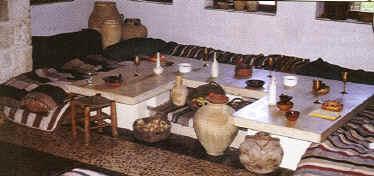
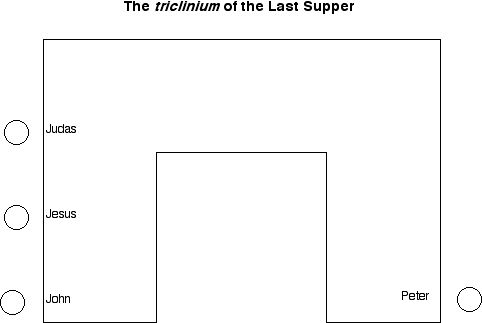
The Lord's table (10) - who was at the Last Supper?


We have artists like Leonardo Da Vinci to thank for giving the impression that the 'Last Supper' was eaten at a table with Jesus seated in the centre. Da Vinci, however, was wrong.

The Synoptic Gospels (Matthew, Mark and Luke) are clear that the last supper was the Jewish Passover meal and that it was eaten in a reclining position, as was customary. According to the practice at the time, the table would have been close to the floor and the participants reclined on cushions. Alfred Edershem (The Life and Times of Jesus the Messiah) and other scholars have explained how the guests would have been seated. The meal would have been eaten at a three-sided table called a triclinium.


Edersheim carefully analysed the conversations and other recorded details of the last supper and demonstrated that we can actually work out the seating positions of four participants at the meal.


I won't go into the details here as to how we know this seating arrangement, but I can provide the details later if anyone is interested.

Another important thing which Edersheim brings to our attention is the number of people who would have been celebrating the Passover in Jerusalem in the time of Christ. This was one of the obligatory feasts when a large number of pilgrims would have been in the city.

It was necessary that the meal be eaten indoors, in groups, and following certain procedures which were carefully laid down in the Law and by tradition. Jerusalem on Passover night was a crowded city and space was at a premium. (By the way, if you have any doubts that the Last Supper was actually the Passover, Matthew, Mark and Luke were unanimous that it was - Mark even specifies that it was on the day when the Paasover lambs were sacrificed [Mk 14:12] - and the comment in John 18:28 that appears to contradict this can easily be reconciled with the Synoptists once we understand the terminology related to the Feasts of Israel. John refers to a claim by the Chief Priests that defilement would make it impossible for them to eat the Passover. By the time of Christ Passover day and the feast of unleavened bread which followed Passover were referred to collectively as "Passover". John's reference is to the priests being unable to join in with the festival meals during the week-long "Passover" festival, and not to the Passover meal itself which had already happened the night before. Any other interpretation puts John in conflict with Matthew, Mark and Luke).

To find a vacant "large upper room" (Mark 14:15; Luke 22:12) in Jerusalem at Passover would have well nigh on impossible. At best they would have arranged to have shared a large room, with other groups of between 10 and 20 people (the numbers specified by Jewish law). For several families or groups to have gathered together in one large room, and then to have eaten the meal around their individual tables would have been such a common practice that the Jewish Law (the Mishnah) explained the regulations for such cases.

Luke refers to a group of 120 "all together in one place" in Jerusalem a short time after (Acts 2:1). Elsewhere he refers to the Jerusalem church meeting at the home of John Mark (Acts 12:12) and there is some circumstantial evidence that the last supper was held in the same home (let me know if you'd like me to provide it).

It is extremely likely that Jesus and the Twelve celebrated Passover in a large room which could have accomodated 120 people. They probably shared the room with several other groups, possibly with other disciples, especially the ones who travelled around the country with them. This helps to explain why private conversations between Peter and John, John and Jesus, and Jesus and Judas , were not heard by the others present. There would have been considerable background noise.

Of course, I cannot "prove" that there were more than 13 present at the last supper, but I don't need to. The number of people present at the meal does not alter anything I've previously said about the nature of this meal. However, those who insist that this meal was a small, exclusive, private gathering have a bit of explaining to do.

Throughout the Gospels we find different types of meals where Jesus was present: from meals with disciples or friends to meals with His religious enemies; meals with crowds of thousands, to small, intimate gatherings. Each setting has lessons to teach us. One thing that was common to them all was that Jesus turned no one away. He taught His disciples and the exclusivist Pharisees to open their meals and celebrations to all who were disenfranchised, rejected, despised and considered 'unclean'. At His last supper he welcomed the one who would soon betray him, a disciple who was about to deny knowing him, and friends who were arguing about which of them should have the most prominent positions, in denial of all He had taught them about servanthood. In fact, within hours all of them would desert him (Matthew 26:56; Mark 14:50). Even knowing that he was about to eat with men who were weak, wavering, even treacherous, men who would deny knowing him or even betray him, he welcomed them all and greatly desired to have this meal with them (Luke 22:15). Such was our Lord's inclusiveness.